Cahaba in Dallas County, Alabama — The American South (East South Central)
Working and Living in a "Dead Town"
Courtesy of Jonathan Matthews, Old Cahawba Archaeological Park, December 30, 2024
1. Working and Living in a "Dead Town" Marker
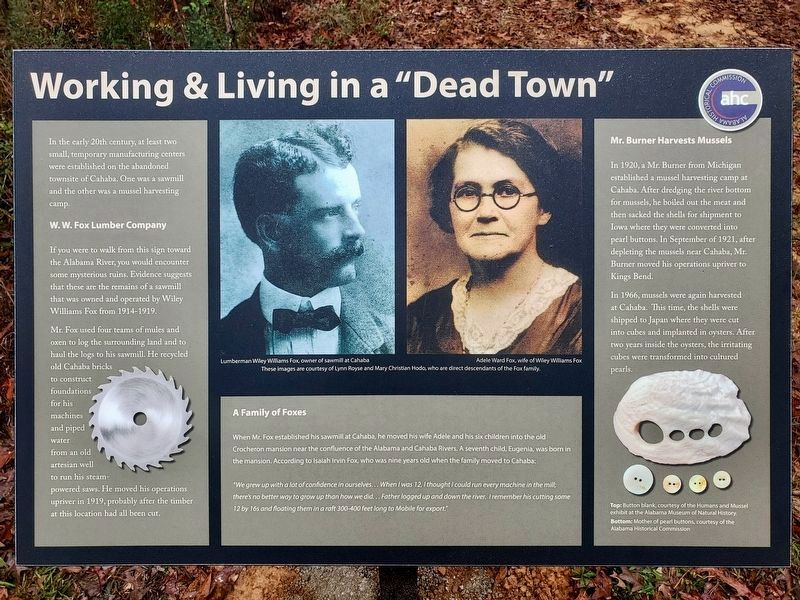
In the early 20th century, at least two small, temporary manufacturing centers were established on the abandoned townsite of Cahaba. One was a sawmill and the other was a mussel harvesting camp.
W. W. Fox Lumber Company
If you were to walk from this sign toward the Alabama River, you would encounter some mysterious ruins. Evidence suggests that these are the remains of a sawmill that was owned and operated by Wiley Williams Fox from 1914-1919.
Mr. Fox used four teams of mules and oxen to log the surrounding land and to haul the logs to his sawmill. He recycled old Cahaba bricks to construct foundations for his machines and piped water from an old artesian well to run his steam-powered saws. He moved his operations upriver in 1919, probably after the timber at this location had all been cut. In the early 20th century, at least two small, temporary manufacturing centers were established on the abandoned townsite of Cahaba. One was a sawmill and the other was a mussel harvesting camp.
A Family of Foxes
When Mr. Fox established his sawmill at Cahaba, he moved his wife Adele and his six
this page online
"We grew up with a lot of confidence in ourselves... When I was 12, I thought I could run every machine in the mill; there's no better way to grow up than how we did... Father logged up and down the river. I remember his cutting some 12 by 16s and floating them in a raft 300-400 feet long to Mobile for export."
Mr. Burner Harvests Mussels
In 1920, a Mr. Burner from Michigan established a mussel harvesting camp at Cahaba. After dredging the river bottom for mussels, he boiled out the meat and then sacked the shells for shipment to Iowa where they were converted into pearl buttons. In September of 1921, after depleting the mussels near Cahaba, Mr. Burner moved his operations upriver to Kings Bend.
In 1966, mussels were again harvested at Cahaba. This time, the shells were shipped to Japan where they were cut into cubes and implanted in oysters. After two years inside the oysters,
Courtesy of Jonathan Matthews, Old Cahawba Archaeological Park, December 30, 2024
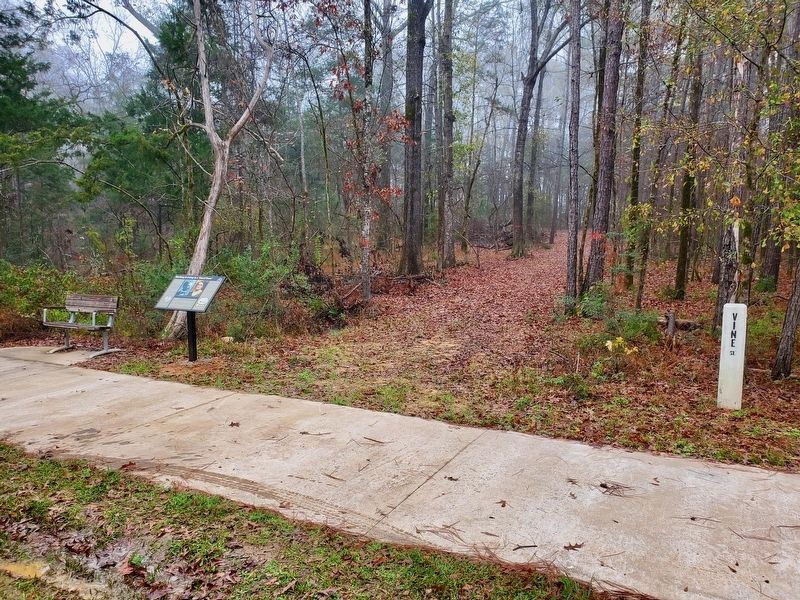
2. Working and Living in a "Dead Town" Marker along Vine Street Nature Trail.
Vehicles prohibited
Captions
[Middle Left] Lumberman Wiley Williams Fox, owner of sawmill at Cahaba
[Middle Right) Adele Ward Fox, wife of Wiley Williams Fox
These images are courtesy of Lynn Royse and Mary Christian Hodo, who are direct descendants of the Fox family.
[Bottom Right] Top: Button blank, courtesy of the Humans and Mussel exhibit at the Alabama Museum of Natural History.
[Bottom Right] Bottom : Mother of pearl buttons, courtesy of the Alabama Historical Commission
Erected 2024 by the Alabama Historical Commission.
Topics. This historical marker is listed in this topic list: Industry & Commerce. A significant historical month for this entry is September 1921.
Location. 32° 18.864′ N, 87° 5.878′ W. Marker is in Cahaba, Alabama, in Dallas County. It can be reached from Vine Street, on the right when traveling north. Located within the Old Cahawba Archaeological Park (nominal fee required). Touch for map. Marker is in this post office area: Orrville AL 36767, United States of America. Touch for directions.

Regionally, this marker is in the American South, specifically in the Deep South, and in the Black Belt. Globally, it is in North America, a Gulf of Mexico state, the Western Hemisphere, the Western World, and the Anglosphere. Historically, it finds itself in what was once New Spain, the territory of the Mississippian Culture, one of the Confederate States of America, and the Antebellum South.
Other nearby markers. At least 8 other markers are within walking distance of this marker: Castle Perine (approx. 0.2 miles away); Footprint of a Church (approx. 0.2 miles away); Cahawba - circa 1500 (approx. 0.2 miles away); Civil War Prison (approx. 0.2 miles away); Castle Morgan & Jesse Hawes (approx. 0.2 miles away); Major Hiram Solon Hanchett (approx. 0.2 miles away); A Prison Chimney? (approx. 0.2 miles away); Methodist Church (approx. 0.2 miles away). Touch for a list and map of all markers in Cahaba.
Another marker is no longer nearby. St. Luke's Episcopal Church (was approx. 0.2 miles away but has been permanently removed).
Credits. This page was last revised on June 13, 2025. It was originally submitted on June 7, 2025, by Mark Hilton of Montgomery, Alabama. This page has been viewed 147 times since then and 44 times this year. Photos: 1, 2. submitted on June 7, 2025, by Mark Hilton of Montgomery, Alabama.
