Bremen-Mitte in Mitte, Germany — Central Europe
Das Schnoorviertel
⎯⎯⎯
The Schnoor Quarter
Photographed by Andrew Ruppenstein, May 18, 2025
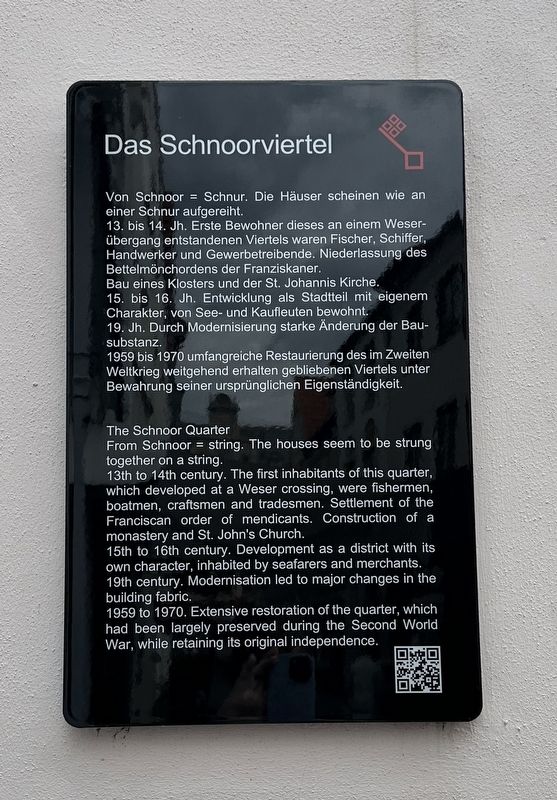
1. Das Schnoorviertel / The Schnoor Quarter Marker

Von Schnoor = Schnur. Die Häuser scheinen wie an einer Schnur aufgereiht.
13. bis 14. Jh. Erste Bewohner dieses an einem Weserübergang entstandenen Viertels waren Fischer, Schiffer, Handwerker und Gewerbetreibende. Niederlassung des Bettelmönchordens der Franziskaner.
Bau eines Klosters und der St. Johannis Kirche.
15. bis 16. Jh. Entwicklung als Stadtteil mit eigenem Charakter, von See- und Kaufleuten bewohnt.
19. Jh. Durch Modernisierung starke Änderung der Bausubstanz.
1959 bis 1970 umfangreiche Restaurierung des im Zweiten Weltkrieg weitgehend erhalten gebliebenen Viertels unter Bewahrung seiner ursprünglichen Eigenständigkeit.
The Schnoor Quarter
From Schnoor = string. The houses seem to be strung together on a string.
13th to 14th century. The first inhabitants of this quarter, which developed at a Weser crossing, were fishermen, boatmen, craftsmen and tradesmen. Settlement of the Franciscan order of mendicants. Construction of a monastery and St. John's Church.
15th to 16th century. Development as a district with its own character, inhabited by seafarers and merchants. 19th
this page online
1959 to 1970. Extensive restoration of the quarter, which had been largely preserved during the Second World War, while retaining its original independence.
Topics and series. This historical marker is listed in this topic list: Notable Places. In addition, it is included in the Bremen Red Key series list. A significant historical year for this entry is 1959.
Location. 53° 4.387′ N, 8° 48.532′ E. Marker is in Bremen, in Mitte. It is in Bremen-Mitte. It is at the intersection of Schnoor and Stavendamm, on the right when traveling east on Schnoor. Touch for map. Marker is at or near this postal address: Schnoor 23 A, Bremen 28195, Germany. Touch for directions.

Regionally, it is in Europe, the European Union, Atlantic Europe, Central Europe, the Schengen Area, Western Europe, and the Western World. Historically, it finds itself in what was once the Holy Roman Empire.
Other nearby markers. At least 8 other markers are within walking distance of this marker: Der Fries / This Frieze (within shouting distance of this marker); Bremen Synagoge / Bremen Synagogue
Photographed by Andrew Ruppenstein, May 18, 2025
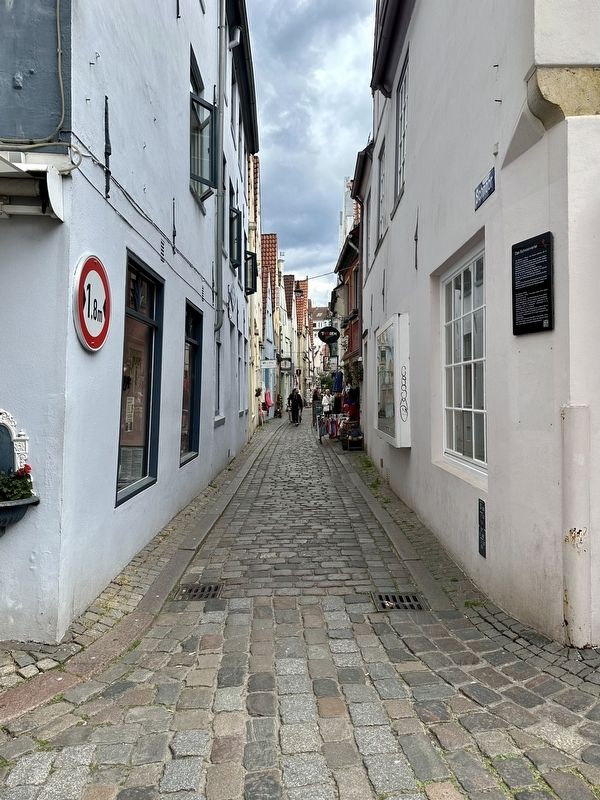
2. Das Schnoorviertel / The Schnoor Quarter Marker - wide view
The marker is visible here on the right side of the entrance onto the street.
Also see . . . Schnoor (Wikipedia). The QR code on the marker leads to this Wikipedia page. Overview:
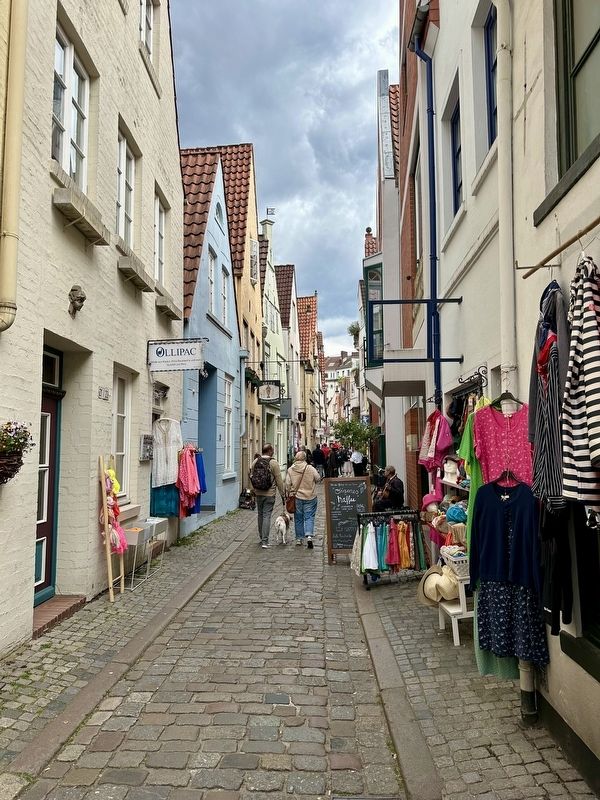
Schnoor is a neighbourhood in the medieval centre of the German city of Bremen, and the only part of it that has preserved a medieval character. The neighbourhood owes its name to old handicrafts associated with shipping. The alleys between the houses were often associated with occupations or objects: There was an area in which ropes and cables were produced (string = Schnoor) and a neighboring area, where wire cables and anchor chains were(Submitted on June 7, 2025.)manufactured (wire = Wieren). Schnoor is also the name of the main street in this neighbourhood…Photographed by Andrew Ruppenstein, May 18, 20253. Schnoor - looking east (taken from about 10 m. east of the marker)
Photographed by Andrew Ruppenstein, May 18, 2025
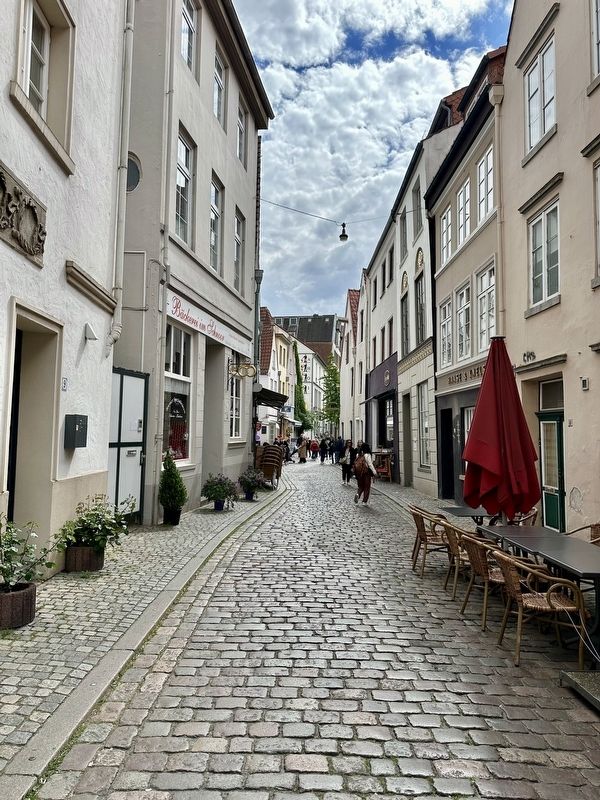
4. Schnoor - looking west (taken from about 50 m. east of the marker)
Credits. This page was last revised on June 7, 2025. It was originally submitted on June 7, 2025, by Andrew Ruppenstein of Lamorinda, California. This page has been viewed 121 times since then and 17 times this year. Photos: 1, 2, 3, 4. submitted on June 7, 2025, by Andrew Ruppenstein of Lamorinda, California.
