Blue Island in Cook County, Illinois — The American Midwest (Great Lakes)
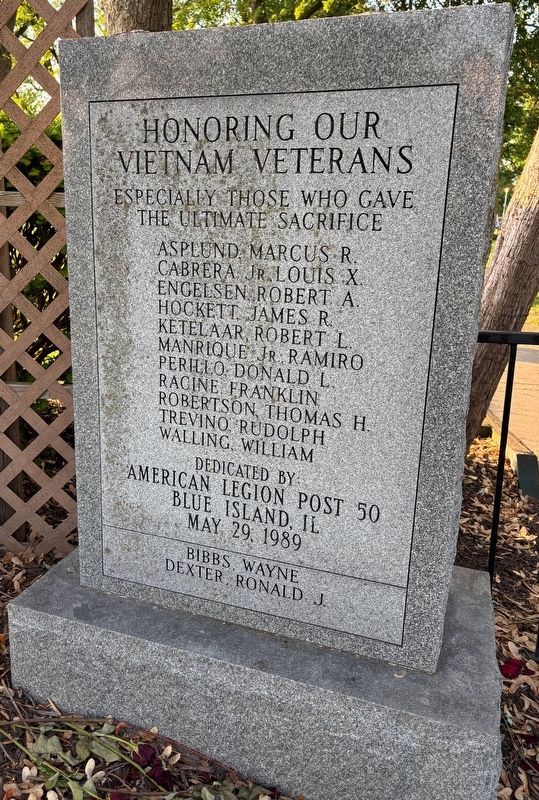
Blue Island Vietnam Veterans Memorial
Photographed by Sean P. Flynn, May 31, 2025
1. Blue Island Vietnam War Veterans Memorial Marker
Especially those who gave the ultimate sacrifice
Asplund, Marcus R. • Cabrera Jr., Louis X. • Engelsen, Robert A. • Hockett, James R. • Ketelaar, Robert L. • Manrique Jr., Ramiro • Perillo, Donald L. • Racine, Franklin • Robertson, Thomas H. • Trevino, Rudolph • Walling, William
American Legion Post 50
Blue Island, IL
May 29, 1989
Bibbs, Wayne • Dexter, Ronald J.
Erected 1989 by American Legion Post 50.
Topics. This memorial is listed in this topic list: War, Vietnam.
Location. 41° 39.659′ N, 87° 41.279′ W. Memorial is on Blue Island, Illinois, in Cook County. It can be reached from Highland Avenue south of 127th Street, on the right when traveling south. The monument is part of a collection of war memorials found in the center of Memorial Park. Touch for map. Memorial is at or near this postal address: 12804 Highland Avenue, Blue Island IL 60406, United States of America. Touch for directions.

Regionally, this memorial is in Greater Chicago and in the Calumet Region. It is also in the American Midwest. Globally, it is in North America, on the Great Lakes, in the Western Hemisphere, in the Western World, and in the Anglosphere. Historically, it finds itself in what was once the Viceroyalty of New France, the territory of the Mississippian Culture, and the Northwest Territory.
Other nearby markers. At least 8 other markers are within walking distance of this marker: Blue Island Memorial Roll (here, next to this marker); Blue Island Korean War Veterans Memorial (here, next to this marker); Grand Army of the Republic (here, next to this marker); In Honor and Remembrance of America's Women (here, next to this marker); Spanish-American War Memorial (a few steps from this marker); A-7D Corsair II
this page online
More about this memorial. It's likely that the two men placed below the dedication at the bottom of the memorial are there because they were MIA and, as of 1989, had not been found.
Regarding Blue Island Vietnam Veterans Memorial. The memorial honors 13 Blue Island men, including two who were MIA at the time the memorial was erected in 1989, who died in Vietnam.
Marcus Asplund was born in Blue Island and graduated from Blue Island High in 1963. He served in Vietnam as a helicopter commander. On July 27, 1968, the UH-1C helicopter he was piloting over Phuoc Long Province was shot down while supporting ground troops and burst into flames. Two of the crew members died in crash; Asplund and his co-pilot, Michael Wilson, were evacuated but were critically burned. Wilson died on August 11. Asplund died two days later of pneumonia related to the burns he received. Asplund is
Photographed by Sean P. Flynn, May 31, 2025
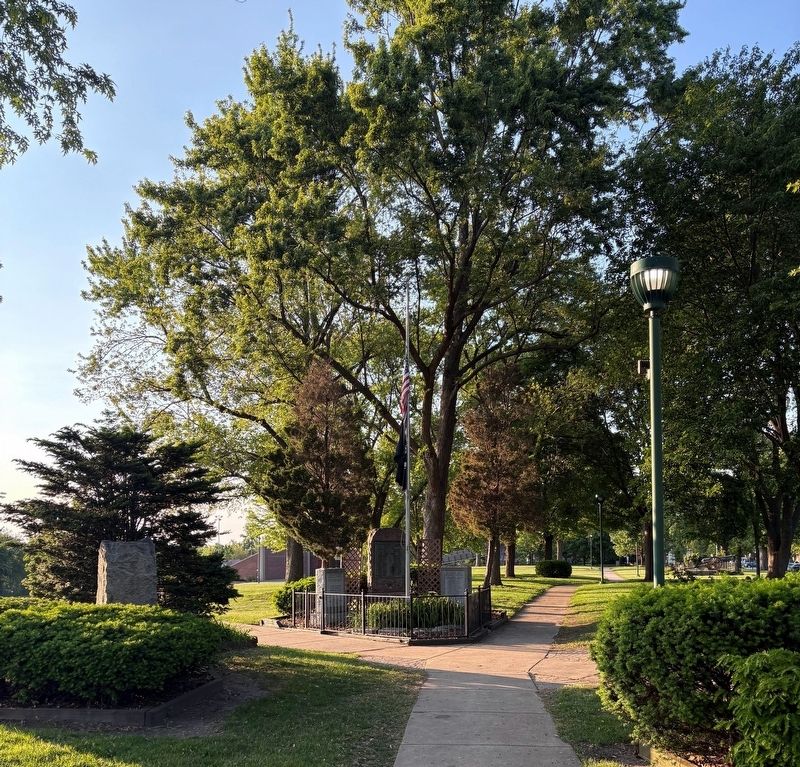
2. War memorials at Memorial Park
The Korean War memorial is one of several located around the flagpole at Memorial Park.
Louis X. Cabrera Jr. graduated from Eisenhower High and was attending Thornton Junior College when he enlisted in the Marines on August 31, 1965. He was deployed in Vietnam in June 1966 with the 3d Battalion, 5th Marine Regiment, 1st Marine Division. A week after arriving, Cabrera was killed when a mine exploded in Phú Yên, tearing off his right leg at his hip. He was 20 years old. Cabrera is buried at Saint Benedict Catholic Cemetery in Crestwood, Illinois, about three miles west of this park.
Robert A. Engelsen’s home address was listed as 2327 Orchard Street in Blue Island, about ¾ of a mile northeast (as the crow flies) from this park. Deployed in Vietnam as a Marine hospital corpsman on April 15, 1968, he was killed about two weeks later, on May 1, while trying to assist a wounded soldier during the Battle of Dai Do. He was 19 years old.
1st Lt. James Hockett was a platoon leader in A Company, 4th Battalion, 23rd Infantry of the U.S. Army. He was wounded by mortar fire on September 17, 1968, during battle east of Tay Ninh. Hackett
Photographed by Sean P. Flynn, May 31, 2025
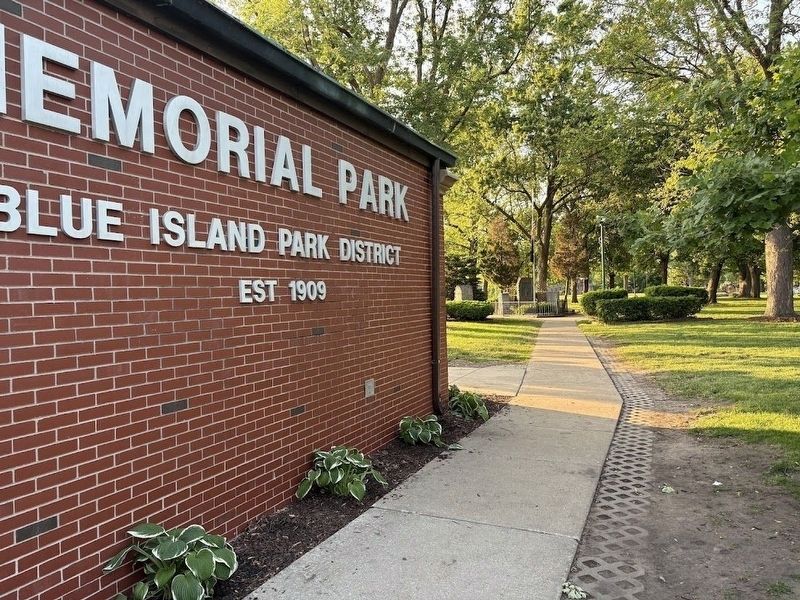
3. Memorial Park recreation building
The set of war memorials is just north of the recreation buliding
Specialist Robert Ketelaar attended Whittier Elementary and Eisenhower High School in Blue Island. He served a one-year tour in Vietnam in 1968, but volunteered for another six-month tour of duty in 1969. He was one of six men killed when the helicopter they were flying on crashed near An Voc, Vietnam, on August 22, 1969. He is buried at Beverly Cemetery in Blue Island.
Ramiro Manrique Jr. was raised in Blue Island and graduated from Eisenhower High. According to a newspaper report about his death, his home address was 13318 Western Avenue, about ¾ of a mile south of this park. He volunteered for the Army in 1964 and was deployed to Vietnam a year later. A specialist in the 16th Infantry, he was killed when his unit was ambushed by the Viet Cong on July 11, 1966. He is buried at St. Benedict Cemetery.
Donald Perillo grew up in Blue Island; his home address was listed as 2738 W. 135th Street. Perillo was deployed in Vietnam in February 1968 as an antitank assaultman with the 1st Marine Division. On April 4, 1968, during Operation Pegasus, Pfc. Perillo was shot and killed by friendly fire when mistaken for an enemy soldier. He is buried at Holy Sepulchre Cemetery in Alsip.
Specialist Franklin Douglas Racine was one of seven children born and raised in Blue Island. He attended Bremen Township High School in Midlothian, and enlisted in the Army soon after graduation in the summer of 1960. Early in the morning of October 20, 1965, Racine and three other men were aboard a UH-1B Huey helicopter on a mission to recover troops that had been attacked at a special forces camp when the aircraft was shot down and crashed in flames near the camp, at Plei Me. His body was recovered about 10 days later. Racine left behind an infant son and his wife, Jackie, who gave birth to their second son on October 25, 1965, five days after his death. He is buried at St. Benedict Cemetery.
Thomas Robertson lived at 2524 Grove Street, about ½ a mile south of this park. He graduated from Eisenhower in 1965 and later attended Bloom Junior College, before joining the Army in 1967. Robertson was injured by enemy gunfire on March 25, 1969, near Chu Chio, and transported to the Army hospital in Okinawa. According to the Chicago Tribune, his parents were en route to visit him in Okinawa when he died of his battle wounds on April 12, 1969. He was 22 years old. He is buried at Christ Lutheran Cemetery in Orland Park.
Rudolph Trevino was born in Chicago in 1947 and raised in Blue Island. He enlisted in Chicago in January 1968 and was deployed to Vietnam that August. A rifleman with the 3rd Battalion, 9th Marine Regiment, 3rd Marine Division, Pfc. Trevino was mortally wounded by enemy fire during an ambush near Hill 452 of the DMZ on May 31, 1969, a couple of weeks after his 22nd birthday. He is buried at St. Benedict Cemetery.
William Walling of Blue Island was a Navy machinist serving on the U.S.S. Oriskany when it caught fire. Walling was one of 44 men killed in the fire, at the time one of the worst fires on an American ship since World War II. Walling is buried at Chapel Hill Gardens South in Oak Lawn.
Wayne Bibbs's hometown is listed as Blue Island, although some news reports from the time of his death say he lived in Robbins, the neighboring village. Bibbs had unenrolled from Eisenhower High School in Blue Island to join the Army when he was only 17 years old, and was deployed less than a year later to Vietnam. Three days before his 18th birthday, on June 11, 1972, Bibbs was a door gunner on an OH-6A Cayuse helicopter that was flying a reconnaissance mission over Thua Thien-Hue Province when it met enemy gunfire, exploded and crashed. Search teams flew over the crash site but could not search the area due to a concentration of enemy forces; all three men on the crew, including Bibbs, were presumed dead. Joint U.S.-Vietnam search teams resumed the search in the area in the early 1990s, and in 2006 the bodies of Bibbs and his two crewmates, Capt. Arnold Holm and specialist Robin Yeakley, were positively identified. Bibbs, Holm and Yeakley were buried in November 2011 at Arlington National Cemetery.
Ronald James Dexter was born in 1933 in Chicago and raised in the Chicago area, eventually graduating from Blue Island High School (later renamed after Dwight Eisenhower) in 1951. He moved to Texas at some point later, and in 1960 he was named in an Abilene Reporter News article about nine West Texas men who enlisted for the Army; the article said Dexter signed up for a six-year term. Dexter, his wife and their six children lived in Mineral Wells, Texas, at the time of his deployment to Vietnam. There, Dexter served in the Command and Control Detachment, 5th Special Forces Group, as a sergeant major. On June 3, 1967, Dexter was a passenger on a Boeing Sea Knight Cargo Helicopter on an extraction mission inside Laos, with a crew of six American servicemen and an unknown number of South Vietnamese troops, when it took enemy fire soon after takeoff and crashed behind enemy lines. One of the six American soldiers was able to escape and return behind American lines a few days later. Three were caught in the helicopter's wreckage and are believed to have died (or possibly captured) when it was overrun by enemy troops. Dexter, along with another U.S. soldier, Frank Cius, and several South Vietnamese troops, is believed to have survived the crash unhurt and was taken prisoner. Cius survived imprisonment and was freed in 1973 in a prisoner exchange. Meanwhile, according to Cius, Dexter died in captivity on July 29, 1967, about 8 weeks after his capture and 6 days after his 34th birthday. His remains have never been found. A memorial stone for him can be found at Zion Lutheran Church Cemetery in Matteson, Illinois, about 15 miles south of this memorial.
Credits. This page was last revised on June 19, 2025. It was originally submitted on June 9, 2025, by Sean P. Flynn of Oak Park, Illinois. This page has been viewed 206 times since then and 30 times this year. Photos: 1. submitted on June 9, 2025, by Sean P. Flynn of Oak Park, Illinois. 2, 3. submitted on June 3, 2025, by Sean P. Flynn of Oak Park, Illinois.
