Barrie in Simcoe County, Ontario — Central Canada (North America)
Tulips
World War II
| — | Barrie Waterfront Heritage Trail | — |
Photographed by Cosmos Mariner, June 5, 2024
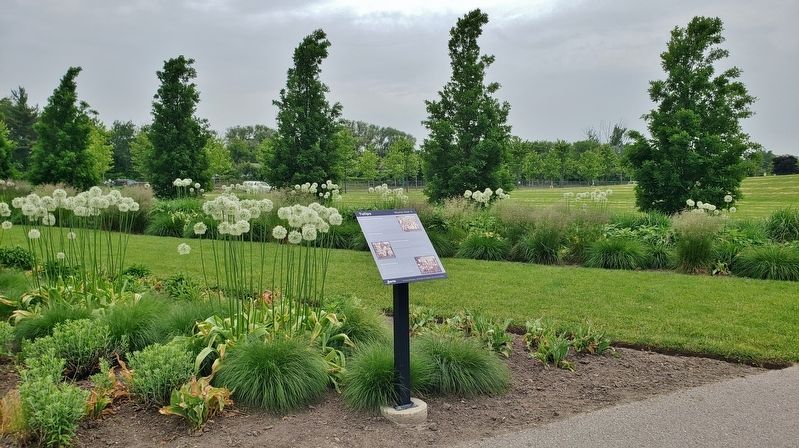
1. Tulips Marker
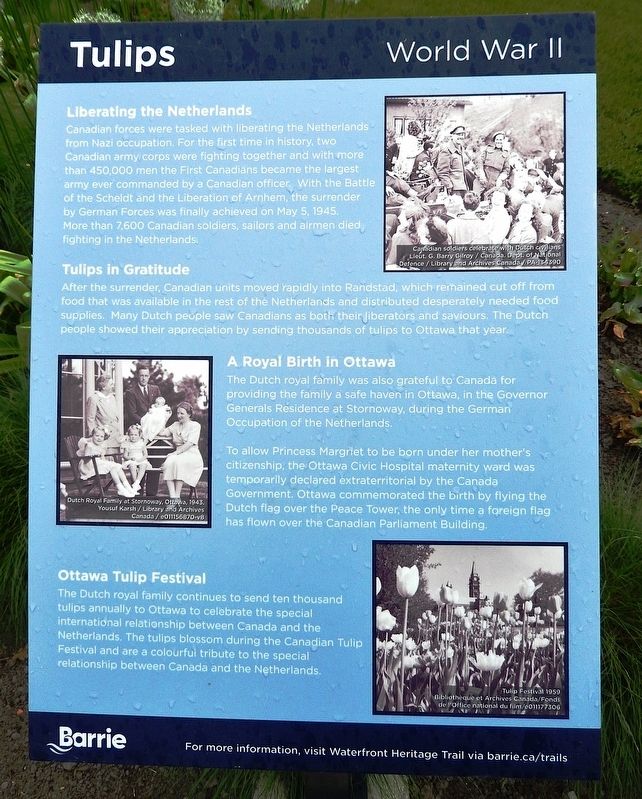
Liberating the Netherlands
Canadian forces were tasked with liberating the Netherlands from Nazi occupation. For the first time in history, two Canadian army corps were fighting together and with more than 450,000 men the First Canadians became the largest army ever commanded by a Canadian officer. With the Battle of the Scheldt and the Liberation of Arnhem, the surrender by German Forces was finally achieved on May 5, 1945. More than 7,600 Canadian soldiers, sailors and airmen died fighting in the Netherlands.
Tulips in Gratitude
After the surrender, Canadian units moved rapidly into Randstad, which remained cut off from food that was available in the rest of the Netherlands and distributed desperately needed food supplies. Many Dutch people saw Canadians as both their liberators and saviors. The Dutch people showed their appreciation by sending thousands of tulips to Ottawa that year.
A Royal Birth in Ottawa
The Dutch royal family was also grateful to Canada for providing the family a safe haven in Ottawa, in the Governor Generals Residence at Stornoway, during the German Occupation of the Netherlands.
To allow Princess
this page online
Ottawa Tulip Festival
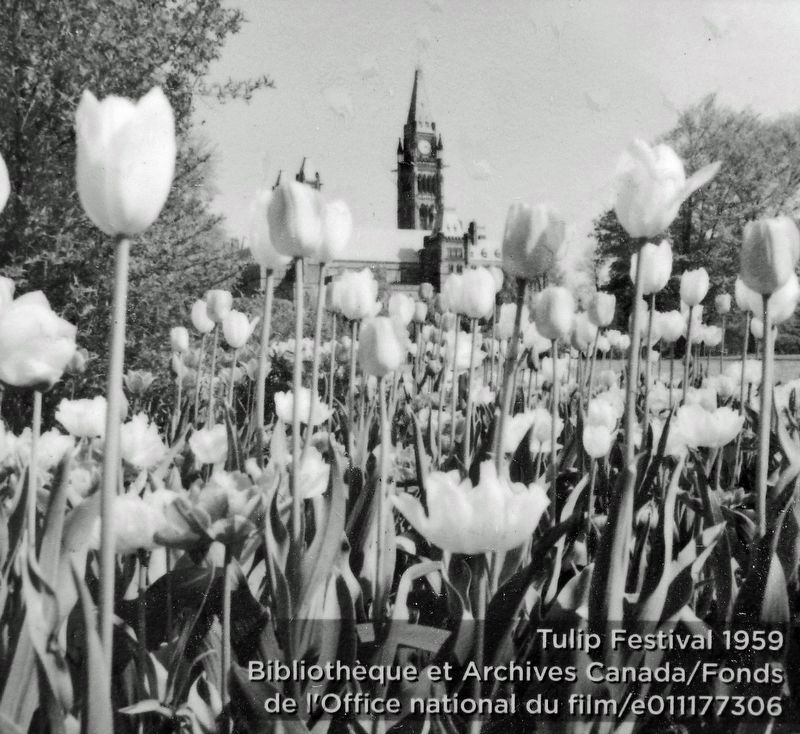
The Dutch royal family continues to send ten thousand tulips annually to Ottawa to celebrate the special international relationship between Canada and the Netherlands. The tulips blossom during the Canadian Tulip Festival and are a colourful tribute to the special relationship between Canada and the Netherlands.
Erected by Barrie Waterfront Heritage Trail.
Topics and series. This historical marker is listed in these topic lists: Patriots & Patriotism • War, World II. In addition, it is included in the Canadian Tulip Festival, Ottawa series list. A significant historical date for this entry is May 5, 1945.
Location. 44° 22.443′ N, 79° 40.716′ W. Marker is in Barrie, Ontario, in Simcoe County. It can be reached from Lakeshore Drive 0.9 kilometers west of Minet's Point Road, on the right when traveling west.
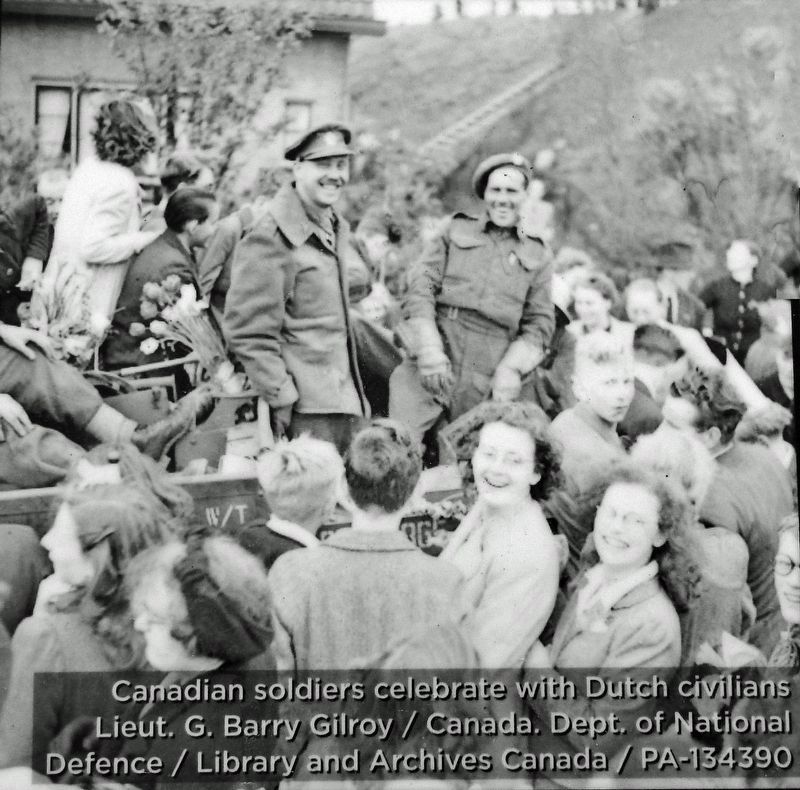
Lieut. G. Barry Gilroy/Canada. Dept. of National Defence/Library & Archives Canada/PA-134390
2. Marker detail: Canadian soldiers celebrate with Dutch civilians

Regionally, this marker is in Central Ontario Cottage Country and specifically in Georgian Bay Country. It is also in Central Canada. Globally, it is in North America, on the Great Lakes, in the Western Hemisphere, in the Western World, and in the Anglosphere. Historically, it finds itself in what was once a British colony, the Viceroyalty of New France, the Haudenosaunee (Iroquois) Confederacy, and Rupert’s Land.
Other nearby markers. At least 8 other markers are within walking distance of this marker: Vimy Oaks (a few steps from this marker); Francis Pegahmagabow (a few steps from this marker); Canadian Victoria Cross Recipients / Bénéficiaires de la Croix Victoria canadien (a few steps from this marker); Trench Warfare (within shouting distance of this marker); South African War (within shouting distance of this marker); Northwest Rebellion (within shouting distance of this
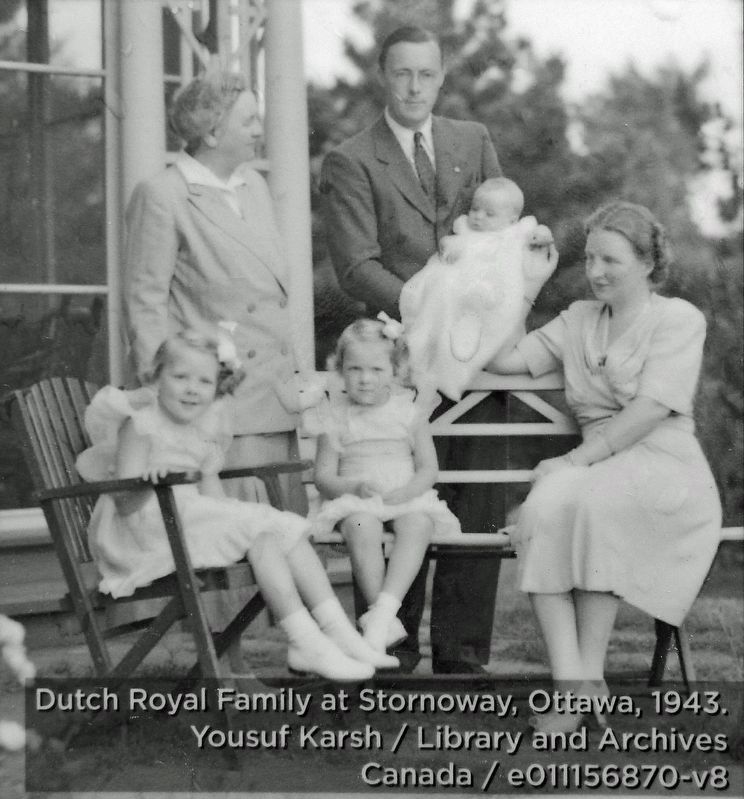
Yousuf Karsh/Library and Archives Canada/e011156870-v8
3. Marker detail: Dutch Royal Family at Stornoway, Ottawa, 1943
Related markers. Click here for a list of markers that are related to this marker. Military Heritage Park
Also see . . .
1. Netherlands in World War II (Wikipedia).
Excerpt: Despite Dutch neutrality, Nazi Germany invaded the Netherlands on 10 May 1940. On 15 May 1940, one day after the bombing of Rotterdam, the Dutch forces surrendered. The Dutch government and the royal family relocated to London. Princess Juliana and her children sought refuge in Ottawa, Canada, until after the war.(Submitted on June 11, 2025, by Cosmos Mariner of Cape Canaveral, Florida.)
German occupation lasted in some areas until the German surrender in May 1945. Active resistance, at first carried out by a minority, grew in the course of the occupation. The occupiers deported the majority of the country's Jews to Nazi concentration camps.
After crossing the Rhine at Wesel and Rees, Canadian, British and Polish forces entered the Netherlands from the east and liberated the eastern and the northern provinces. Notable battles during the movementare the Battle of Groningen and the Battle of Otterlo, both in April 1945. The western provinces were not liberated until the surrender of German forces in the Netherlands was negotiated on the eve of 5 May 1945 (three days before the general capitulation of Germany), in the Hotel de Wereld in Wageningen.Bibliothèque et Archives Canada/Fonds de l’Office national du film/e0111773064. Marker detail: Tulip Festival 1959
2. Canadian Tulip Festival (Wikipedia).
Excerpt: In 1945, the Dutch royal family sent 100,000 tulip bulbs to Ottawa in gratitude for Canadians having sheltered the future Queen Juliana and her family for the preceding three years during the Nazi occupation of the Netherlands. The most noteworthy event during their time in Canada was the birth in 1943 of Princess Margriet at the Ottawa Civic Hospital.(Submitted on June 11, 2025, by Cosmos Mariner of Cape Canaveral, Florida.)
In 1946, Juliana sent another 20,500 bulbs requesting that a display be created for the hospital, and promised to send 10,000 more bulbs each year. By 1963 the festival featured more than 2 million tulips, rising to nearly 3 million by 1995.
In the years following Queen Juliana's original donation, Ottawa became famous for its tulips and in 1953the Ottawa Board of Trade and photographer Malak Karsh organized the first "Canadian Tulip Festival". Queen Juliana returned to celebrate the festival in 1967, and Princess Margriet returned in 2002 to celebrate the 50th anniversary of the festival.Photographed by Cosmos Mariner, June 5, 20245. Tulips MarkerMilitary Heritage Park is in the background.
Credits. This page was last revised on June 21, 2025. It was originally submitted on June 9, 2025, by Cosmos Mariner of Cape Canaveral, Florida. This page has been viewed 233 times since then and 144 times this year. Photos: 1, 2, 3, 4, 5. submitted on June 11, 2025, by Cosmos Mariner of Cape Canaveral, Florida.
