Barrie in Simcoe County, Ontario — Central Canada (North America)
Trench Warfare
World War I
| — | Barrie Waterfront Heritage Trail | — |
Photographed by Cosmos Mariner, June 5, 2024
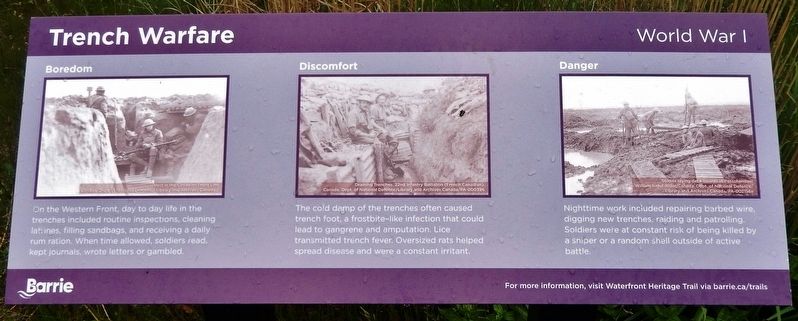
1. Trench Warfare Marker
Boredom
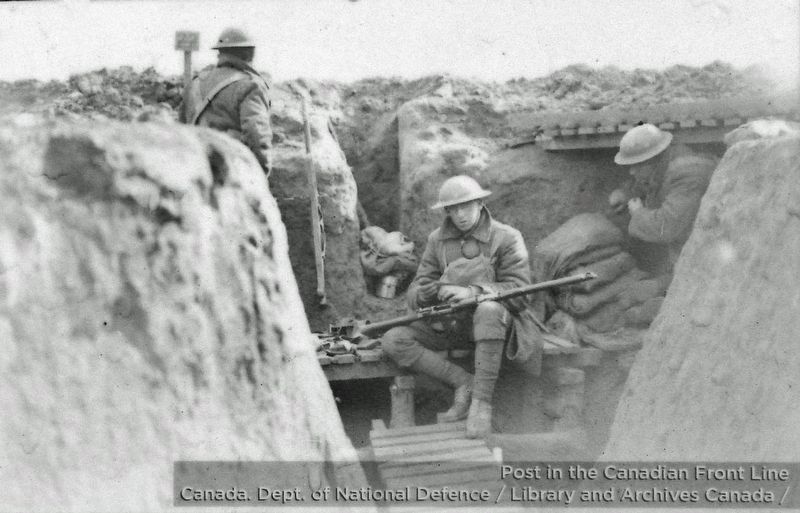
On the Western Front, day to day life in the trenches included routine inspections, cleaning latrines, filling sandbags, and receiving a daily rum ration. When time allowed, soldiers read, kept journals, wrote letters or gambled.
Discomfort
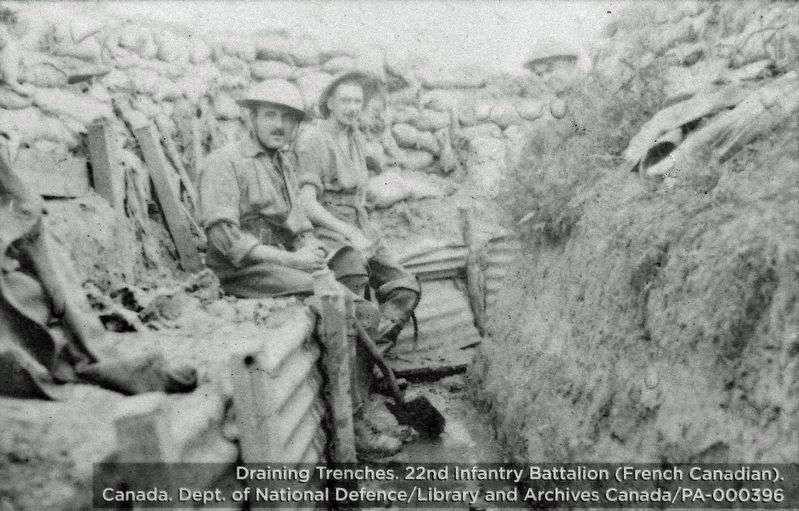
The cold damp of the trenches often caused trench foot, a frostbite-like infection that could lead to gangrene and amputation. Lice transmitted trench fever. Oversized rats helped spread disease and were a constant irritant.
Danger
Nighttime work included repairing barbed wire, digging new trenches, raiding and patrolling. Soldiers were at constant risk of being killed by a sniper or a random shell outside of active battle.
Erected by Barrie Waterfront Heritage Trail.
Topics. This historical marker is listed in this topic list: War, World I.
Location. 44° 22.435′ N, 79° 40.701′ W. Marker is in Barrie, Ontario, in Simcoe County. It can be reached from Lakeshore Drive 0.9 kilometers west of Minet's Point Road, on the right when traveling west. The marker is on the Barrie Waterfront Heritage Trail at Station #2 (Military Heritage)
this page online

Regionally, this marker is in Central Ontario Cottage Country and specifically in Georgian Bay Country. It is also in Central Canada. Globally, it is in North America, on the Great Lakes, in the Western Hemisphere, in the Western World, and in the Anglosphere. Historically, it finds itself in what was once a British colony, the Viceroyalty of New France, the Haudenosaunee (Iroquois) Confederacy, and Rupert’s Land.
Other nearby markers. At least 8 other markers are within walking distance of this marker: Canadian Victoria Cross Recipients / Bénéficiaires de la Croix Victoria canadien (a few steps from this marker); Vimy Oaks (a few steps from this marker); Tulips (within shouting distance of this marker); South African War (within shouting distance of this marker); Northwest Rebellion (within shouting distance of this marker); Francis Pegahmagabow (within shouting distance of this marker); Fenian Raids (within shouting distance of this marker); Juno Beach (about
Canada Dept. of National Defence / Library and Archives Canada
2. Marker detail: Post in the Canadian Front Line
Related markers. Click here for a list of markers that are related to this marker. Military Heritage Park
Also see . . . Trench warfare (Wikipedia).
Excerpt: Warfare using occupied lines largely comprising military trenches, in which combatants are well-protected from the enemy's small arms fire and are substantially sheltered from artillery. It became archetypically associated with World War I. On the Western Front in 1914–1918, both sides constructed elaborate trench, underground, and dugout systems opposing each other along a front, protected from assault by barbed wire. The area between opposing trench lines (known as "no man's land") was fully exposed to artillery fire from both sides. Attacks, even if successful, often sustained severe casualties.(Submitted on June 13, 2025, by Cosmos Mariner of Cape Canaveral, Florida.)While the main cause of death in the trenches came from shelling and gunfire, diseases and infections were always present and became prevalent for all sides as the war progressed. Medical procedures, while considerably more effective than at any previous time in history,
were still not very helpful; antibiotics had not yet been discovered or invented. As a result, an infection caught in a trench often went untreated and could fester until the soldier died. The main killer in the trenches was artillery fire; around 75 percent of known casualties. Even if a soldier was not hit directly by the artillery, shell fragments and debris had a high chance of wounding those in close proximity to the blast.Canada. Dept. of National Defence / Library and Archives Canada / PA-0003963. Marker detail: Draining Trenches. 22nd Infantry Battalion (French Canadian).
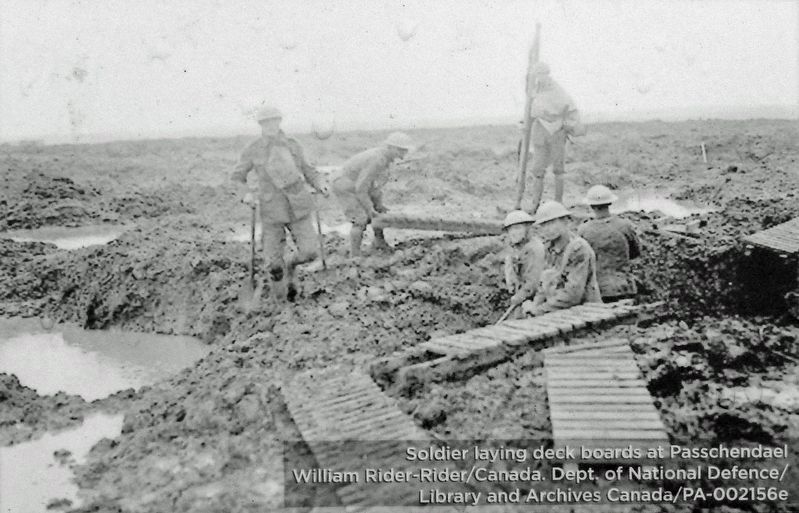
William Rider / Canada. Dept. of National Defence / Library and Archives Canada / PA-002156e
4. Marker detail: Soldier laying deck boards at Passchendaele
Photographed by Cosmos Mariner, June 5, 2024
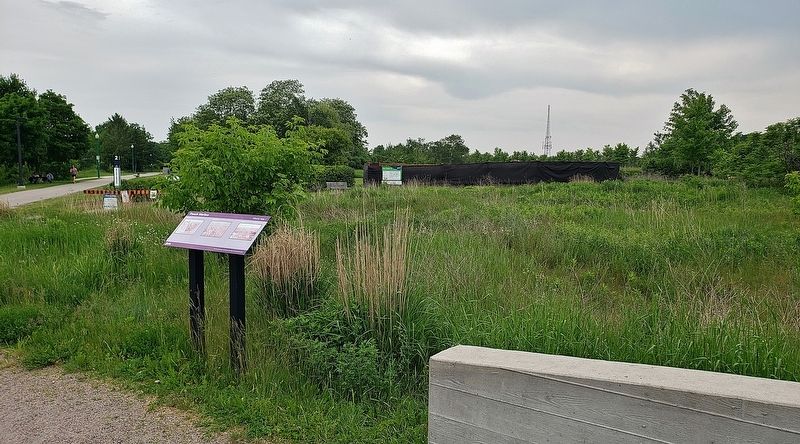
5. Trench Warfare Marker
Looking east along the Barrie Waterfront Heritage Trail, through Military Heritage Park.
Credits. This page was last revised on June 21, 2025. It was originally submitted on June 9, 2025, by Cosmos Mariner of Cape Canaveral, Florida. This page has been viewed 102 times since then and 14 times this year. Photos: 1. submitted on June 12, 2025, by Cosmos Mariner of Cape Canaveral, Florida. 2, 3, 4, 5. submitted on June 13, 2025, by Cosmos Mariner of Cape Canaveral, Florida.
