Bremen-Mitte in Mitte, Germany — Central Europe
Roselius-Haus
⎯⎯⎯
Roselius House
| — | Böttcherstraße | — |
Photographed by Andrew Ruppenstein, May 19, 2025
1. Roselius-Haus / Roselius House Marker

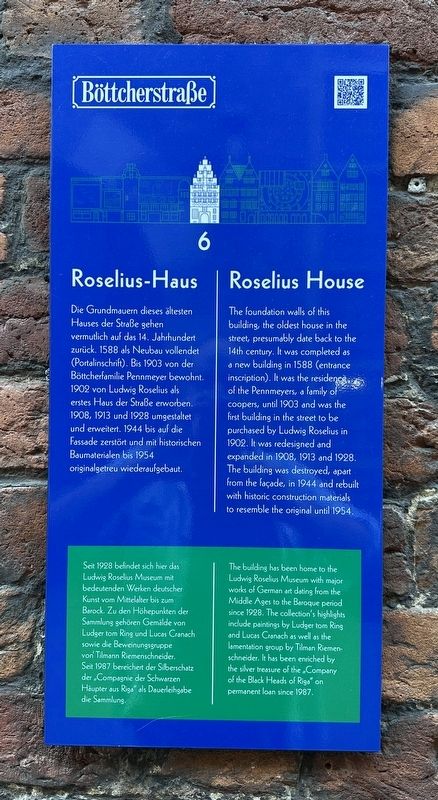
Die Grundmauern dieses ältesten Hauses der Straße gehen vermutlich auf das 14. Jahrhundert zurück. 1588 als Neubau vollendet (Portalinschrift). Bis 1903 von der Böttcherfamilie Pennmeyer bewohnt. 1902 von Ludwig Roselius als erstes Haus der Straße erworben. 1908, 1913 und 1928 umgestaltet und erweitert. 1944 bis auf die Fassade zerstört und mit historischen Baumaterialen bis 1954 originalgetreu wiederaufgebaut.
Seit 1928 befindet sich hier das Ludwig Roselius Museum mit bedeutenden Werken deutscher Kunst vom Mittelalter bis zum Berock. Zu den Höhepunkten der Sammlung gehören Gemälde von Ludger tom Ring und Lucas Cranach sowie die Beweinungsgruppe von Tilmann Riemenschneider. Seit 1987 bereichert der Silberschatz der Compagnie der Schwarzen Heupter aus Riga" als Dauerleihsabe die Sammlung.
Roselius House
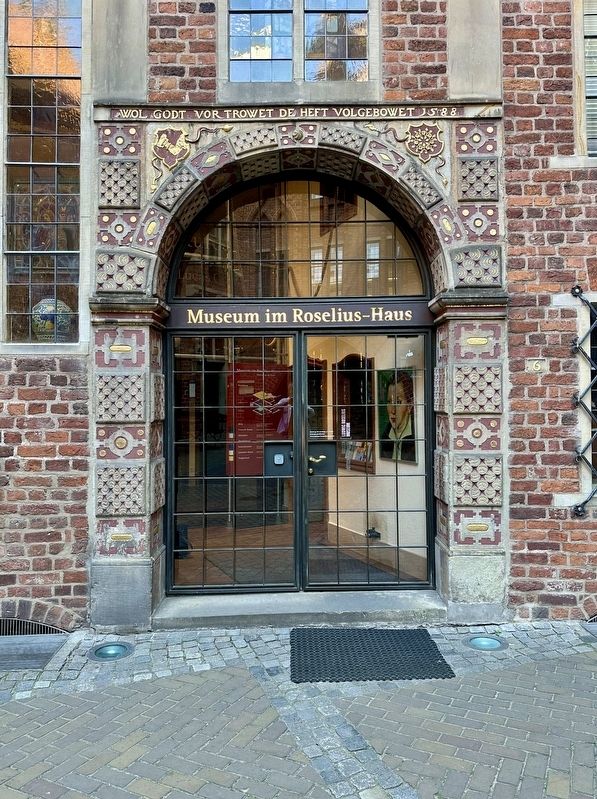
The foundation walls of this building, the oldest house in the street, presumably date back to the 14th century. It was completed as a new building in 1588 (entrance inscription). It was the residence of the Pennmeyers, a family of coopers, until 1903 and was the first building in the street to be purchased by Ludwig Roselius in 1902. It was redesigned and expanded in 1908, 1913 and 1928. The building was destroyed, apart from the façade, in 1944 and rebuilt with historic construction materials to resemble the original until 1954.
The building has been home to the Ludwig Roselius Museum with major works of German art dating from the Middle Ages to the Baroque period since 1928. The collection's highlights include paintings by Ludger tom Ring and Lucas Cranach as well as the lamentation group by Tilman Riemenschneider. It has been enriched by the silver treasure of the Company of the “Black Heads of Riga” on permanent loan since 1987.
Topics. This historical
this page online
Location. 53° 4.503′ N, 8° 48.345′ E. Marker is in Bremen, in Mitte. It is in Bremen-Mitte. It is on Böttcherstraße, on the left when traveling south. Touch for map. Marker is at or near this postal address: Böttcherstraße 6, Bremen 28195, Germany. Touch for directions.

Regionally, it is in Europe, the European Union, Atlantic Europe, Central Europe, the Schengen Area, Western Europe, and the Western World. Historically, it finds itself in what was once the Holy Roman Empire and also the former West Germany.
Other nearby markers. At least 8 other markers are within walking distance of this marker: Haus St. Petrus / St Petrus House (a few steps from this marker); Die Gluckhenne / The Broody Hen (a few steps from this marker); Condor Rekordflug / Condor Record Flight (a few steps from this marker); Haus des Glockenspiels / Glockenspiel House (a few steps from this marker); Haus der Sieben Faulen / House of the Seven Lazy Brothers (a few steps from this marker); Haus Atlantis / House Atlantis
Photographed by Andrew Ruppenstein, May 19, 2025
2. Roselius-Haus / Roselius House Marker - wide view
Also see . . . No. 6 Roselius House (Archiv Böttcherstraße, in German and English). The QR code at the top of the marker leads to this page (with a link to its English equivalent), with an extensive history of the building. Excerpt:
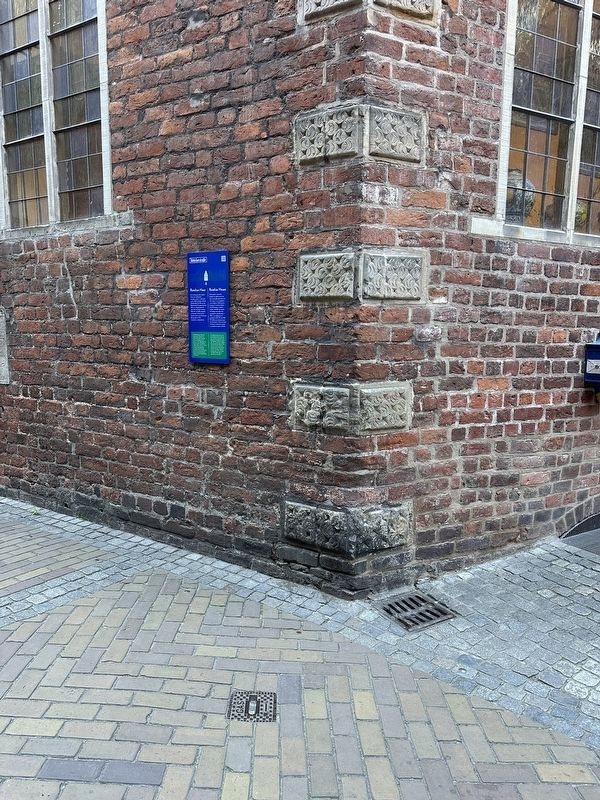
The foundation walls of the oldest building in the street are thought to date back to the 14th century, whilst the inscription over the entrance gives the date of completion of the new property as 1588. It is the only building in Böttcherstrasse where there is evidence of it being used by barrel-makers, although it was not built in the style of a craftsman’s house. With its high lobby on the ground floor and multiple low warehouse floors reaching up into the gable, it is a prime example of a Hanseatic merchant’s house. In 1785, the heir of the widow Esich sold the property to the barrel-maker Albert Stuke,(Submitted on June 10, 2025.)from whom, in turn, it was purchased in 1814 by the cooper Johann Jürgen Pennmeyer... Ludwig Roselius first used this building located at the heart of the street as the head office of his business Roselius & Co., from which Kaffee HAG (Kaffee Handels Aktien Gesellschaft) emerged in 1906. He also made the house available to the Low German Association and often held meetings here with the regulars of the “Niedersachsenrunde von 1900” (Lower Saxony Round Table of 1900).Photographed by Andrew Ruppenstein, May 19, 20253. Roselius-Haus / Roselius House and markerThe marker is (barely) visible here just around the left corner of the building.
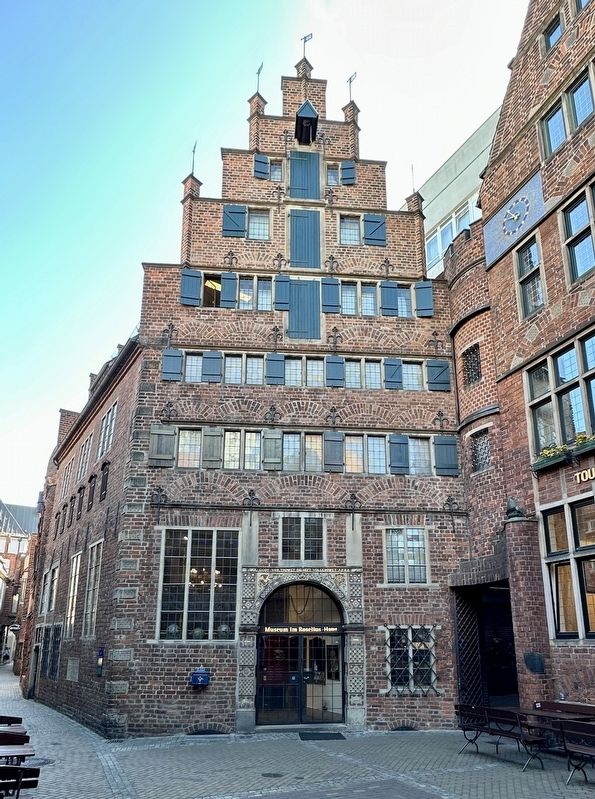
In 1928, the old Bremen merchant’s house was expanded to accommodate Ludwig Roselius’ extensive private art collection. In the process, it received its distinctive stepped gable and was renamed Roselius House. The building was destroyed except for its façade during the major Allied attack on Bremen city centre on 7th October 1944 (Fig. 4). The remainders of the walls had to be completely pulled down in 1947 due to the risk of collapse. Using old masonry from the similarly demolished Kornhaus in Langenstrasse, the family rebuilt Roselius House by 1954 with the help of Kaffee HAG as a largely faithful replica of the pre-war state based on plans and photographic documentation.As such, the house is actually the youngest in today’s Böttcherstrasse in terms of its building fabric…Photographed by Andrew Ruppenstein, May 19, 20254. Roselius-Haus / Roselius House - entrance
Credits. This page was last revised on June 10, 2025. It was originally submitted on June 10, 2025, by Andrew Ruppenstein of Lamorinda, California. This page has been viewed 122 times since then and 19 times this year. Photos: 1, 2, 3, 4. submitted on June 10, 2025, by Andrew Ruppenstein of Lamorinda, California.
