Near McConnells in York County, South Carolina — The American South (South Atlantic)
Huck's Defeat
The Battle of Williamson's Plantation
| — | The Revolutionary War in the Carolina Backcountry | — |
Photographed by Mark Parker, May 3, 2025
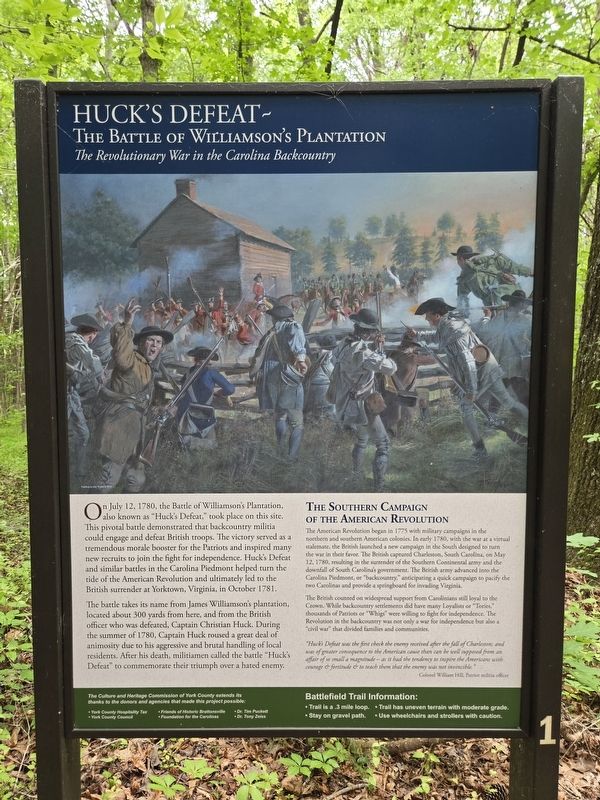
1. Huck's Defeat Marker
On July 12, 1780, the Battle of Williamson's Plantation, known as "Huck's Defeat", took place on this site. This pivotal battle demonstrated that backcountry militia could engage and defeat British troops. The victory served as a tremendous morale booster for the Patriots and inspired many new recruits to join the fight for independence. Huck's Defeat and similar battles in the Carolina Piedmont helped turn the tide of the American Revolution and ultimately led to the British surrender at Yorktown, Virginia, in October 1781.
The battle takes its name from James Williamson's plantation, located about 300 yards from here, and from the British officer who was defeated, Captain Christian Huck. During the summer of 1780, Captain Huck roused a great deal of animosity due to his aggressive and brutal handling of local residents. After his death, militiamen called the battle "Huck's Defeat" to commemorate their triumph over a hated enemy.
The Southern Campaign of the American Revolution
The American Revolution began in 1775 with military campaigns in the northern and southern American colonies. In early 1780, with the
this page online
The British counted on widespread support from Carolinians still loyal to the Crown. While backcountry settlements did have many Loyalists or "Tories" thousands of Patriots or "Whigs" were willing to fight for independence. The Revolution in the backcountry was not only a war for independence but also a "civil war" that divided families and communities.
"Huck's Defeat was the first check the enemy received after the fall of Charleston; and was of greater consequence to the American cause than can be well supposed from an affair of so small magnitude - as it had the tendency to inspire the Americans with courage & fortitude & to teach them that the enemy was not invincible."
Colonel
Photographed by Mark Parker, May 3, 2025
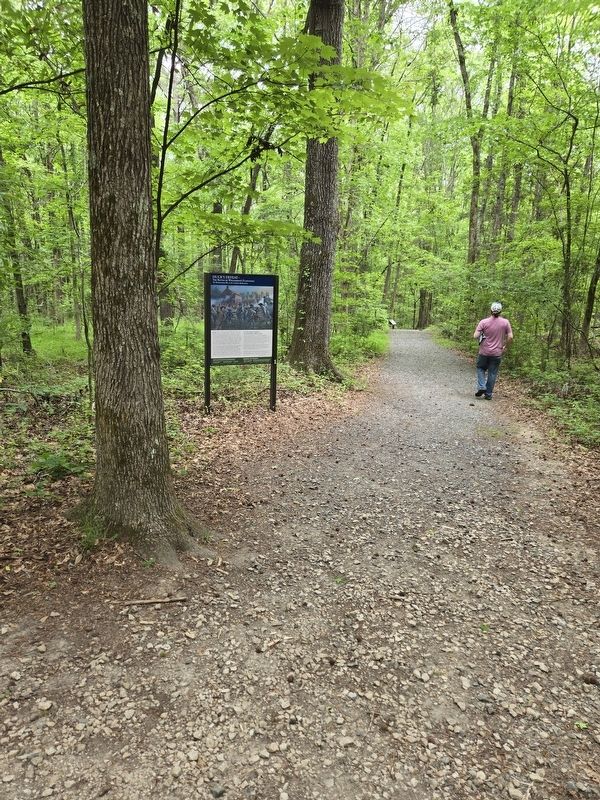
2. Huck's Defeat Marker at the start of the battlefield trail
(Credit) Painting by Don Troiani © 2014
Topics. This historical marker is listed in this topic list: War, US Revolutionary. A significant historical date for this entry is July 12, 1780.
Location. 34° 51.951′ N, 81° 10.411′ W. Marker is near McConnells, South Carolina, in York County. It can be reached from Brattonsville Road (South Carolina Route 165) north of Percival Road ( Road 46-380), on the right when traveling north. The marker is at the start of the Huck's Defeat Battlefield Trail, located at Historic Brattonsville. The trail is to the east of the visitors center or to the north of the parking lot. Touch for map. Marker is at or near this postal address: 1444 Brattonsville Rd, Rock Hill SC 29730, United States of America. Touch for directions.

Regionally, this marker is in the Midlands and in the Olde English District. It is also in the American South and specifically in the Deep South. Globally, it is in North America, the Western Hemisphere, the Western World, and the Anglosphere. Historically, it finds itself in what was once the original Cherokee Nation, the territory of the Mississippian

Photographed by Mark Parker, May 3, 2025
3. Battlefield Trail sign behind the visitors center
Other nearby markers. At least 8 other markers are within walking distance of this marker: The Combatants (within shouting distance of this marker); Attack on the Loyalist Militia Camp (within shouting distance of this marker); Martha and Watt (within shouting distance of this marker); Attack on the British Provincials (about 300 feet away, measured in a direct line); Brattonsville Academy 1840 (about 300 feet away); Huck's Death (about 400 feet away); Backwoods Cabin (about 400 feet away); The Officers' Council (about 500 feet away). Touch for a list and map of all markers in McConnells.
Also see . . . Battle of Huck's Defeat. Culture and Heritage Museums website entry (Submitted on June 9, 2025, by Mark Parker of Hickory, North Carolina.)

Photographed by Mark Parker, May 3, 2025
4. Battlefield Trail entrance to the left. Brattonsville parking lot on the right
Note: battlefield trail entrance is a part of the entry fee, which is paid at the visitors center

Photographed by Mark Parker, May 3, 2025
5. Battlefield Trail entrance to the left. Brattonsville parking lot on the right
Note: battlefield trail entrance is a part of the entry fee, which is paid at the visitors center
Credits. This page was last revised on July 20, 2025. It was originally submitted on June 9, 2025. This page has been viewed 630 times since then and 193 times this year. Last updated on June 11, 2025. Photos: 1, 2, 3, 4, 5. submitted on June 9, 2025, by Mark Parker of Hickory, North Carolina. • Bernard Fisher was the editor who published this page.
