Workington in Cumberland, England, United Kingdom — Northwestern Europe (the British Isles)
Workington Hall
Photographed by Ray Gurganus, April 11, 2025
1. Workington Hall Marker
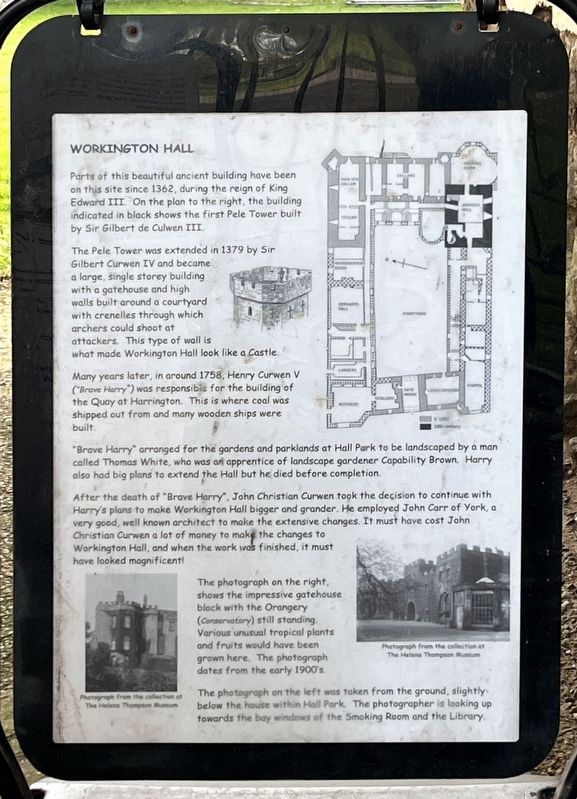
The Pele Tower was extended in 1379 by Sir Gilbert Curwen IV and became a large, single storey building with a gatehouse and high walls built around a courtyard with crenelles through which archers could shoot at attackers. This type of wall is what made Workington Hall look like a Castle.
Many years later, in around 1758, Henry Curwen V ("Brave Harry") was responsible for the building of the Quay at Harrington. This is where coal was shipped out from and many wooden ships were built.
"Brave Harry" arranged for the gardens and parklands at Hall Park to be landscaped by a man called Thomas White, who was an apprentice of landscape gardener Capability Brown. Harry also had big plans to extend the Hall but he died before completion.
After the death of "Brave Harry", John Christian Curwen took the decision to continue with Harry's plans to make Workington Hall bigger and grander. He
this page online
The photograph on the right shows the impressive gatehouse block with the Orangery (Conservatory) still standing. Various unusual tropical plants and fruits would have been grown here. The photograph dates from the early 1900's.
The photograph on the left was taken from the ground, slightly below the house within Hall Park. The photographer is looking up towards the bay windows of the Smoking Room and the Library.
Topics. This historical marker is listed in this topic list: Forts and Castles. A significant historical year for this entry is 1362.
Location. 54° 38.666′ N, 3° 32.367′ W. Marker is in Workington, England, in Cumberland. It is on Hall Brow. Touch for map. Marker is at or near this postal address: 1 Hall Brow, Workington, England CA14 2DP, United Kingdom. Touch for directions.

Regionally, this marker is in North West England. Globally, it is on the Atlantic Ocean,

Photographed by Ray Gurganus, April 11, 2025
2. The Remains of Workington Hall
Other nearby markers. At least 8 other markers are within walking distance of this marker: Workington Hall Parklands (about 150 meters away, measured in a direct line); Workington Station (approx. 1.2 kilometers away); James Alexander Smith (approx. 1.2 kilometers away); The Rails Which Circled the World (approx. 1.2 kilometers away); The Helena Thompson Museum (approx. 1.2 kilometers away); A History of Workington Station (approx. 1.2 kilometers away); Remembering World War II (approx. 1.2 kilometers away); Remembering World War I (approx. 1.2 kilometers away). Touch for a list and map of all markers in Workington.

Photographed by Ray Gurganus, April 11, 2025
3. The Remains of Workington Hall
Credits. This page was last revised on June 26, 2025. It was originally submitted on June 11, 2025, by Ray Gurganus of Washington, District of Columbia. This page has been viewed 131 times since then and 26 times this year. Photos: 1, 2, 3. submitted on June 11, 2025, by Ray Gurganus of Washington, District of Columbia. • Andrew Ruppenstein was the editor who published this page.
