Schießhaus in Bayreuth, Bavaria, Germany — Central Europe
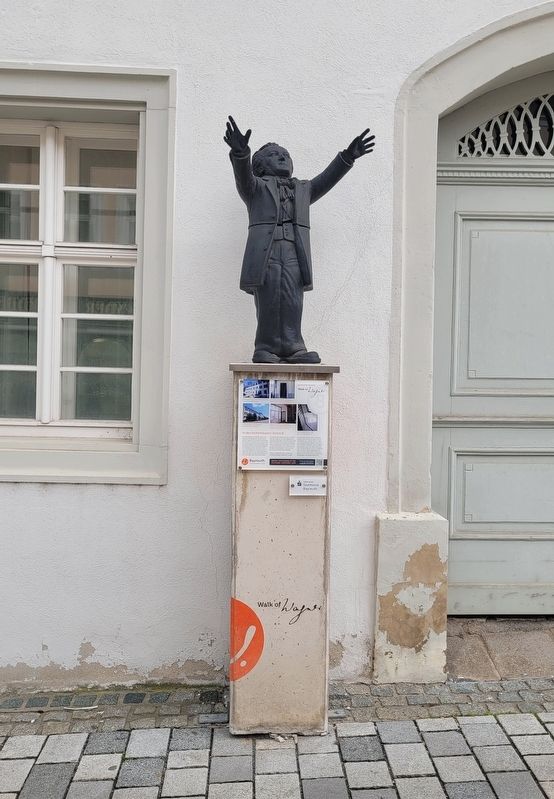
In den Escherhäusern: Zürich II
Wo Wagner wohnte
⎯⎯⎯
In the Escherhäuser: Zürich II
Walk of Wagner

Photographed by James Hulse, May 29, 2025
1. In den Escherhäusern: Zürich II / In the Escherhäuser: Zürich II Marker

Die Escherhäuser verdanken sich einer Initiative des Königs von Zürich, Alfred Escher. Wagner hat, natürlich hintereinander, gleich in mehreren dieser neuen, von Leonhard Zeugheer, dem Architekten der Villa Wesendonck entworfenen Gebäude am Zeltweg gewohnt. Zunächst mietete er sich zusammen mit seiner Frau im September 1849 in der Steinwiesstraße 3, einem Teil der Hinteren Escherhäuser, ein, wo er bis Mitte April 1850 die Schriften Kunstwerk der Zukunft, Kunst und Klima und den Entwurf zur Oper Wieland der Schmied aufschrieb. Ende November 1851 fand man ihn in einer „zwar sehr kleinen, aber gut gelegenen” Wohnung im Parterre des Hauses Zeltweg 11, einem der sog. Vorderen Escherhäuser, wo er am Text des Ring des Nibelungen arbeitete.
Schon im April 1853 zog er zusammen mit Minna Wagner wieder um: in den zweiten Stock der Nummer 13. Bis zum Frühjahr 1857 wird er hier leben und am „Arbeitstisch aus weichem Holz” in einer „neu ausgestatteten Elégance” (wie Franz Liszt bemerkte) Rheingold und Die Walküre komponieren, auch den Beginn des Siegfried. Die Wohnung ist heute in Privatbesitz, aber wer sich in das
this page online
Bildunterschriften
(Foto #1) Kunst und Klima in der Steinwiesstraße 3. Hintere Escherhäuser.
(Foto #2) Mit Gedenktafel: Die Vorderen Escherhäuser am Zeltweg.
(Foto #3) Der Eingang zu einer „gut gelegenen Wohnung”: Vordere Escherhäuser 11.
(Foto #4) Damals „eine neu ausgestattete Elégance": die Wohnung über der Wagner-Wohnung, Zeltweg 13.
(Foto #5) 1853 bis 1857 ging er hier hoch: im Zeltweg Nr. 13.
The Escher Houses owe their existence to an initiative by the “King of Zürich,” Alfred Escher. Wagner, naturally one after the other, lived in several of these new buildings on Zeltweg, designed by Leonhard Zeugheer, the architect of Villa Wesendonck. In September 1849, he first rented an apartment together with his wife at Steinwiesstraße 3, part of the Hintere Escherhäuser, where he stayed until mid-April 1850 and wrote The Artwork of the Future, Art and Climate, and the draft for the opera Wieland the Smith. At the end of November 1851, he could be found in a very small but well-located
Photographed by James Hulse, May 29, 2025
2. In den Escherhäusern: Zürich II / In the Escherhäuser: Zürich II Marker
By April 1853, he and Minna Wagner moved again — to the second floor of Number 13. He would live here until the spring of 1857 and, at his “work table made of soft wood” in surroundings of “newly furnished elegance” (as Franz Liszt remarked), compose Das Rheingold and Die Walküre, as well as begin Siegfried. The apartment is privately owned today, but those who happen to find their way into the Portuguese consulate on the third floor can still get an impression of the layout and the stuccoed ceiling décor of Wagner’s former residence.
Captions
(Photo #1) Art and Climate at Steinwiesstraße 3. Hintere Escherhäuser.
(Photo #2) With commemorative plaque: The Vordere Escherhäuser on Zeltweg.
(Photo #3) The entrance to a “well-located apartment”: Vordere Escherhäuser 11.
(Photo #4) At that time, “a newly furnished Elégance”: the apartment above the Wagner apartment, Zeltweg 13.
(Photo #5) From 1853 to 1857 he went up here: at Zeltweg No. 13.
Erected by Bayreuth Da steckt Wagner
Photographed by James Hulse, May 29, 2025
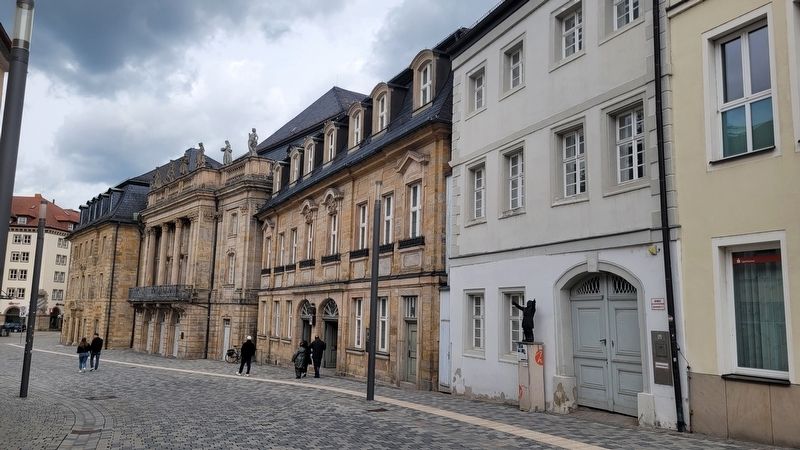
3. The view of the marker along the street
Topics. This historical marker is listed in this topic list: Notable Buildings. A significant historical month for this entry is April 1850.
Location. 49° 56.638′ N, 11° 34.689′ E. Marker is in Bayreuth, Bayern (Bavaria). It is in Schießhaus. It is on Opernstraße just south of Münzgasse, on the left when traveling south. The marker is located along the building. Touch for map. Marker is at or near this postal address: Opernstraße 12, Bayreuth BY 95444, Germany. Touch for directions.

Regionally, this marker is in German Franconia. Globally, it is in Europe, the European Union, Atlantic Europe, Central Europe, the Schengen Area, Western Europe, and the Western World. Historically, it finds itself in what was once the Holy Roman Empire and also the former West Germany.
Other nearby markers. At least 8 other markers are within walking distance of this marker: Georg Paul Finck Haus (within shouting distance of this marker); Anton Bruckner (within shouting distance of this marker); Sternplatz (within shouting distance of this marker); Schlosskirche / Palace Church (within shouting distance of this marker); Ehemaliges Redoutenhaus / Former Assembly and Ballroom Hall (within shouting distance of this marker); Si Deus Cum Nobis, Quis Contra Nos. / If God is with us, who is against us? (within shouting distance of this marker); Opernstraße (within shouting distance of this marker); a different marker also named Schlosskirche / Palace Church (within shouting distance of this marker). Touch for a list and map of all markers in Bayreuth.
Another marker is no longer nearby. Drei Schweizer/Three Swiss: Sulzer, Müller, Ott-Usteri (was here, next to this marker but has been permanently removed).
Also see . . . My tour: Bayreuth yesterday and today. Future History
Discover historic Bayreuth from the turn of the 19th to the 20th century, and see how the sights present themselves today. Our informative city tour takes you from the Tourist Information Center past the Margravial Opera House, to Haus Wahnfried, the New Palace, the Baroque Friedrichstrasse, the City Church, and the Market Square with its many facets. Finally, you return to the starting point via the Old Palace.(Submitted on June 15, 2025, by James Hulse of Medina, Texas.)
Credits. This page was last revised on June 15, 2025. It was originally submitted on June 15, 2025, by James Hulse of Medina, Texas. This page has been viewed 133 times since then and 46 times this year. Photos: 1, 2, 3. submitted on June 15, 2025, by James Hulse of Medina, Texas.
