Schießhaus in Bayreuth, Bavaria, Germany — Central Europe
Der Tristan-Palazzo: Venedig I
Wo Wagner wohnte
⎯⎯⎯
The Tristan Palace: Venice I
Walk of Wagner
Photographed by James Hulse, May 29, 2025
1. Der Tristan-Palazzo: Venedig I / The Tristan Palace: Venice I Marker

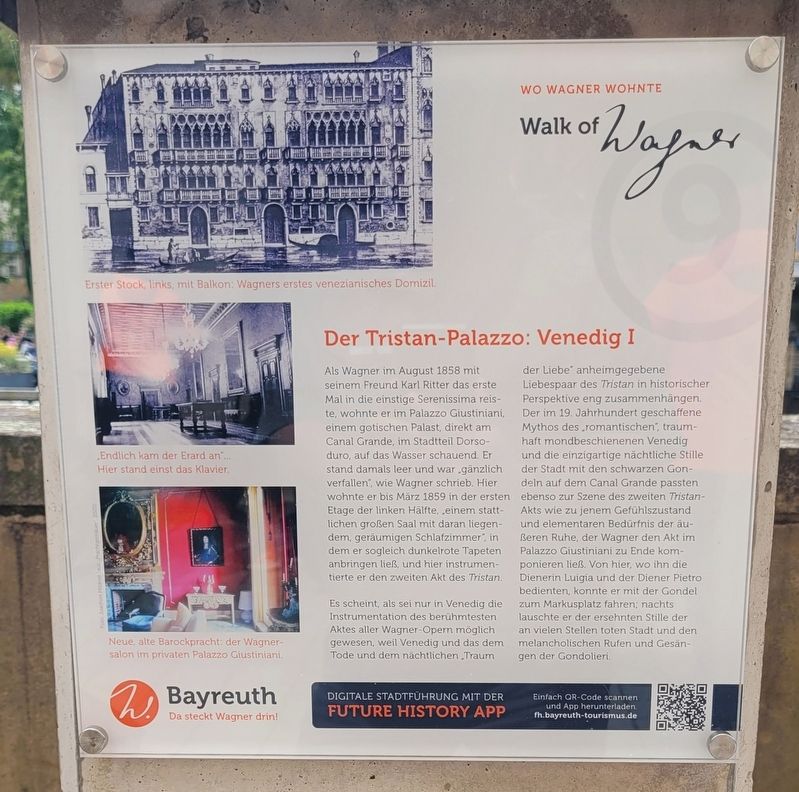
Als Wagner im August 1858 mit seinem Freund Karl Ritter das erste Mal in die einstige Serenissima reiste, wohnte er im Palazzo Giustiniani, einem gotischen Palast, direkt am Canal Grande, im Stadtteil Dorsoduro, auf das Wasser schauend. Er stand damals leer und war „gänzlich verfallen“, wie Wagner schrieb. Hier wohnte er bis März 1859 in der ersten Etage der linken Hälfte, „einem stattlichen großen Saal mit daran liegendem, geräumigen Schlafzimmer“, in dem er sogleich dunkelrote Tapeten anbringen ließ, und hier instrumentierte er den zweiten Akt des Tristan.
Es scheint, als sei nur in Venedig die Instrumentation des berühmtesten Aktes aller Wagner-Opern möglich gewesen, weil Venedig und das dem Tode und dem nächtlichen „Traum der Liebe“ anheimgegebene Liebespaar des Tristan in historischer Perspektive eng zusammenhängen. Der im 19. Jahrhundert geschaffene Mythos des „romantischen“, traumhaft mondbeschienenen Venedig und die einzigartige nächtliche Stille der Stadt mit den schwarzen Gondeln auf dem Canal Grande passten ebenso zur Szene des zweiten Tristan-Akts wie zu jenem Gefühlszustand und elementaren
this page online
Bildunterschriften
(Foto #1) Erster Stock, links, mit Balkon: Wagners erstes venezianisches Domizil.
(Foto #2) „Endlich kam der Erard an“... Hier stand einst das Klavier.
(Foto #3) Neue, alte Barockpracht: der Wagner-salon im privaten Palazzo Giustiniani.
When Wagner traveled to the former Serenissima for the first time in August 1858 with his friend Karl Ritter, he stayed at the Palazzo Giustiniani, a Gothic palace directly on the Grand Canal in the Dorsoduro district, overlooking the water. At that time, it stood empty and was, as Wagner wrote, “completely dilapidated.” He lived there until March 1859 on the first floor of the building’s left half, “a stately large hall with an adjoining, spacious bedroom,” in which he immediately had dark red wallpaper installed.
Photographed by James Hulse, May 29, 2025
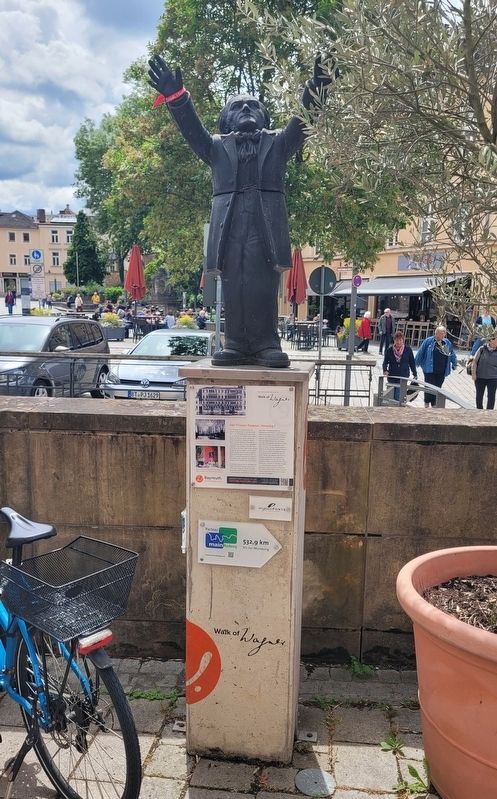
2. Der Tristan-Palazzo: Venedig I / The Tristan Palace: Venice I Marker
It seems that only in Venice could the instrumentation of the most famous act of all Wagner’s operas have been possible, because Venice and the lovers of Tristan, surrendered to death and the nocturnal dream of love, are closely intertwined from a historical perspective. The 19th-century myth of “romantic,” dreamlike, moonlit Venice and the city’s unique nocturnal silence, with black gondolas gliding over the Grand Canal, matched the scene of Tristan’s second act as well as the emotional state and elemental need for outward calm that compelled Wagner to finish composing the act in Palazzo Giustiniani. From here, where the maid Luigia and the servant Pietro tended to him, he could take a gondola to St. Mark’s Square; at night, he listened to the longed-for silence of the city, dead in many places, and to the melancholic calls and songs of the gondoliers.
Captions
(Photo #1) First floor, left, with balcony: Wagner's first Venetian residence.
(Photo #2) "Finally the Erard arrived"... Here once stood the piano.
(Photo #3) New, old baroque splendor: the Wagner salon in the private Palazzo Giustiniani.
Erected by Bayreuth Da steckt Wagner drin!.
Topics. This historical marker is listed in this topic list: Notable Buildings. A significant historical month for this entry is March 1859.
Location. 49° 56.699′ N, 11° 34.674′ E. Marker is in Bayreuth, Bayern (Bavaria). It is in Schießhaus. It is at the intersection of Opernstraße and Wölfelstraße on Opernstraße. The marker is located along the sidewalk and canal. Touch for map. Marker is at or near this postal address: Opernstraße 24-26, Bayreuth BY 95444, Germany. Touch for directions.

Regionally, this marker is in German Franconia. Globally, it is in Europe, the European Union, Atlantic Europe, Central Europe,
Photographed by James Hulse, May 29, 2025
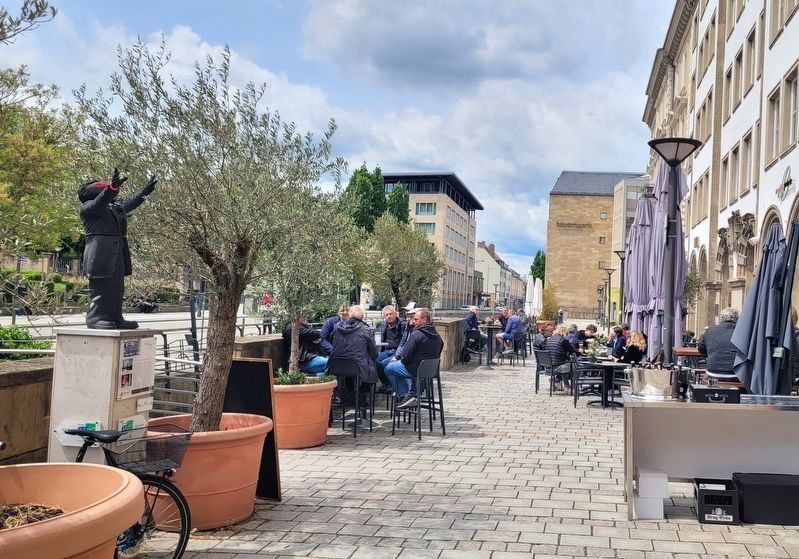
3. The view of the Tristan Palace: Venice I Marker along the street
Other nearby markers. At least 8 other markers are within walking distance of this marker: Opernstraße (within shouting distance of this marker); Iwalewahaus / Iwalewa House (within shouting distance of this marker); Ehemaliges Redoutenhaus / Former Assembly and Ballroom Hall (within shouting distance of this marker); Schlosskirche / Palace Church (within shouting distance of this marker); a different marker also named Schlosskirche / Palace Church (about 90 meters away, measured in a direct line); Der Hochadel: Napoleon III., die Kaiserin & Pauline Metternich (about 90 meters away); Anton Bruckner (about 90 meters away); Georg Paul Finck Haus (about 90 meters away). Touch for a list and map of all markers in Bayreuth.
Another marker is no longer nearby. E.T.A. Hoffman: Ein genialer Dichter und grosser Musiker / A Genius Poet and Great Musician (was about 90 meters away but has been permanently removed).
Also see . . . My tour: Bayreuth yesterday and today. Future History
Discover historic Bayreuth from the turn of the 19th to the 20th century, and see how the sights present themselves today. Our informative city tour takes you from the Tourist Information Center past the Margravial Opera House, to Haus Wahnfried, the New Palace, the Baroque Friedrichstrasse, the City Church, and the Market Square with its many facets. Finally, you return to the starting point via the Old Palace.(Submitted on June 15, 2025, by James Hulse of Medina, Texas.)
Credits. This page was last revised on June 15, 2025. It was originally submitted on June 15, 2025, by James Hulse of Medina, Texas. This page has been viewed 93 times since then and 19 times this year. Photos: 1, 2, 3. submitted on June 15, 2025, by James Hulse of Medina, Texas.
