Schießhaus in Bayreuth, Bavaria, Germany — Central Europe
Vom Neumarkt zum Palais: Dresden
Wo Wagner wohnte
⎯⎯⎯
From Neumarkt to the Palace: Dresden
Walk of Wagner
Photographed by James Hulse, May 29, 2025
1. Vom Neumarkt zum Palais: Dresden / From Neumarkt to the Palace: Dresden Marker

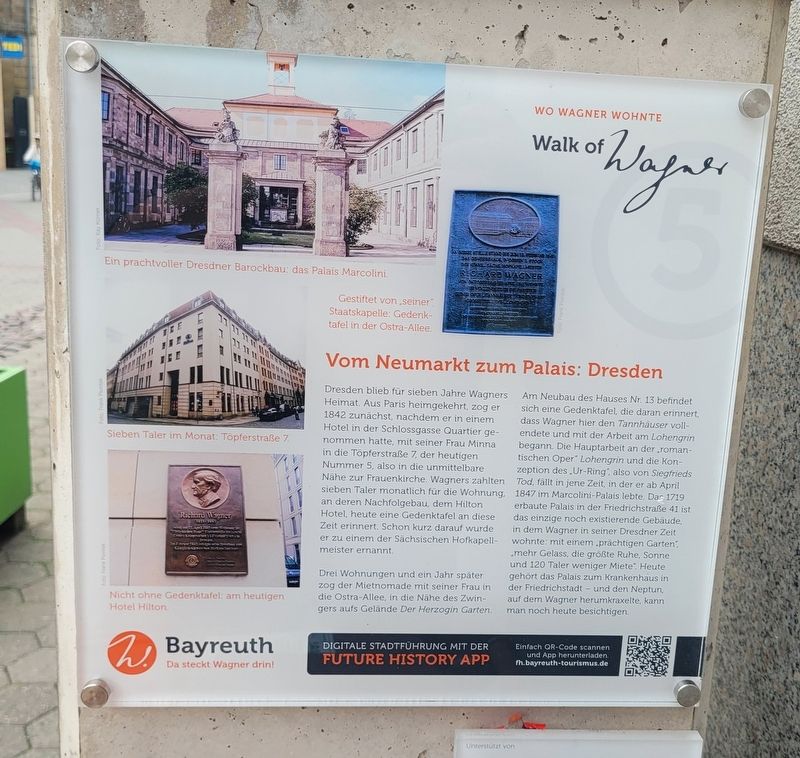
Dresden blieb für sieben Jahre Wagners Heimat. Aus Paris heimgekehrt, zog er 1842 zunächst, nachdem er in einem Hotel in der Schlossgasse Quartier genommen hatte, mit seiner Frau Minna in die Töpferstraße 7, der heutigen Nummer 5, also in die unmittelbare Nähe zur Frauenkirche. Wagners zahlten sieben Taler monatlich für die Wohnung, an deren Nachfolgebau, dem Hilton Hotel, heute eine Gedenktafel an diese Zeit erinnert. Schon kurz darauf wurde er zu einem der Sächsischen Hofkapellmeister ernannt.
Drei Wohnungen und ein Jahr später zog der Mietnomade mit seiner Frau in die Ostra-Allee, in die Nähe des Zwingers aufs Gelände Der Herzogin Garten. Am Neubau des Hauses Nr. 13 befindet sich eine Gedenktafel, die daran erinnert, dass Wagner hier den Tannhäuser vollendete und mit der Arbeit am Lohengrin begann. Die Hauptarbeit an der „romantischen Oper“ Lohengrin und die Konzeption des „Ur-Ring“, also von Siegfrieds Tod, fällt in jene Zeit, in der er ab April 1847 im Marcolini-Palais lebte. Das 1719 erbaute Palais in der Friedrichstraße 41 ist das einzige noch existierende Gebäude, in dem Wagner in seiner Dresdner
this page online
Bildunterschriften
(Foto #1) Ein prachtvoller Dresdner Barockbau: das Palais Marcolini. Foto: Kay Korner
(Foto #2) Sieben Taler im Monat: Töpferstraße 7. Foto: Frank Piontek
(Foto #3) Nicht ohne Gedenktafel: am heutigen Hotel Hilton.
(Foto #4) Gestiftet von „seiner“ Staatskapelle: Gedenktafel in der Ostra-Allee.
Dresden remained Wagner’s home for seven years. Having returned from Paris, he moved in 1842 — after initially taking quarters in a hotel on Schlossgasse — together with his wife Minna to Töpferstraße 7, today’s number 5, placing them in the immediate vicinity of the Frauenkirche. The Wagners paid seven talers a month for the apartment, on whose successor building, now the Hilton Hotel, a commemorative plaque today recalls this period. Shortly afterward, he was appointed one of the Saxon Court Kapellmeisters.
Three apartments and a year
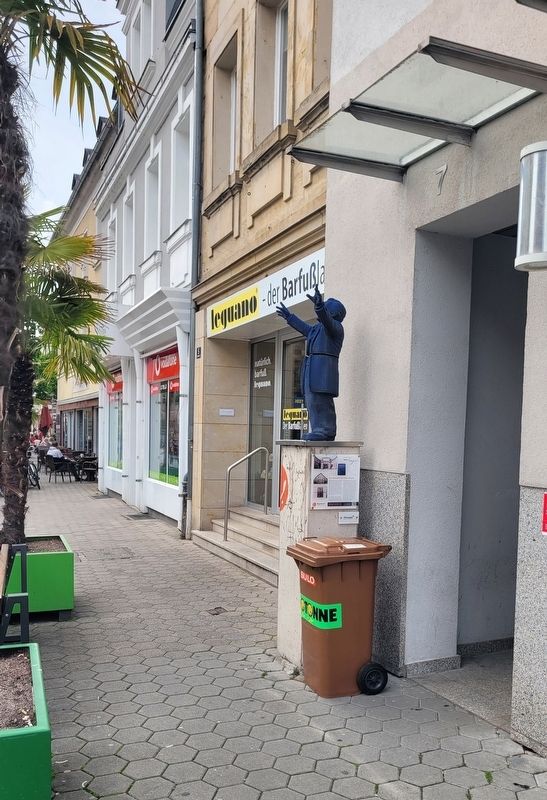
Photographed by James Hulse, May 29, 2025
2. Vom Neumarkt zum Palais: Dresden / From Neumarkt to the Palace: Dresden Marker
Captions
(Photo #1) A magnificent Baroque building in Dresden: the Marcolini Palace. Photo: Kay Korner
(Photo #2) Seven talers a month: Töpferstraße 7. Photo: Frank Piontek
(Photo #3) Not without a commemorative plaque: at today’s Hotel Hilton. Photo: Frank Piontek
(Photo #4) Donated by “his” Staatskapelle: commemorative plaque on Ostra-Allee.
Erected by Bayreuth Da steckt Wagner drin!.
Topics. This historical marker is listed in this topic list: Notable Buildings. A significant historical month for this entry is April 1847.
Location. 49° 56.583′ N, 11° 34.737′ E. Marker is in Bayreuth, Bayern (Bavaria). It is in Schießhaus. It is on Richard-Wagner-Straße just west of Dilchertstraße. The marker is located along the street. Touch for map. Marker is at or near this postal address: Richard-Wagner-Straße 8, Bayreuth BY 95444, Germany. Touch for directions.

Regionally, this marker is in German Franconia. Globally, it is in Europe, the European Union, Atlantic Europe, Central Europe,
Photographed by James Hulse, May 29, 2025
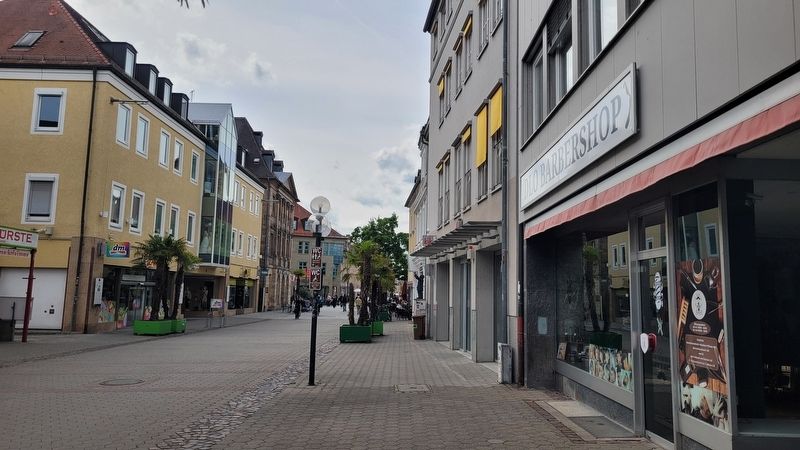
3. The view of the marker along the street
Other nearby markers. At least 8 other markers are within walking distance of this marker: Jean Paul und die Sonne / Jean Paul and the Hotel Sonne (within shouting distance of this marker); Zwei Intendanten / Two Directors: Lüttichau (mit Frau) und Bronsart von Schellendorf (within shouting distance of this marker); Sternplatz (within shouting distance of this marker); Eine widerliche Ausdünstung von Schnaps und Spiritus: Riga (about 90 meters away); In den Escherhäusern: Zürich II / In the Escherhäuser: Zürich II (about 120 meters away); Georg Paul Finck Haus (about 150 meters away); Anton Bruckner (about 150 meters away); City Wall (about 150 meters away). Touch for a list and map of all markers in Bayreuth.
Other markers no longer nearby. Mehrere Komponisten: Meyerbeer Bruckner und die Strauß-Kapelle (was about 90 meters away, measured in a direct line but has been permanently removed); Drei Schweizer/Three Swiss: Sulzer, Müller, Ott-Usteri (was about 120 meters away but has been permanently removed).
Also see . . . My tour: Bayreuth yesterday and today. Future History
Discover historic Bayreuth from the turn of the 19th to the 20th century, and see how the sights present themselves today. Our informative city tour takes you from the Tourist Information Center past the Margravial Opera House, to Haus Wahnfried, the New Palace, the Baroque Friedrichstrasse, the City Church, and the Market Square with its many facets. Finally, you return to the starting point via the Old Palace.(Submitted on June 16, 2025, by James Hulse of Medina, Texas.)
Credits. This page was last revised on June 16, 2025. It was originally submitted on June 16, 2025, by James Hulse of Medina, Texas. This page has been viewed 78 times since then and 8 times this year. Photos: 1, 2, 3. submitted on June 16, 2025, by James Hulse of Medina, Texas.
