Schießhaus in Bayreuth, Bavaria, Germany — Central Europe
Die ersten drei Monate: Zürich I
Wo Wagner wohnte
⎯⎯⎯
The first three months: Zurich I
Walk of Wagner
Photographed by James Hulse, May 29, 2025
1. Die ersten drei Monate: Zürich I / The first three months: Zurich I Marker

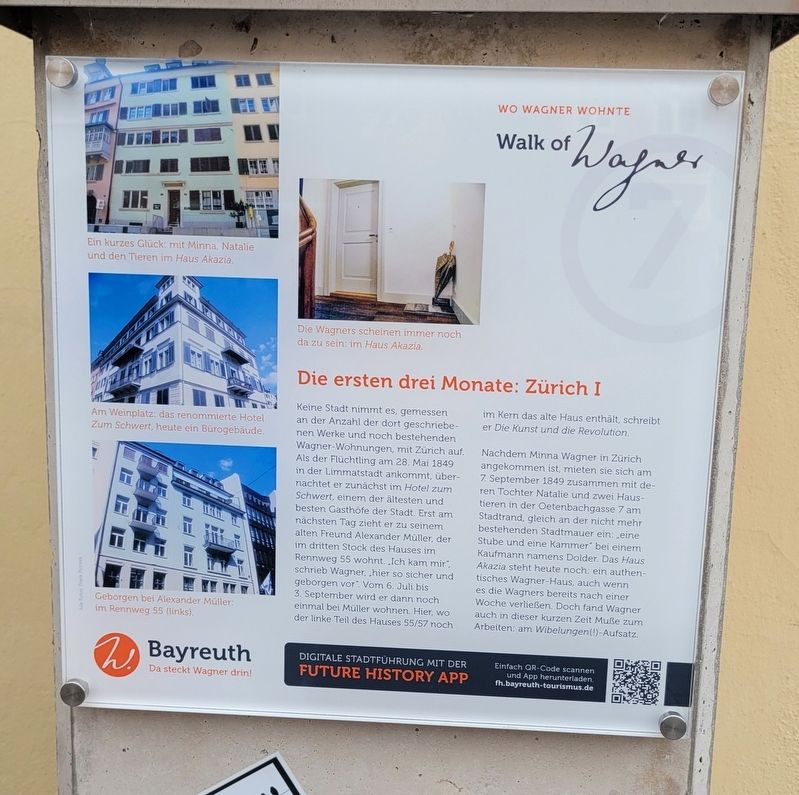
Keine Stadt nimmt es, gemessen an der Anzahl der dort geschriebenen Werke und noch bestehenden Wagner-Wohnungen, mit Zürich auf. Als der Flüchtling am 28. Mai 1849 in der Limmatstadt ankommt, übernachtet er zunächst im Hotel zum Schwert, einem der ältesten und besten Gasthöfe der Stadt. Erst am nächsten Tag zieht er zu seinem alten Freund Alexander Müller, der im dritten Stock des Hauses im Rennweg 55 wohnt. „Ich kam mir“, schrieb Wagner, „hier so sicher und geborgen vor“. Vom 6. Juli bis 3. September wird er dann noch einmal bei Müller wohnen. Hier, wo der linke Teil des Hauses 55/57 noch im Kern das alte Haus enthält, schreibt er Die Kunst und die Revolution.
Nachdem Minna Wagner in Zürich angekommen ist, mieten sie sich am 7. September 1849 zusammen mit deren Tochter Natalie und zwei Haustieren in der Oetenbachgasse 7 am Stadtrand, gleich an der nicht mehr bestehenden Stadtmauer ein: „eine Stube und eine Kammer“ bei einem Kaufmann namens Dolder. Das Haus Akazia steht heute noch: ein authentisches Wagner-Haus, auch wenn es die Wagners bereits nach einer Woche verließen. Doch fand Wagner auch in dieser
this page online
Bildunterschriften
(Foto #1) Ein kurzes Glück: mit Minna, Natalie und den Tieren im Haus Akazia.
(Foto #2) Am Weinplatz: das renommierte Hotel Zum Schwert, heute ein Bürogebäude.
(Foto #3) Geborgen bei Alexander Müller: im Rennweg 55 (links).
(Foto #4) Die Wagners scheinen immer noch da zu sein: im Haus Akazia.
Alle Fotos: Frank Piontek
No city can rival Zurich when measured by the number of works written there and the Wagner residences still standing. When the refugee arrived in the Limmat city on May 28, 1849, he first spent the night at the Hotel zum Schwert, one of the city’s oldest and finest inns. Only the next day did he move in with his old friend Alexander Müller, who lived on the third floor of the building at Rennweg 55. “I felt so safe and sheltered here,” Wagner later wrote. From July 6 to September 3, he would stay with Müller once again. Here, in the left part of the building at 55/57, which still contains the original structure, he wrote Art and Revolution.
After Minna Wagner arrived in Zurich, they rented a place together
Photographed by James Hulse, May 29, 2025
2. Die ersten drei Monate: Zürich I / The first three months: Zurich I Marker
Captions
(Photo #1) A brief moment of happiness: with Minna, Natalie and the animals in the Akazia House.
(Photo #2) At Weinplatz: the renowned Hotel Zum Schwert, now an office building.
(Photo #3) Safely located at Alexander Müller’s: Rennweg 55 (left).
(Photo #4) The Wagners seem to still be there: in the Akazia house.
All photos: Frank Piontek
Erected by Bayreuth Da steckt Wagner drin!.
Topics. This historical marker is listed in this topic list: Notable Buildings. A significant historical date for this entry is May 28, 1849.
Location. 49° 56.657′ N, 11° 34.49′ E. Marker is in Bayreuth, Bayern (Bavaria). It is in Schießhaus. It is on Maximilianstraße just west of Brautgasse, on the right when traveling east. Touch for map. Marker is at or near this postal address: Maximilianstraße 24, Bayreuth BY 95444, Germany. Touch for directions.

Regionally, this marker is in German Franconia. Globally, it is in Europe, the European Union, Atlantic Europe, Central Europe, the Schengen Area, Western Europe, and the Western World. Historically, it finds itself in what was once the Holy Roman Empire and also the former West Germany.
Other nearby markers. At least 8 other markers are within walking distance of this marker: Max Stirner (here, next to this marker); Altes Rathaus / Old Town Hall (a few steps from this marker); a different marker also named Max Stirner (a few steps from this marker); Eisenwarengeschäft Wirsing / Friedrich Wirsing's Shop
Photographed by James Hulse, May 29, 2025
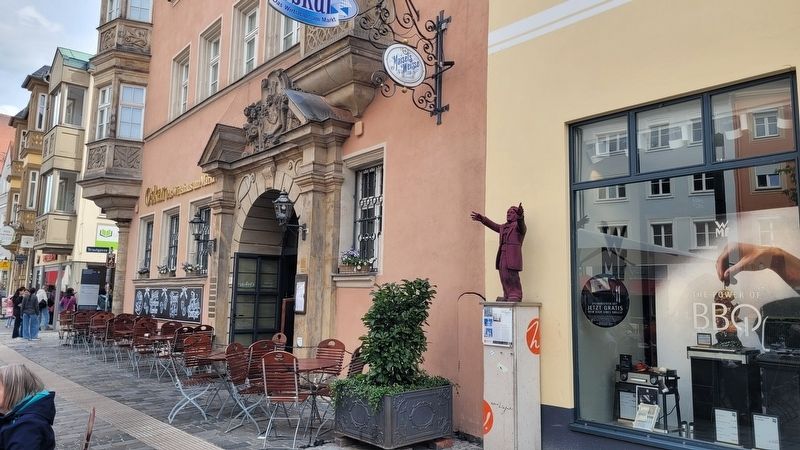
3. The view of the marker along the street
Another marker is no longer nearby. Ein grösserer Meister: Joseph Haydn / A Greater Master: Joseph Haydn (was here, next to this marker but has been permanently removed).
Also see . . . My tour: Bayreuth yesterday and today. Future History
Discover historic Bayreuth from the turn of the 19th to the 20th century, and see how the sights present themselves today. Our informative city tour takes you from the Tourist Information Center past the Margravial Opera House, to Haus Wahnfried, the New Palace, the Baroque Friedrichstrasse, the City Church, and the Market Square with its many facets. Finally, you return to the starting point via the Old Palace.(Submitted on June 16, 2025, by James Hulse of Medina, Texas.)
Credits. This page was last revised on June 16, 2025. It was originally submitted on June 16, 2025, by James Hulse of Medina, Texas. This page has been viewed 82 times since then and 11 times this year. Photos: 1, 2, 3. submitted on June 16, 2025, by James Hulse of Medina, Texas.
