Bremen-Mitte in Mitte, Germany — Central Europe
Haus Rohlandseck
⎯⎯⎯
Rohlandseck Building
Obernstr. 1/Unser Lieben Frauen Kirchhof 26
Photographed by Andrew Ruppenstein, May 18, 2025
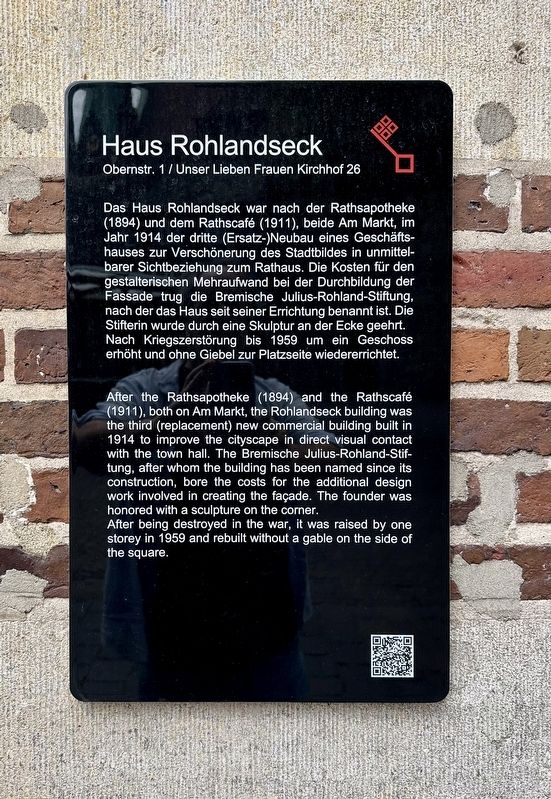
1. Haus Rohlandseck / Rohlandseck Building Marker

After the Rathsapotheke (1894) and the Rathscafé (1911), both on Am Markt, the Rohlandseck building was the third (replacement) new commercial building built in 1914 to improve the cityscape in direct visual contact with the town hall. The Bremische Julius-Rohland-Stiftung, after whom the building has been named since its construction, bore the costs for the additional design work involved in creating the façade. The founder was honored with a sculpture on the corner. After being destroyed in the war, it was raised by one storey
this page online
Topics and series. This historical marker is listed in this topic list: Industry & Commerce. In addition, it is included in the Bremen Red Key series list. A significant historical year for this entry is 1914.
Location. 53° 4.597′ N, 8° 48.41′ E. Marker is in Bremen, in Mitte. It is in Bremen-Mitte. It is at the intersection of Unser Lieben Frauen Kirchhof and Obernstraße, on the right when traveling south on Unser Lieben Frauen Kirchhof. Touch for map. Marker is at or near this postal address: Unser Lieben Frauen Kirchhof 26, Bremen 28195, Germany. Touch for directions.

Regionally, it is in Europe, the European Union, Atlantic Europe, Central Europe, the Schengen Area, Western Europe, and the Western World. Historically, it finds itself in what was once the Holy Roman Empire and also the former West Germany.
Other nearby markers. At least 8 other markers are within walking distance of this marker: Unser Lieben Frauen / Church of Our Lady (within shouting distance of this marker); Geschäfts- und Bürohaus / Commercial- and Office Building (within shouting distance
Photographed by Andrew Ruppenstein, May 18, 2025
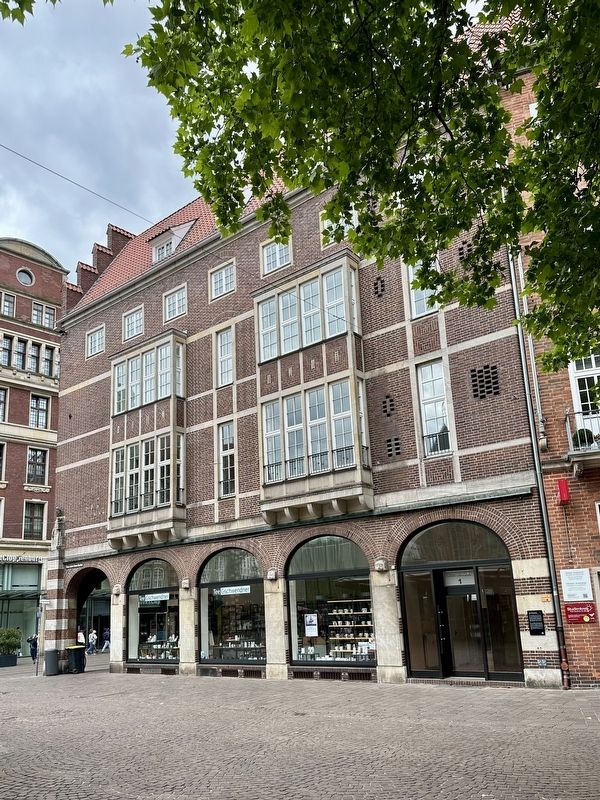
2. Haus Rohlandseck / Rohlandseck Building and marker
Also see . . . Haus Rohlandseck (Wikipedia). Excerpt (in translation):
Even in old city views (1638–1647) by Matthäus Merian, two gabled houses can be seen between the square and Sögestraße. Before 1914, a predecessor building stood here, which was considered inappropriate due to its neoclassical façade facing Bremen City Hall and the Church of Our Lady.(Submitted on June 16, 2025, by Andrew Ruppenstein of Lamorinda, California.)
The new, then three-story, clinker-clad building was built in 1914 in a prime urban location for the businessman von Hütschler and Streckewald. The building was intended to contribute to the beautification of the city center. Therefore, following a competition won by Eeg, the additional design effort for the façade, including the ashlar incorporation, stepped gable, and bay window, was assumed by the Bremen Julius Rohland Foundation.
The Bremen State Office for the Preservation of Historic Buildings wrote: "The... commercial building was based on the Bremen tradition of the urban gabled brick house... in its choice of materials and basic form, without, however, becoming rigidly historicist."
In 1944, after the war damage, only the ground floor survived. The reconstruction from 1948 to 1959 was overseen by Eeg in collaboration with the architect Albert Meyer. It resembles the previous building. The building was raised by a fourth story.…
Credits. This page was last revised on June 16, 2025. It was originally submitted on June 16, 2025, by Andrew Ruppenstein of Lamorinda, California. This page has been viewed 83 times since then and 9 times this year. Photos: 1, 2. submitted on June 16, 2025, by Andrew Ruppenstein of Lamorinda, California.
