Central Hamilton , Ontario — Central Canada (North America)
The Argyll and Sutherland Highlanders of Canada (Princess Louise’s), 1903-39
Photographed by Tim Boyd, June 11, 2025
1. The Argyll and Sutherland Highlanders of Canada (Princess Louise’s), 1903-39 Marker
Inscription.
The Argyll and Sutherland Highlanders of Canada (Princess Louise’s), 1903-39. . , Foundation of the Regiment , Kilts and bagpipes are the distinctive symbols of a tradition rooted in Canadian military history for over 200 years - the Highland regiment. Since Confederation, Highland regiments have been closely identified with the militia., Between 1880 and the First World War, kilted regiments were raised in cities across Canada. Hamilton has had a kilted military presence since 1856, when a Highland company was formed (later a company of the XIII Royal Regiment, the RHLI)., The "idea" for a Highland regiment in Hamilton "first took shape among the members of the St. Andrew's Society and the Sons of Scotland." Late in 1902, meetings were held and prominent members of the city's Highland-Canadian community were asked to "take hold of the matter." Lawyer James Chisholm (president of the Liberal Party of Hamilton and a member of both sponsoring organizations) and his legal partner, William Logie (a captain in the XIII), took a predominant role in organizing locally and in lobbying Ottawa. With the support of local Scottish organizations and clan societies, a deputation went to Ottawa bearing a petition to the minister of militia and defence. The Liberal minister, Sir Frederick Borden, was less than enthusiastic about the potential cost and the Highland character of the proposed unit (he wanted the militia in a common uniform)., The community-based initiative prevailed, and Hamilton's Scottish-Canadian elite moved quickly to fill the ranks of the officer corps and to raise the funds to outfit the regiment in full Highland dress. As a result of broad community support and effective political organization, the Regiment was gazetted on 16 September 1903 as the 91st Regiment Canadian Highlanders., The Regiment established its Canadian character by its choice of name, "Canadian Highlanders," and affirmed its Scottish-Highland roots with its Gaelic motto - Albain Gu Brath (Scotland Forever). Although there have always been individuals with Scottish ties or Highland forebears, the Regiment and its great symbols quickly came to represent the face of Canada, whether in 1903 or now., The First World War , Like the militia generally, the Regiment has suffered or prospered according to the dictates of government policy. Peace, fortunately, has been the norm during most of the Regiment's history. Thus, the contours of the unit's existence have been marked mainly by a routine of ceremony, drilling, lectures, training, exercises, administration, and recruitment. Part-time soldiering has always required an almost full-time commitment., During the First World War, the Regiment acted as a recruiting depot, providing 145 officers and 5,207 other ranks for service in the numbered battalions of the Canadian Expeditionary Force (CEF), especially the 16th, 19th, and 173rd Highlanders. The latter was broken up for reinforcements, much to the chagrin of its men. Although the Argylls perpetuate both the 19th and the 173rd, it is the former that provides its most intimate connection with the Great War. The 91st gave the 19th all four of its commanding officers and its pipe major, Charles Dunbar, DCM, its command structure, and about 30% of its original establishment., As part of the 2nd Division, the 19th went from the mud and misery of Salisbury Plain, England, to the mud and blood of Flanders, Belgium. It saw its first action at St Eloi in April 1916 and went on to distinguish itself on the Somme, at Courcelette, Vimy Ridge, Hill 70, Passchendaele, Drocourt-Quéant, and the pursuit to Mons, to name but a few. In December 1918, its Pipe Band played a victorious Canadian Corps across the Rhine and into Germany: here was one of the memorable pictorial representations of Canada's military past. All told, the 19th and the various machine-gun companies and 3rd Machine Gun Battalion lost 1,374 soldiers and had over three times that number wounded., The 19th Battalion's historian, Dr David Campbell, has written:, "From mobilization in 1914 to demobilization in 1919, 118 officers and between 4,731 and 5,004 other ranks passed through the 19th Battalion. Of these men, 3,076 were casualties, including 737 fatalities (all ranks). Commenting on this remarkable turnover, ... veteran R.H. (Harry) Neil later declared, '[T]he battalion had changed over in personnel, almost four and one half times.... But ... it was the same old 19th: [The casualty rate is 60.1% with 5,004 other ranks and 118 officers.], .... Experience and training had transformed its personnel from amateur volunteers into battle-hardened professionals. It is highly unlikely that the unit that landed in France in 1915 would have performed as effectively during the Hundred Days as did the battalion that had come through the crucible of St Eloi, the Somme, Vimy, Hill 70, and Passchendaele.", The Regiment was young, with its history now written in blood. "I can only say that War is an awful thing and the hardships are great," Pte Deward Barnes later wrote, "and there is something wrong if a man has seen as much of it as I have and wishes to see another." Pte V. E. Thompson thought the war "was simply a matter of being lucky enough to come through alive and being able to endure the strain of the life." LCl John Gaetz wrote of the "friendship of the genuine sort built up" and the acute awareness that "much [will be] appreciated afterward and never forgotten.", Inter-war , The Regiment survived the inter-war years, the militia, and funding cuts. It amalgamated with the 3rd Machine Gun Battalion in 1936 to form The Argyll and Sutherland Highlanders of Canada (Princess Louise's) (Machine Gun). The MG suffix was dropped on 1 February 1941. The unit rarely paraded below 400 and benefited from cadres of veterans. It enjoyed a visible civic profile through weekly parades and the activities of three bands (pipes, brass and bugle).
Foundation of the Regiment
Kilts and bagpipes are the distinctive symbols of a tradition rooted in Canadian military history for over 200 years - the Highland regiment. Since Confederation, Highland regiments have been closely identified with the militia.
Between 1880 and the First World War, kilted regiments were raised in cities across Canada. Hamilton has had a kilted military presence since 1856, when a Highland company was formed (later a company of the XIII Royal Regiment, the RHLI).
The "idea" for a Highland regiment in Hamilton "first took shape among the members of the St. Andrew's Society and the Sons of Scotland." Late in 1902, meetings were held and prominent members of the city's Highland-Canadian community were asked to "take hold of the matter." Lawyer James Chisholm (president of the Liberal Party of Hamilton and a member of both sponsoring organizations) and his legal partner, William Logie (a captain in the XIII), took a predominant role in organizing locally and in lobbying Ottawa.
With the support of local Scottish organizations and clan societies, a deputation went to Ottawa bearing a petition to the minister of militia and defence. The Liberal minister, Sir Frederick Borden, was less than enthusiastic about the potential cost and the Highland character of the proposed unit (he
Click or scan to see this page online
wanted the militia in a common uniform).
The community-based initiative prevailed, and Hamilton's Scottish-Canadian elite moved quickly to fill the ranks of the officer corps and to raise the funds to outfit the regiment in full Highland dress. As a result of broad community support and effective political organization, the Regiment was gazetted on 16 September 1903 as the 91st Regiment Canadian Highlanders.
The Regiment established its Canadian character by its choice of name, "Canadian Highlanders," and affirmed its Scottish-Highland roots with its Gaelic motto - Albain Gu Brath (Scotland Forever). Although there have always been individuals with Scottish ties or Highland forebears, the Regiment and its great symbols quickly came to represent the face of Canada, whether in 1903 or now.
The First World War
Like the militia generally, the Regiment has suffered or prospered according to the dictates of government policy. Peace, fortunately, has been the norm during most of the Regiment's history. Thus, the contours of the unit's existence have been marked mainly by a routine of ceremony, drilling, lectures, training, exercises, administration, and recruitment. Part-time soldiering has always required an almost full-time commitment.
During the First World War, the Regiment acted as a recruiting depot, providing 145 officers
Photographed by Tim Boyd, June 11, 2025
2. The Argyll and Sutherland Highlanders of Canada (Princess Louise’s), 1903-39 Marker
The marker on the left. The Argyll and Sutherland Memorial is visible at the upper left
and 5,207 other ranks for service in the numbered battalions of the Canadian Expeditionary Force (CEF), especially the 16th, 19th, and 173rd Highlanders. The latter was broken up for reinforcements, much to the chagrin of its men. Although the Argylls perpetuate both the 19th and the 173rd, it is the former that provides its most intimate connection with the Great War. The 91st gave the 19th all four of its commanding officers and its pipe major, Charles Dunbar, DCM, its command structure, and about 30% of its original establishment.
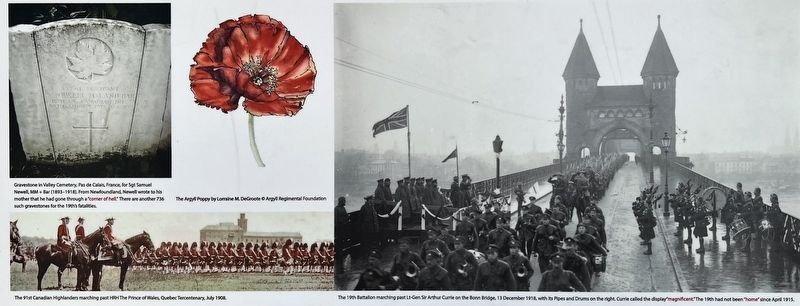
As part of the 2nd Division, the 19th went from the mud and misery of Salisbury Plain, England, to the mud and blood of Flanders, Belgium. It saw its first action at St Eloi in April 1916 and went on to distinguish itself on the Somme, at Courcelette, Vimy Ridge, Hill 70, Passchendaele, Drocourt-Quéant, and the pursuit to Mons, to name but a few. In December 1918, its Pipe Band played a victorious Canadian Corps across the Rhine and into Germany: here was one of the memorable pictorial representations of Canada's military past. All told, the 19th and the various machine-gun companies and 3rd Machine Gun Battalion lost 1,374 soldiers and had over three times that number wounded.
The 19th Battalion's historian, Dr David Campbell, has written:
"From mobilization in 1914 to demobilization in 1919, 118 officers and between
Photographed by Tim Boyd, June 11, 2025
3. The Argyll and Sutherland Highlanders of Canada (Princess Louise’s), 1903-39, photos and captions
Upper left
4,731 and 5,004 other ranks passed through the 19th Battalion. Of these men, 3,076 were casualties, including 737 fatalities (all ranks). Commenting on this remarkable turnover, ... veteran R.H. (Harry) Neil later declared, '[T]he battalion had changed over in personnel, almost four and one half times.... But ... it was the same old 19th: [The casualty rate is 60.1% with 5,004 other ranks and 118 officers.]
.... Experience and training had transformed its personnel from amateur volunteers into battle-hardened professionals. It is highly unlikely that the unit that landed in France in 1915 would have performed as effectively during the Hundred Days as did the battalion that had come through the crucible of St Eloi, the Somme, Vimy, Hill 70, and Passchendaele."
The Regiment was young, with its history now written in blood. "I can only say that War is an awful thing and the hardships are great," Pte Deward Barnes later wrote, "and there is something wrong if a man has seen as much of it as I have and wishes to see another." Pte V. E. Thompson thought the war "was simply a matter of being lucky enough to come through alive and being able to endure the strain of the life." LCl John Gaetz wrote of the "friendship of the genuine sort built up" and the acute awareness that "much [will be] appreciated afterward and never forgotten."
Inter-war
The
Photographed by Tim Boyd, June 11, 2025
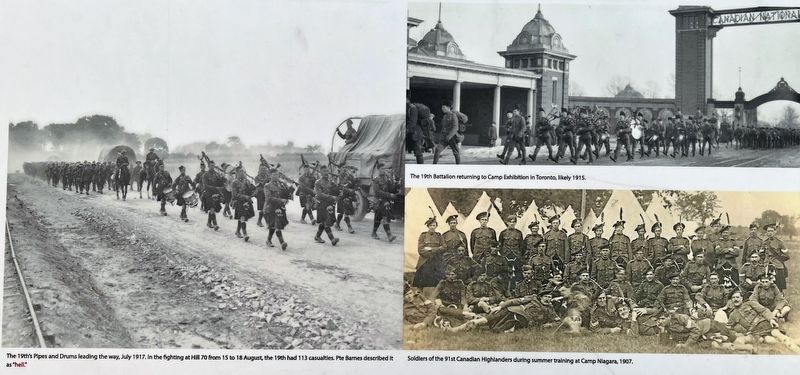
4. The Argyll and Sutherland Highlanders of Canada (Princess Louise’s), 1903-39, photos and captions
Upper centre
Regiment survived the inter-war years, the militia, and funding cuts. It amalgamated with the 3rd Machine Gun Battalion in 1936 to form The Argyll and Sutherland Highlanders of Canada (Princess Louise's) (Machine Gun). The MG suffix was dropped on 1 February 1941. The unit rarely paraded below 400 and benefited from cadres of veterans. It enjoyed a visible civic profile through weekly parades and the activities of three bands (pipes, brass and bugle).
Topics. This historical marker is listed in these topic lists: Military • War, World I. A significant historical date for this entry is February 1, 1941.
Location. 43° 16.288′ N, 79° 52.45′ W. Marker is in Hamilton, Ontario. It is in Central Hamilton. It can be reached from Harbour Front Drive. The marker is in Bayfront Park on the Waterfront Trail, approx. 450 metres from the parking lot at the end of Harbour Front Drive. Touch for map. Marker is in this post office area: Hamilton ON L8R 2Z8, Canada. Touch for directions.
Regionally, this marker is on Ontario’s Golden Horseshoe, in the Hamilton-Halton-Brant Area, and specifically in the Toronto Metropolitan Area. It is also in Central Canada. Globally, it is in North America, the Western Hemisphere, the Western World, and the Anglosphere. Historically, it finds itself in what was once a British colony, the Viceroyalty of New France, the Haudenosaunee (Iroquois) Confederacy, and Rupert’s Land.
6. The Argyll and Sutherland Highlanders of Canada (Princess Louise’s), 1903-39, photos and captions
Lower centre
Credits. This page was last revised on June 17, 2025. It was originally submitted on June 16, 2025, by Tim Boyd of Hamilton, Ontario. This page has been viewed 107 times since then and 14 times this year. Photos:1, 2, 3, 4, 5, 6. submitted on June 16, 2025, by Tim Boyd of Hamilton, Ontario. • Andrew Ruppenstein was the editor who published this page.