Bremen-Mitte in Mitte, Germany — Central Europe
Wilhelm Kaisen
Photographed by Andrew Ruppenstein, May 18, 2025
1. Wilhelm Kaisen Marker

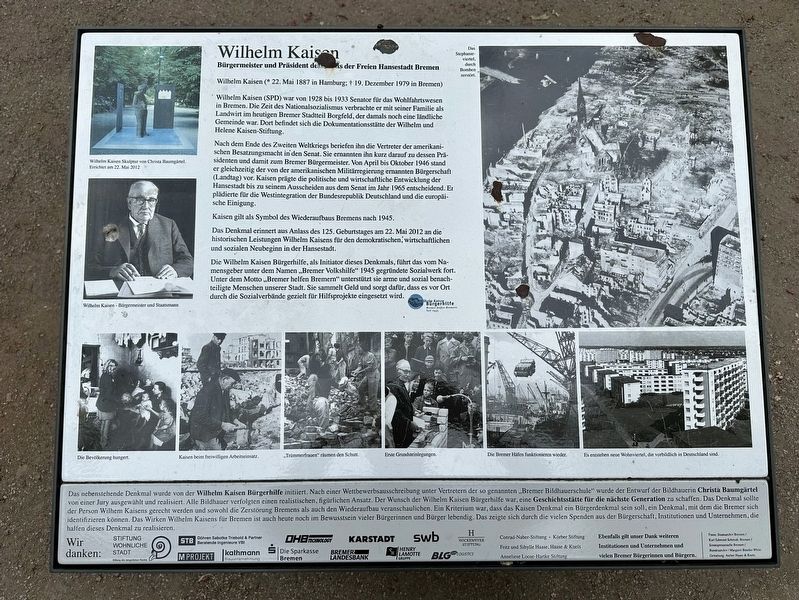
Wilhelm Kaisen (* 22. Mai 1887 in Hamburg; † 19. Dezember 1979 in Bremen)
Wilhelm Kaisen (SPD) war von 1928 bis 1933 Senator für das Wohlfahrtswesen in Bremen. Die Zeit des Nationalsozialismus verbrachte er mit seiner Familie als Landwirt im heutigen Bremer Stadtteil Borgfeld, der damals noch eine ländliche Gemeinde war. Dort befindet sich die Dokumentationsstätte der Wilhelm und Helene Kaisen-Stiftung.
Nach dem Ende des Zweiten Weltkriegs beriefen ihn die Vertreter der amerikanischen Besatzungsmacht in den Senat. Sie ernannten ihn kurz darauf zu dessen Präsidenten und damit zum Bremer Bürgermeister. Von April bis Oktober 1946 stand er gleichzeitig der von der amerikanischen Militärregierung ernannten Bürgerschaft (Landtag) vor. Kaisen prägte die politische und wirtschaftliche Entwicklung der Hansestadt bis zu seinem Ausscheiden aus dem Senat im Jahr 1965 entscheidend. Er plädierte für die Westintegration der Bundesrepublik Deutschland und die europäische Einigung.
Kaisen gilt als Symbol des Wiederaufbaus Bremens nach
this page online
Das Denkmal erinnert aus Anlass des 125. Geburtstages am 22. Mai 2012 an die historischen Leistungen Wilhelm Kaisens für den demokratischen, wirtschaftlichen und sozialen Neubeginn in der Hansestadt.
Die Wilhelm Kaisen Bürgerhilfe, als Initiator dieses Denkmals, führt das vom Namensgeber unter dem Namen „Bremer Volkshilfe“ 1945 gegründete Sozialwerk fort Unter dem Motto „Bremer helfen Bremern“ unterstützt sie arme und sozial benach- teiligte Menschen unserer Stadt. Sie sammelt Geld und sorgt dafür, dass es vor Ort durch die Sozialverbände gezielt für Hilfsprojekte eingesetzt wird.
Das von nebenstehende Denkmal wurde von der Wilhelm Kaisen Bürgerhilfe initiiert. Nach einer Wettbewerbsausschreibung unter Vertretern der so genannten Bremer Bildhauerschule” wurde der Entwurf der Bildhauerin Christa Baumgärtel einer Jury ausgewählt und realisiert. Alle Bildhauer verfolgten einen realistischen, figürlichen Ansatz. Der Wunsch der Wilhelm Kaisen Bürgerhilfe war, eine Geschichtsstätte für die nächste Generation zu schaffen. Das Denkmal sollte der Person Wilhem Kaisens gerecht werden und sowohl die Zerstörung Bremens als auch den Wiederaufbau veranschaulichen. Ein Kriterium war, dass das Kaisen Denkmal ein Bürgerdenkmal sein soll, ein Denkmal, mit dem die Bremer sich identifizieren können. Das Wirken Wilhelm Kaisens für Bremen ist auch heute noch im Bewusstsein vieler Bürgerinnen und Bürger lebendig. Das zeigte sich durch die vielen Spenden aus der Bürgerschaft, Institutionen und Unternehmen, die halfen dieses Denkmal zu realisieren.
(English translation:)
Wilhelm Kaisen, Mayor and President of the Senate of the Free Hanseatic City of Bremen
Wilhelm
Photographed by Andrew Ruppenstein, May 18, 2025
2. Wilhelm Kaisen marker and memorial
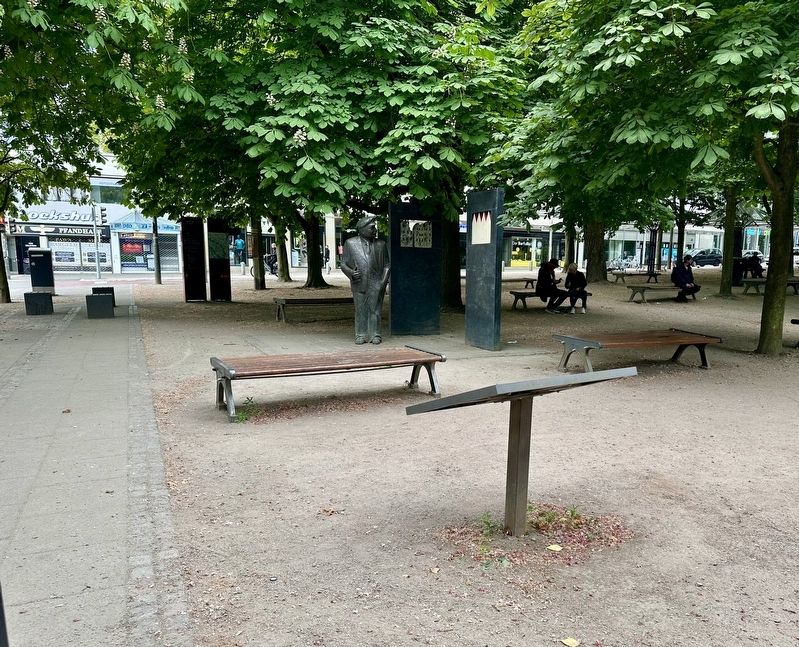
The back of the marker is visible here in the foreground, with the memorial itself visible in the background.
Wilhelm Kaisen (SPD) was Senator for Welfare in Bremen from 1928 to 1933. He spent the Nazi era with his family as a farmer in what is now the Bremen district of Borgfeld, which was then still a rural community. The Wilhelm and Helene Kaisen Foundation's documentation center is located there.
After the end of World War II, representatives of the American occupying forces appointed him to the Senate. Shortly thereafter, they appointed him its President and thus Mayor of Bremen. From April to October 1946, he also headed the state parliament (Landtag) appointed by the American military government. Kaisen played a decisive role in shaping the political and economic development of the Hanseatic city until his retirement from the Senate in 1965. He advocated for the western integration of the Federal Republic of Germany and European unification.
Kaisen is considered a symbol of Bremen's reconstruction after 1945.
The memorial, commemorating Wilhelm Kaisen's 125th birthday on May 22, 2012, commemorates his historic achievements in the democratic, economic,
Photographed by Andrew Ruppenstein, May 18, 2025
3. Wilhelm Kaisen memorial
The Wilhelm Kaisen Citizens' Aid, the initiator of this memorial, continues the social welfare organization founded by the man's namesake in 1945 under the name "Bremer Volkshilfe." Under the motto "Bremers help Bremers," it supports poor and socially disadvantaged people in our city. It collects funds and ensures that they are used specifically for aid projects by local social organizations.
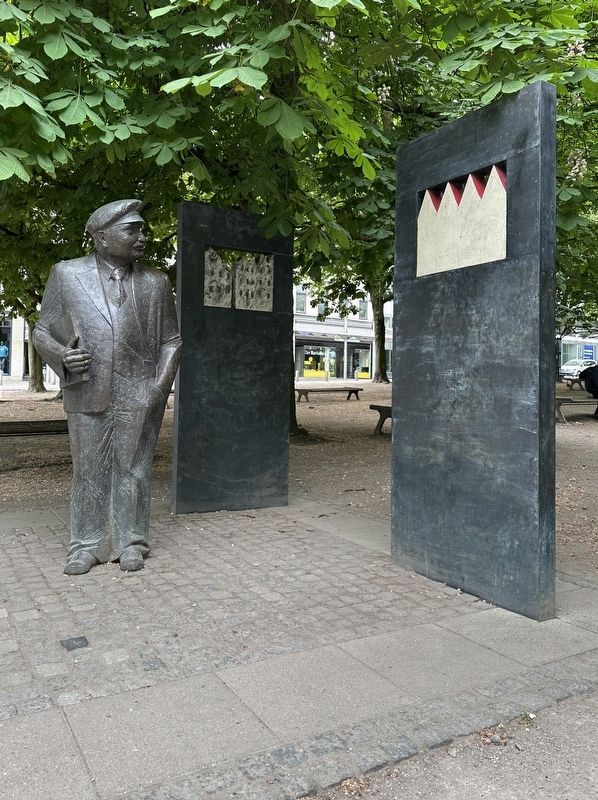
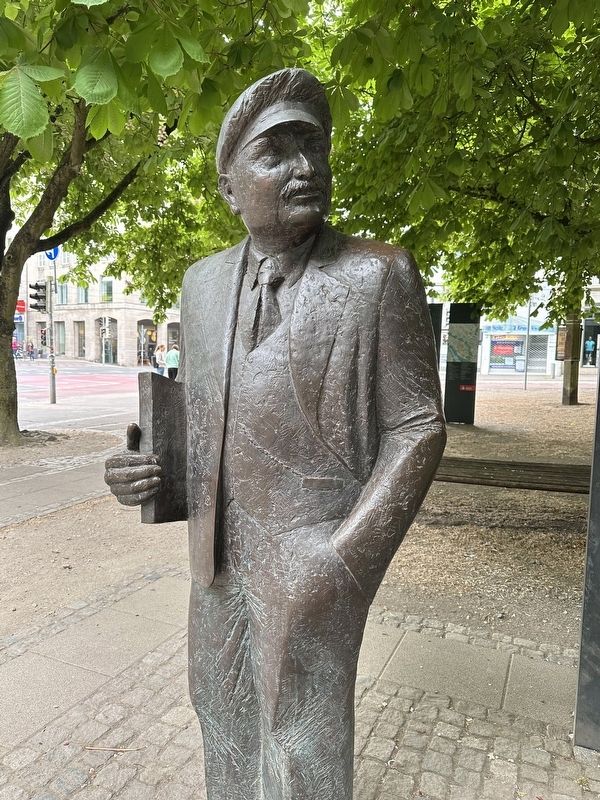
The adjacent memorial here was initiated by the Wilhelm Kaisen Citizens' Aid Association. Following a competition among representatives of the so-called Bremen School of Sculpture, a design by sculptor Christa Baumgärtel was selected by a jury and realized. All sculptors pursued a realistic, figurative approach. The Wilhelm Kaisen Citizens' Aid Association wished to create a historical site for the next generation. The memorial should do justice to the person of Wilhelm Kaisen and illustrate both the destruction of Bremen and its reconstruction. One criterion was that the Kaisen Memorial should be a civic memorial, a memorial with which the people of Bremen can identify. Wilhelm Kaisen's work for Bremen is still alive in the consciousness of many citizens today. This was demonstrated by the many donations from citizens, institutions and companies that helped to realize this memorial.
Topics.
Photographed by Andrew Ruppenstein, May 18, 2025
4. Wilhelm Kaisen statue
Location. 53° 4.754′ N, 8° 48.543′ E. Marker is in Bremen, in Mitte. It is in Bremen-Mitte. It is at the intersection of Herdentor and Am Wall when traveling south on Herdentor. Touch for map. Marker is in this post office area: Bremen 28195, Germany. Touch for directions.

Regionally, it is in Europe, the European Union, Atlantic Europe, Central Europe, the Schengen Area, Western Europe, and the Western World. Historically, it finds itself in what was once the Holy Roman Empire and also the former West Germany.
Other nearby markers. At least 8 other markers are within walking distance of this marker: Geschäftshaus / Commercial Building (within shouting distance of this marker); Hotel am Hillmanplatz (within shouting distance of this marker); Die Sögestrasse / “Sow” Street (about 90 meters away, measured in a direct line); Geschäftshaus / Business and Office Building (about 120 meters away); Salomon Kelman (about 120 meters away); Ronning-Haus (about 120 meters away); Windmühle am Wall / Windmill on the Wall (about 180 meters away); Wallmühle / Wall Mill (about 180 meters away). Touch for a list and map of all markers in Bremen.
Also see . . . Wilhelm Kaisen (Wikipedia). Overview:
Carl Wilhelm Kaisen (22 May 1887 – 19 December 1979) was a German politician from the Social Democratic Party of Germany (SPD) who served as the 2nd President of the Senate and Mayor of Bremen from 1945 to 1965. In 1958/59 he served as the 10th President of the Bundesrat. He became a symbolic figure of the German reconstruction in Bremen after 1945.(Submitted on June 16, 2025.)
Additional keywords. Gedenktafel
Credits. This page was last revised on June 16, 2025. It was originally submitted on June 16, 2025, by Andrew Ruppenstein of Lamorinda, California. This page has been viewed 179 times since then and 64 times this year. Photos: 1, 2, 3, 4. submitted on June 16, 2025, by Andrew Ruppenstein of Lamorinda, California.
