North End West in Hamilton, Ontario — Central Canada (North America)
The Argyll and Sutherland Highlanders (Princess Louise’s), 1940 to the Present

Photographed by Tim Boyd, June 11, 2025
1. The Argyll and Sutherland Highlanders (Princess Louise’s), 1940 to the Present Marker
The Second World War
For Pte James Farrell, an Argyll veteran,
"In the army ... you're automatically a friend, you're one of them... no matter who you are or what you are - colour, creed or anything - you are one of them and that's it."
The Argylls mobilized in June 1940 with little else save First World War uniforms and weapons, and too many people without training. The first months were spent on dreary local guard duty, a time for setting the foundations for excellent administration and transforming civilians into soldiers. In May 1941, the battalion went to Nanaimo, B.C., for tedious months of route marches and inspections. September 1941 to May 1943 brought a sojourn in the sun - garrison duty in Jamaica, where the unit received modern weapons and equipment, improved its cohesion, and rotated its companies through comprehensive training.
The Argylls returned in May 1943, embarking overseas in June. Two months later, they joined the 4th Armoured Division. Overseas, the war diarist noted: "Stalwarts ... of every race, creed and condition have been poured into the melting pot from which is brewed soldiers and Argylls."
this page online
The first major action, Hill 195 on 10 August, was brilliant, unconventional, and successful; Stewart and his Scout Platoon led the four rifle companies single file at night to infiltrate enemy lines and capture the hitherto unassailable strong point, a feat lauded by historians for its "warrior spirit" and Stewart's "outstanding leadership."
Imaginative, daring, and calculating, Stewart devised a night-time infiltration rather than an immediate frontal assault against a backdrop of catastrophic failure. As one veteran put it, "One day is... sufficient to do away with the glamour + glory" - battle was bloody. The day before, a combined force of tanks and infantry attacked Hill 195: the armour lost 47 tanks, 112 men
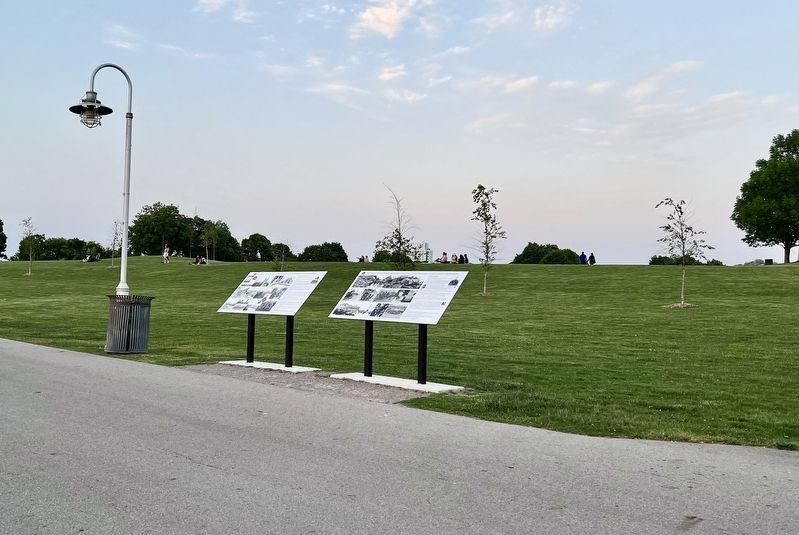
Photographed by Tim Boyd, June 11, 2025
2. The Argyll and Sutherland Highlanders (Princess Louise’s), 1940 to the Present Marker
The marker on the right
Later in the Falaise Gap, two Argyll companies with a squadron of tanks captured St Lambert, holding it for three days against counterattacks. Cpl H. E. Carter wrote, "It's dirty, and fierce and anyone that says they're not scared is crazy."
Losses were inescapable, and casualties were as constant as the need for reinforcements. Through France, Belgium, the Netherlands, and Germany, the Argylls succeeded despite wholesale turnovers. For Capt Sam Chapman, it was a history "bought by blood." Of the approximately 3,300 men who served, there were 288 killed, 808 wounded, 72 taken prisoner, and over 200 injured or left because of illness, for a total of 1,638 (or 41%) of those who served.
The experience was searing, never forgotten, and rarely discussed. Cpl Harry Ruch wrote:
"... the many wet and cold nights and days... without a bath or proper wash for 6 weeks, without shaving for a week or more, without sleep, food and only a quart of water for 72 hours at a time... we lived, ate and slept in trenches ... [saw] our close comrades killed and maimed for life ... our comrades crack and go to pieces, have experienced the sickening smell of death and battle for days, have seen twisted and broken bodies of our own and enemy men... that lay in the open for days... the effect on a man's mind [of]... hearing the cries of his comrades who have been unfortunate ... seeing his men fall ... the bodily weariness... from continually being on the alert.... That is something that ... must be experienced..... In action one has the very close comradeship of men who have submerged all their petty and selfish differences. They are rather out of place amongst the death and destruction of war..... Every day ... men performed what would seem like heroic deeds in civilian life and which were natural and seemed insignificant. Men risked their lives to save a comrade, went out of their way to help others....The old saying 'Eat, Drink, and be Merry as to-morrow you may die' was never truer [than] out there."
As
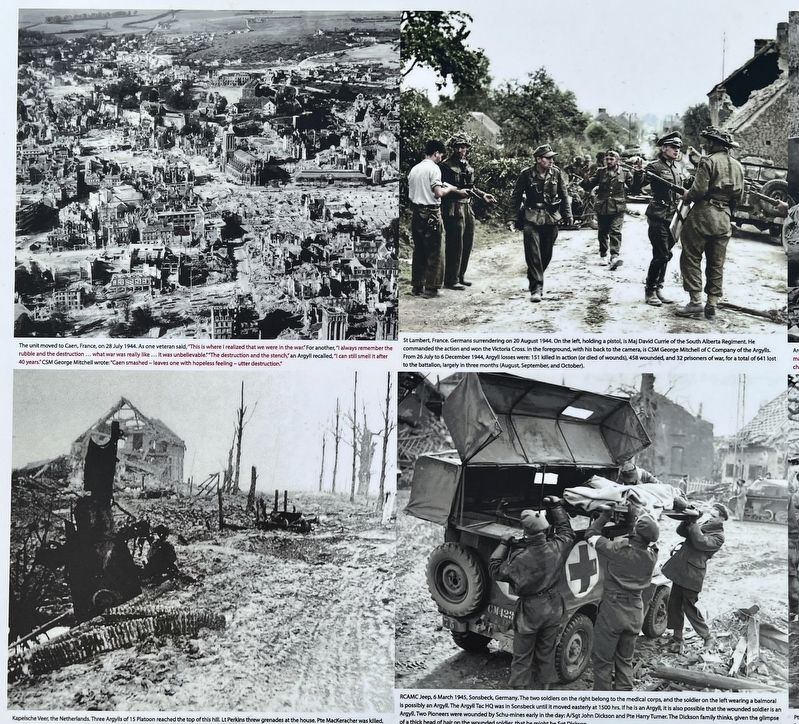
Photographed by Tim Boyd, June 11, 2025
3. The Argyll and Sutherland Highlanders (Princess Louise’s), 1940 to the Present photos and captions
Upper left
Post-war
The Regiment reflects the face of Canada whether combating natural disasters (as 66 Argylls did during the 1998 ice storm) or augmenting UN or NATO deployments. In the 1970s and 1980s, 5 Argylls went to Cyprus and 3 to Germany. From the 1990s, the Regiment's operational role increased dramatically, with 26 deployed to the former Yugoslavia and over 60 to Afghanistan.
On 22 October 2014, Cpl Nathan Cirillo was murdered while standing vigil at the Tomb of the Unknown Soldier in Ottawa.
Argylls served on Ops Unifier (2015-25) in Ukraine - 9; Reassurance in Latvia (2014- ) - 9; and Imapct (2014-25) in the Middle East - 16. They contributed a platoon and headquarters to Lentus (natural disasters); a platoon and headquarters to Laser (Covid-19 pandemic); and headquarters to Provision (settlement of Syrian refugees, 2015-16).
The Argyll tradition is defined by its greatest

Photographed by Tim Boyd, June 11, 2025
4. The Argyll and Sutherland Highlanders (Princess Louise’s), 1940 to the Present, photos and captions
Upper centre
“I figured my battalion was there to save lives, get a job done.”
Topics. This historical marker is listed in these topic lists: Military • War, World II. A significant historical month for this entry is January 1946.
Location. 43° 16.292′ N, 79° 52.449′ W. Marker is in Hamilton, Ontario. It is in North End West. It can be reached from Harbour Front Drive. The marker is in Bayfront Park on the Waterfront Trail, approx. 450 metres from the parking lot on Harbour Front Drive. Touch for map. Marker is in this post office area: Hamilton ON L8L 1C8, Canada. Touch for directions.

Regionally, this marker is on the Golden Horseshoe, in the Hamilton-Halton-Brant Area, and specifically in the Toronto Metropolitan Area. It is also in Central Canada. Globally, it is in North America, on the Great Lakes, in the Western Hemisphere, in the Western World, and in the Anglosphere. Historically, it finds itself in what was once a British colony, the Viceroyalty of New France, the Haudenosaunee (Iroquois) Confederacy, and Rupert’s Land.
Other nearby markers. At least 8 other markers are within walking distance
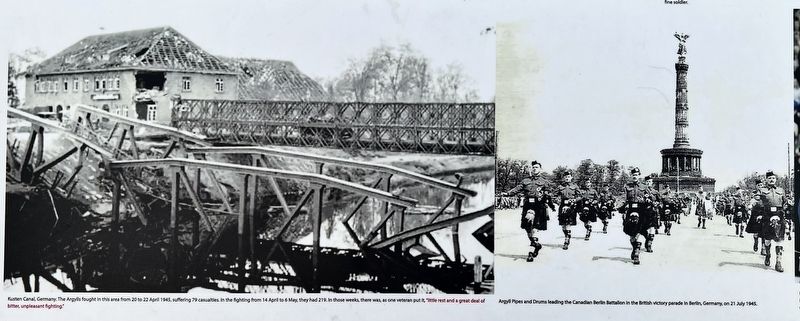
Photographed by Tim Boyd, June 11, 2025
5. The Argyll and Sutherland Highlanders (Princess Louise’s), 1940 to the Present, photos and captions
Lower left

Photographed by Tim Boyd, June 11, 2025
6. The Argyll and Sutherland Highlanders (Princess Louise’s), 1940 to the Present photos and cations
Lower centre
Credits. This page was last revised on June 17, 2025. It was originally submitted on June 16, 2025, by Tim Boyd of Hamilton, Ontario. This page has been viewed 195 times since then and 51 times this year. Photos: 1, 2, 3, 4, 5, 6. submitted on June 16, 2025, by Tim Boyd of Hamilton, Ontario. • Andrew Ruppenstein was the editor who published this page.
