New York Botanical Garden in the Bronx in Bronx County, New York — The American Northeast (Mid-Atlantic)
Hybridizing Lilacs
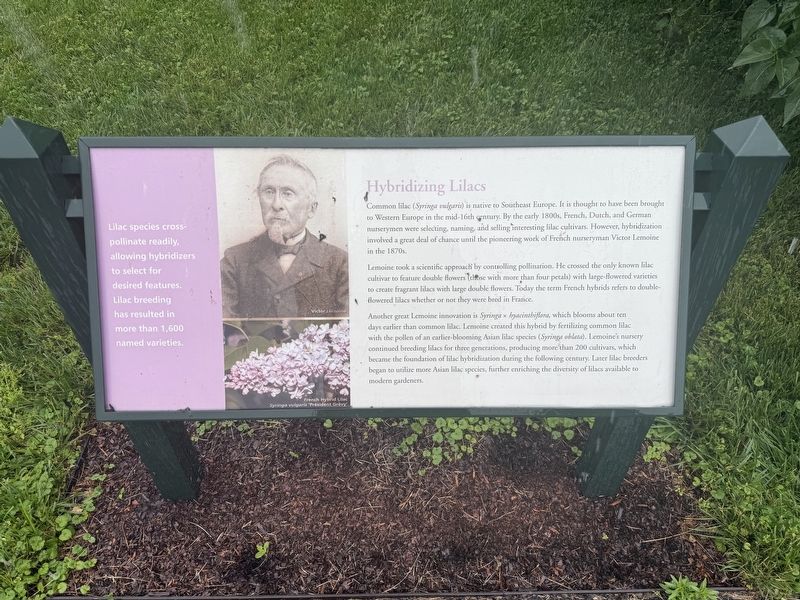
Lilac species cross-pollinate readily, allowing hybridizers to select for desired features. Lilac breeding has resulted in more than 1,600 named varieties.
Common lilac (Syringa vulgaris) is native to Southeast Europe. It is thought to have been brought to Western Europe in the mid-16th century. By the early 1800s, French, Dutch, and German nurserymen were selecting, naming, and selling interesting lilac cultivars. However, hybridization involved a great deal of chance until the pioneering work of French nurseryman Victor Lemoine in the 1870s.
Lemoine took a scientific approach by controlling pollination. He crossed the only known lilac cultivar to feature double flowers (those with more than four petals) with large-flowered varieties to create fragrant lilacs with large double flowers. Today the term French hybrids refers to the double-flowered lilacs whether or not they were bred in France.
Another great Lemoine innovation is Syringa × hyacinthiflora, which blooms about ten days earlier than common lilac. Lemoine created this hybrid by fertilizing common lilac with the pollen of an earlier-blooming Asian lilac
this page online
Erected by New York Botanical Garden.
Topics. This historical marker is listed in this topic list: Horticulture & Forestry.
Location. 40° 51.583′ N, 73° 52.442′ W. Marker is in Bronx, New York, in Bronx County. It is in New York Botanical Garden. It can be reached from the intersection of Southern Boulevard and Xavier Way, on the right when traveling north. Touch for map. Marker is at or near this postal address: 2853 Bronx Park Rd, Bronx NY 10467, United States of America. Touch for directions.

Regionally, this marker is in New York City. It is also in the American Northeast, in the Mid-Atlantic, and on the Eastern Seaboard. Globally, it is in the North Atlantic Region, North America, the Western Hemisphere, the Western World,
Other nearby markers. At least 8 other markers are within walking distance of this marker: Dr. Frank Skinner's Lilacs (here, next to this marker); Lilacs and Climate Study (a few steps from this marker); A World of Lilacs (within shouting distance of this marker); New York Lilacs (within shouting distance of this marker); Restoring a Historic Collection (within shouting distance of this marker); Modern Roses & Their Hybridizers (within shouting distance of this marker); Burn Family Lilac Collection (within shouting distance of this marker); Peggy Rockefeller Rose Garden (within shouting distance of this marker). Touch for a list and map of all markers in Bronx.
Credits. This page was last revised on June 17, 2025. It was originally submitted on June 17, 2025, by Devry Becker Jones of Washington, District of Columbia. This page has been viewed 122 times since then and 21 times this year. Photos: 1, 2. submitted on June 17, 2025, by Devry Becker Jones of Washington, District of Columbia.
