New York Botanical Garden in the Bronx in Bronx County, New York — The American Northeast (Mid-Atlantic)
A World of Lilacs
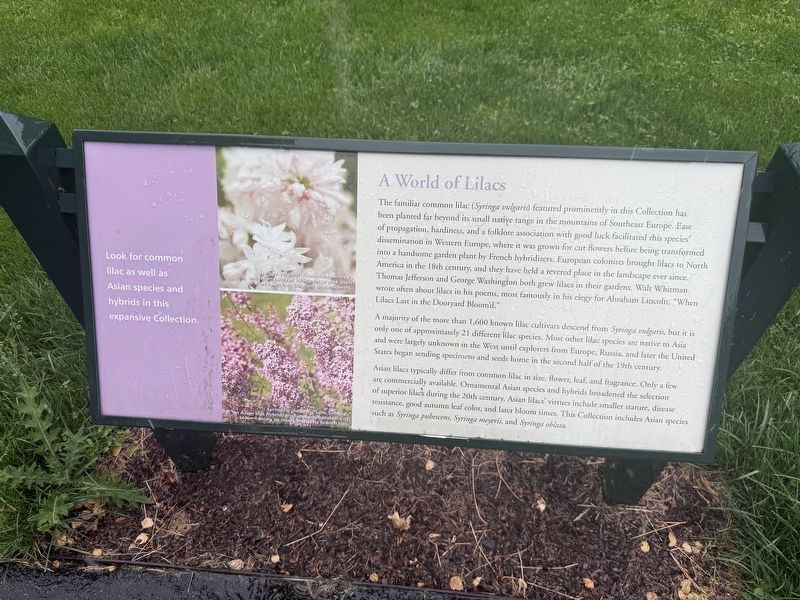
Look for common lilac as well as Asian species and hybrids in this expansive Collection.
The familiar common lilac (Syringa vulgaris) featured prominently in this Collection has been planted far beyond its small native range in the mountains of Southeast Europe. Ease of propagation, hardiness, and a folklore association with good luck facilitated this species dissemination in Western Europe, where it was grown for cut flowers before being transformed into a handsome garden plant by French hybridizers. European colonists brought lilacs to North America in the 18th century, and they have held a revered place in the landscape ever since. Thomas Jefferson and George Washington both grew lilacs in their gardens. Walt Whitman wrote often about lilacs in his poems, most famously in his elegy for Abraham Lincoln "When Lilacs Last in the Dooryard Bloom'd."
A majority of the more than 1,600 known lilac cultivars descend from Syringa vulgaris, but it is only one of approximately 21 different lilac species. Most other lilac species are native to Asia and were largely unknown in the West until explorers from Europe, Russia, and
this page online
Asian lilacs typically differ from common lilac in size, flower, leaf, and fragrance. Only a few are commercially available. Ornamental Asian species and hybrids broadened the selection of superior lilac during the 20th century. Asian lilacs virtues include smaller stature, disease resistance, good autumn leaf color, and later bloom times. This Collection includes Asian species such as Syringa pubescens, Syringa meyerii, and Syringa oblaza.
Erected by New York Botanical Garden.
Topics. This historical marker is listed in this topic list: Horticulture & Forestry.
Location. 40° 51.606′ N, 73° 52.436′ W. Marker is in Bronx, New York, in Bronx County. It is in New York Botanical Garden. It is at the intersection of Southern Boulevard and Xavier Way, on the right when traveling north on Southern Boulevard. Touch for map. Marker is at or near this postal address: 2853 Bronx Park Rd, Bronx NY 10467, United States of America. Touch for directions.

Regionally, this marker is in New York City. It is also in the American Northeast, in the Mid-Atlantic, and on the Eastern Seaboard. Globally, it is in the North Atlantic Region, North America, the Western Hemisphere, the Western World, and the Anglosphere. Historically, it finds itself in what was once New Netherland and also one of the original Thirteen Colonies.
Other nearby markers. At least 8 other markers are within walking distance of this marker: New York Lilacs (here, next to this marker); Dr. Frank Skinner's Lilacs (within shouting distance of this marker); Syringa vulgaris 'Sensation' (within shouting distance of this marker); Burns Family Lilac Collection (within shouting distance of this marker); Hybridizing Lilacs (within shouting distance of this marker); Lilacs and Climate Study (within shouting distance of this marker); T. A. Havemeyer's Lilacs (within shouting distance of this marker); a different marker also named Burns Family Lilac Collection (within shouting distance of this marker). Touch for a list and map of all markers in Bronx.
Credits. This page was last revised on June 17, 2025. It was originally submitted on June 17, 2025, by Devry Becker Jones of Washington, District of Columbia. This page has been viewed 118 times since then and 12 times this year. Photo 1. submitted on June 17, 2025, by Devry Becker Jones of Washington, District of Columbia.
