Fordham Manor in the Bronx in Bronx County, New York — The American Northeast (Mid-Atlantic)
Poe Park
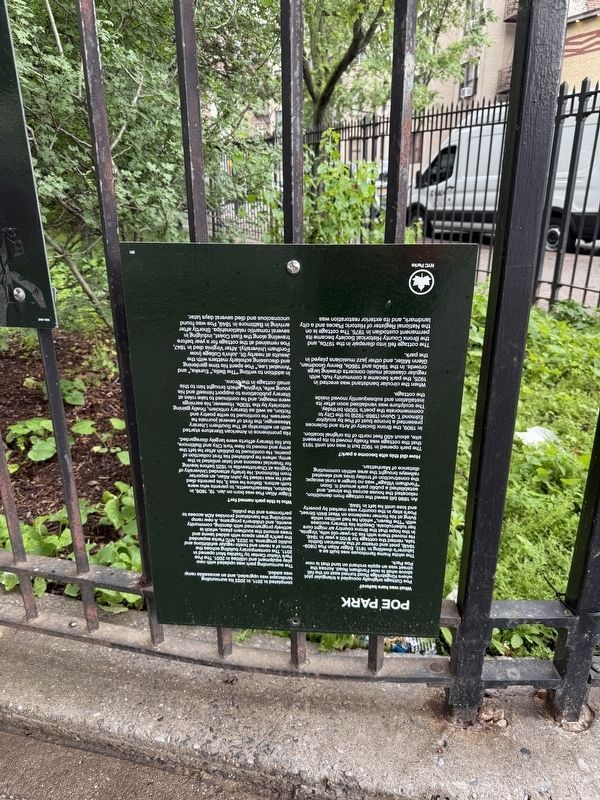
Photographed by Devry Becker Jones (CC0), June 7, 2025
1. Poe Park Marker
Unfortunately, the marker has become partially unfastened from the fencing and was upside down when it was photographed.
What was here before?
Poe Cottage originally occupied a triangular plot where Kingsbridge Road turned east on the hill above what is now Fordham Road. Across the street was an apple orchard on land that is now Poe Park.
The white frame farmhouse was built as a laborer's dwelling in 1812. Edgar Allan Poe (1809-1849), poet and creator of the American Gothic tale, rented the cottage for $100 a year in 1846. He moved there with his 24-year-old wife, Virginia in the hope that the Bronx country air might cure her tuberculosis. Despite his literary success with "The Raven," which he had written while living at his former residence on West 84th Street, Poe's stay in the country was marked by poverty and loss until he left in 1849.
An 1896 bill saved the cottage from demolition, relocated the house across the street, and established a public park around it. Soon "Fordham Village" was no longer a rural escape; the construction of trolley lines and elevated railways brought the area within commuting distance of Manhattan.
How did this site become a park?
The park opened in 1902 but it was not until 1913 that the cottage
this page online
In 1909, the Bronx Society of Arts and Sciences presented a bronze bust of Poe by sculptor Edmond T. Quinn (1868-1929) to the city to commemorate the poet's 100th birthday. The sculpture was vandalized soon after its installation and subsequently moved inside the cottage.
When the circular bandstand was erected in 1925, the park became a community hub, with regular classical music concerts drawing large crowds. In the 1940s and 1950s, Benny Goodman, Glenn Miller, and other jazz musicians played in the park.
The cottage fell into disrepair in the 1970s, and the Bronx County Historical Society became its permanent custodian in 1975. The cottage is on the National Register of Historic Places and a city landmark, and its exterior restoration was completed in 2011. In 2022 it surrounding landscape was upgrade, and an accessible ramp was added.
The surrounding park was updated with new play equipment and utilities in 2001. The Poe Park Visitor Center by Toshiko Mori opened in 2011. The contemporary building echoes the form of a raven and hosts

Who is this park named for?
Edgar Allan Poe was born on Jan. 19, 1809, in Boston, Massachusetts, to parents who were both actors. Before he was 3, his parents died and he was raised by John Allan, an exporter from Richmond. He briefly attended University of Virginia at Charlottesville in 1825 before leaving for financial reasons and later enlisted in the army, where he published his first collection of poems. He continued to publish after he left the army and moved to New York City and Baltimore, but his literary efforts were largely disregarded.
His prominence in American literature started with an editorship at The Southern Literary Messenger, the first of several journals he oversaw. He continued to write poetry and fiction, as well as literary criticism, finally gaining notoriety by the 1830s. However, his earnings were meager, and he continued to take roles at literary publications to support himself and his young wife, Virginia, which brought him to this small cottage in the Bronx.
In addition to writing "The Bells," Eureka," and "Annabel Lee," Poe spent his time gardening and discussing scholarly matters with the Jesuits at nearby St. John's College (now Fordham University). After Virginia died in 1847, Poe remained at the cottage for a year before traveling along the East Coast, indulging in several romantic relationships. Shortly after arriving in Baltimore in 1849, Poe was found unconscious and died several days later.
Erected by NYC Parks. (Marker Number 301.)
Topics and series. This historical marker is listed in these topic lists: Arts, Letters, Music • Communications • Patriots & Patriotism. In addition, it is included in the NYC Parks series list. A significant historical date for this entry is January 19, 1809.
Location. 40° 51.853′ N, 73° 53.72′ W. Marker has been reported damaged. Marker is in Bronx, New York, in Bronx County. It is in Fordham Manor. It is at the intersection of Grand Concourse and East 192nd Street, on the right when traveling north on Grand Concourse. Touch for map. Marker is at or near this postal address: 200 Grand Concourse, Bronx NY 10458, United States of America. Touch for directions.

Regionally, this marker is in New York City. It is also in the American Northeast, in the Mid-Atlantic, and on the Eastern Seaboard. Globally, it is in the North Atlantic Region, North America, the Western Hemisphere, the Western World, and the Anglosphere. Historically, it finds itself in what was once New Netherland and also one of the original Thirteen Colonies.
Other nearby markers. At least 8 other markers are within walking distance of this location: Edgar Allan Poe Cottage (about 500 feet away, measured in a direct line); a different marker also named Edgar Allan Poe Cottage (about 500 feet away); Bronx Land Trust (about 800 feet away); Bryan Park (about 800 feet away); a different marker also named Bryan Park (approx. 0.2 miles away); Rose Hill Park (approx. 0.3 miles away); World War I Memorial (approx. 0.3 miles away); Old Croton Aqueduct Trail (approx. half a mile away). Touch for a list and map of all markers in Bronx.
Credits. This page was last revised on June 17, 2025. It was originally submitted on June 17, 2025, by Devry Becker Jones of Washington, District of Columbia. This page has been viewed 180 times since then and 36 times this year. Photos: 1, 2. submitted on June 17, 2025, by Devry Becker Jones of Washington, District of Columbia.
