Sugar House in Salt Lake City in Salt Lake County, Utah — The American Mountains (Southwest)
History of the Brickyard
⎯⎯⎯
Edward Potter Hemsley
Photographed by Jeremy Snow, June 17, 2025
1. History of the Brickyard Marker
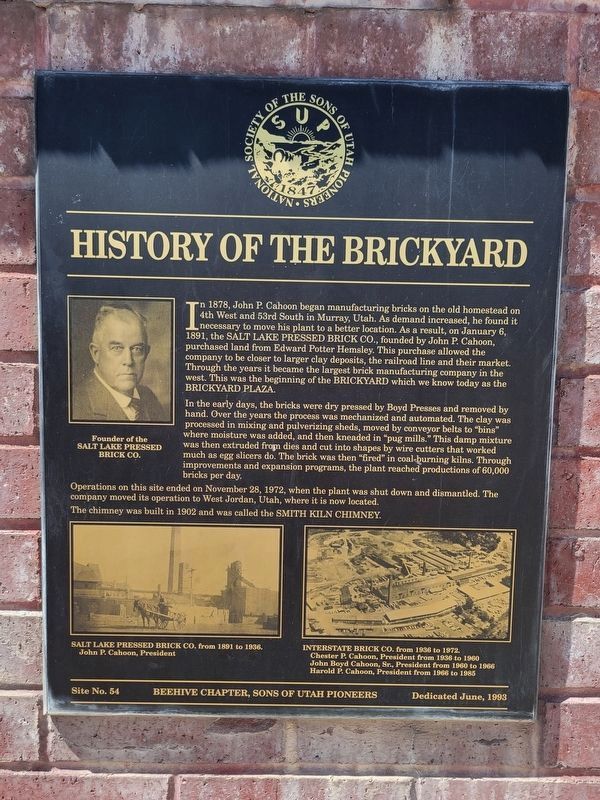
History of the Brickyard
In 1878, John P. Cahoon began manufacturing bricks on the old homestead on 4th West and 53rd South in Murray, Utah. As demand increased, he found it necessary to move his plant to a better location. As a result, on January 6, 1891, the Salt Lake Pressed Brick Co., founded by John P. Cahoon, purchased land from Edward Potter Hemsley. This purchase allowed the company to be closer to larger clay deposits, the railroad line and their market. Through the years it became the largest brick manufacturing company in the west. This was the beginning of the Brickyard which we know today as the Brickyard Plaza.
In the early days, the bricks were dry pressed by Boyd Presses and removed by hand. Over the years the process was mechanized and automated. The clay was processed in mixing and pulverizing sheds, moved by conveyor belts to "bins" where moisture was added, and then kneaded in "pug mills." This damp mixture was then extruded from dies and cut into shapes by wire cutters that worked much as egg slicers do. The brick was then "fired" in coal-burning kilns. Through improvements and expansion programs,
this page online
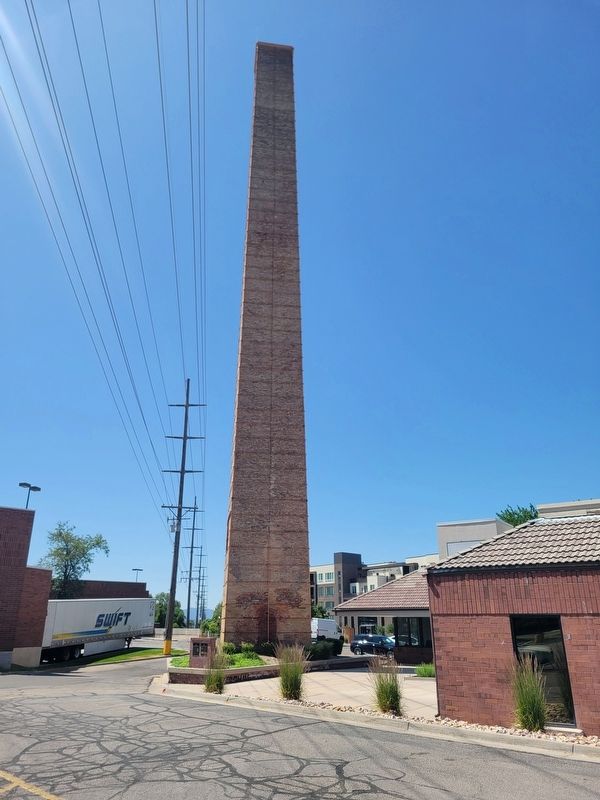
Operations on this site ended on November 28, 1972, when the plant was shut down and dismantled. The company moved its operation to West Jordan, Utah, where it is now located. The chimney was built in 1902 and was called the Smith Kiln Chimney.
(Captions)
Founder of the Salt Lake Pressed Brick Co.
Salt Lake Pressed Brick Co. from 1891 to 1936.
John P. Cahoon, President
Interstate Brick Co. from 1930 to 1972.
Chester P. Cahoon, President from 1936 to 1960
John Boyd Cahoon, Sr, President from 1960 to 1966
Harold P. Cahoon, President from 1966 to 1985
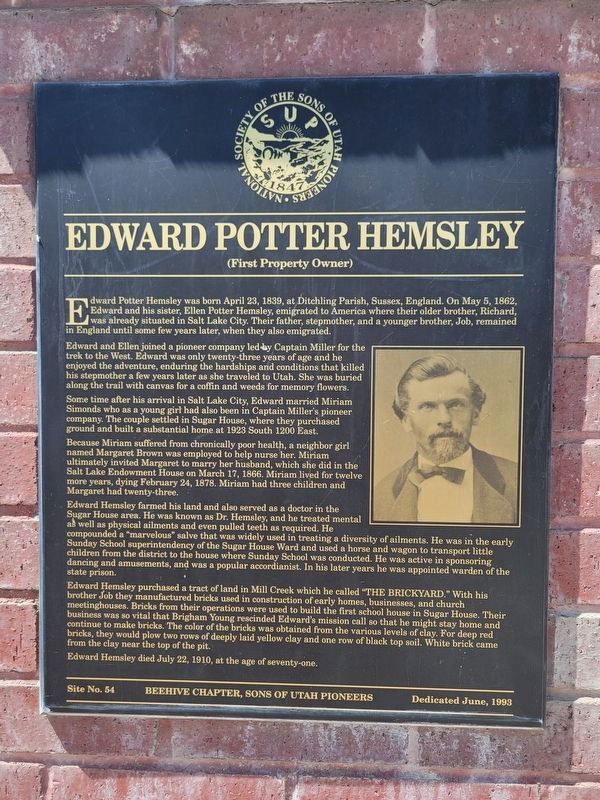
Edward Potter Hemsley
(First Property Owner)
Edward Potter Hemsley was born April 23, 1839, at Ditchling Parish, Sussex, England. On May 5, 1862, Edward and his sister, Ellen Potter Hemsley, emigrated to America where their older brother, Richard, was already situated in Salt Lake City. Their father, stepmother, and a younger brother, Job, remained in England until some few years later, when they also emigrated.
Edward and Ellen joined a pioneer company led by Captain Miller for the trek to the West. Edward
Photographed by Jeremy Snow, June 17, 2025
2. Edward Potter Hemsley Marker
Some time after his arrival in Salt Lake City, Edward married Miriam Simonds who as a young girl had also been in Captain Miller's pioneer company. The couple settled in Sugar House, where they purchased ground and built a substantial home at 1923 South 1200 East.
Because Miriam suffered from chronically poor health, a neighbor girl named Margaret Brown was employed to help nurse her. Miriam ultimately invited Margaret to marry her husband, which she did in the Salt Lake Endowment House on March 17, 1866. Miriam lived for twelve more years, dying February 24, 1878. Miriam had three children and Margaret had twenty-three.
Edward Hemsley farmed his land and also served as a doctor in the Sugar House area. He was known as Dr. Hemsley, and he treated mental as well as physical ailments and even pulled teeth as required. He compounded a "marvelous” salve that was widely used
Photographed by Jeremy Snow, June 17, 2025
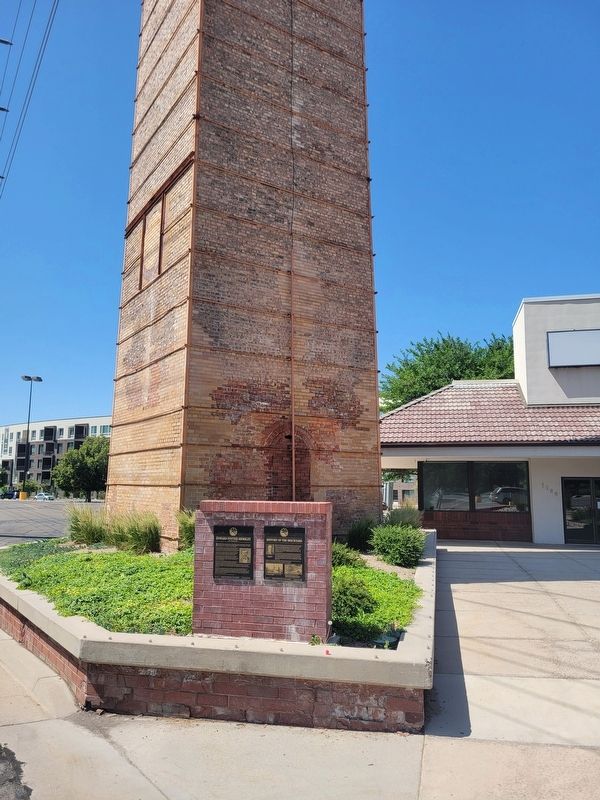
3. History of the Brickyard/Edward Potter Hemsley Marker
Edward Hemsley purchased a tract of land in Mill Creek which he called "The Brickyard.” With his brother Job they manufactured bricks used in construction of early homes, businesses, and church meetinghouses. Bricks from their operations were used to build the first school house in Sugar House. Their business was so vital that Brigham Young rescinded Edward's mission call so that he might stay home and continue to make bricks. The color of the bricks was obtained from the various levels of clay. For deep red bricks, they would plow two rows of deeply laid yellow clay and one row of black top soil. White brick came from the clay near the top of the pit.
Edward Hemsley died July 22, 1910, at the age of seventy-one.
Erected 1993 by Sons of Utah Pioneers.
Photographed by Jeremy Snow, June 17, 2025
4. Brickyard Smokestack
Topics. This historical marker is listed in these topic lists: Industry & Commerce • Settlements & Settlers. A significant historical date for this entry is January 6, 1891.
Location. 40° 42.204′ N, 111° 51.595′ W. Marker is in Salt Lake City, Utah, in Salt Lake County. It is in Sugar House. It can be reached from Brickyard Road. Touch for map. Marker is at or near this postal address: 1166 Brickyard Road, Salt Lake City UT 84106, United States of America. Touch for directions.

Regionally, this marker is in the Wasatch Front and in Greater Salt Lake. It is also in the American Mountain West and on the Colorado Plateau. Globally, it is in North America, the Rocky Mountains, the Western Hemisphere, the Western World, and the Anglosphere. Historically, it finds itself in what was once New Spain and also Mexico’s Alta California.
Other nearby markers. At least 8 other markers are within 2 miles of this marker, measured as the crow flies: Calder's Park (approx. ¾ mile away); Archibald's Garage (approx. 0.9 miles away); Robert Gardner Jr. House and Mill Site / Gardner Home and Mill Site (approx. 0.9 miles away); Gardner's Saw Mill (approx. 0.9 miles away); Historic Home of Robert Gardner, Jr. 1819-1906 (approx. 0.9 miles away); Historic Gardner Saw Mill Site (approx. 0.9 miles away); St. Mark’s/Westminster School of Nursing (approx. 1.2 miles away); The Old Sugar House (approx. 1½ miles away). Touch for a list and map of all markers in Salt Lake City.
Credits. This page was last revised on June 18, 2025. It was originally submitted on June 17, 2025, by Jeremy Snow of Cedar City, Utah. This page has been viewed 391 times since then and 148 times this year. Photos: 1, 2, 3, 4. submitted on June 17, 2025, by Jeremy Snow of Cedar City, Utah. • Andrew Ruppenstein was the editor who published this page.
