Apalachicola in Franklin County, Florida — The American South (South Atlantic)
The Historic Orman Building
| — | Apalachicola Historic Walking Tour | — |
Photographed by Brandon D Cross, June 17, 2025
1. The Historic Orman Building Marker
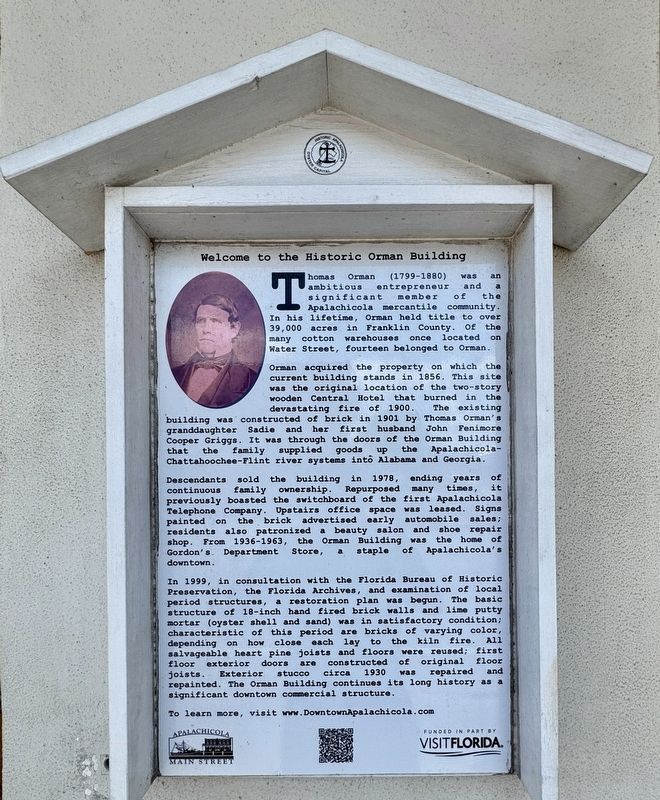
Orman acquired the property on which the current building stands in 1856. This site was the original location of the two-story wooden Central Hotel that burned in the devastating fire of 1900. The existing Orman acquired the property on which the current building stands in 1856. This site was the original location of the two-story wooden Central Hotel that burned in the devastating fire of 1900. The existing building was constructed of brick in 1901 by Thomas Orman's granddaughter Sadie and her first husband John Fenimore Cooper Griggs. It was through the doors of the Orman Building that the family supplied goods up the Apalachicola-Chattahoochee-Flint river systems into Alabama and Georgia.
Descendants sold the building in 1978, ending years of continuous family ownership. Repurposed many times, it previously boasted the switchboard of
this page online
In 1999, in consultation with the Florida Bureau of Historic Preservation, the Florida Archives, and examination of local period structures, a restoration plan was begun. The basic structure of 18-inch hand fired brick walls and lime putty mortar (oyster shell and sand) was in satisfactory condition; characteristic of this period are bricks of varying color, depending on how close each lay to the kiln fire. All salvageable heart pine joists and floors were reused; first floor exterior doors are constructed of original floor joists. Exterior stucco circa 1930 was repaired and repainted. The Orman Building continues its long history as a significant downtown commercial structure.
To learn more, visit www.DowntownApalachicola.com
Erected by Apalachicola Main Street and VisitFlorida.
Topics. This historical

Photographed by Brandon D Cross, June 17, 2025
2. The Historic Orman Building Marker
Location. 29° 43.629′ N, 84° 59.016′ W. Marker is in Apalachicola, Florida, in Franklin County. It is at the intersection of Avenue D and Market Street, on the right when traveling north on Avenue D. Touch for map. Marker is at or near this postal address: 32 Avenue D, Apalachicola FL 32320, United States of America. Touch for directions.

Regionally, this marker is on the Florida Panhandle. It is also in the American South, specifically in the Deep South, and on the Gulf Coast. Globally, it is in the North Atlantic Region, North America, a Gulf of Mexico state, the Western Hemisphere, the Western World, and the Anglosphere. Historically, it finds itself in what was once New Spain, the territory of the Mississippian Culture, one of the Confederate States of America, and the Antebellum South.
Other nearby markers. At least 8 other markers are within walking distance of this marker: The Cook Building (a few steps from this marker); Apalachicola Post Office and Customs House (within shouting distance of this marker);

Photographed by Brandon D Cross, June 17, 2025
3. The Historic Orman Building
Also see . . . Walking Tour - Apalachicola Site of Interest. (Submitted on June 18, 2025, by Brandon D Cross of Flagler Beach, Florida.)
Credits. This page was last revised on March 27, 2026. It was originally submitted on June 18, 2025, by Brandon D Cross of Flagler Beach, Florida. This page has been viewed 179 times since then and 60 times this year. Photos: 1, 2, 3. submitted on June 18, 2025, by Brandon D Cross of Flagler Beach, Florida. • Bernard Fisher was the editor who published this page.
