
Falaise in Calvados, Normandy, France — Western Europe
L’Opération Overlord
⎯⎯⎯
Operation Overlord
Photographed by James Hulse, June 2, 2025
1. L’Opération Overlord / Operation Overlord Marker

De l’Occupation à la Libération, Mémoires du Pays de Falaise
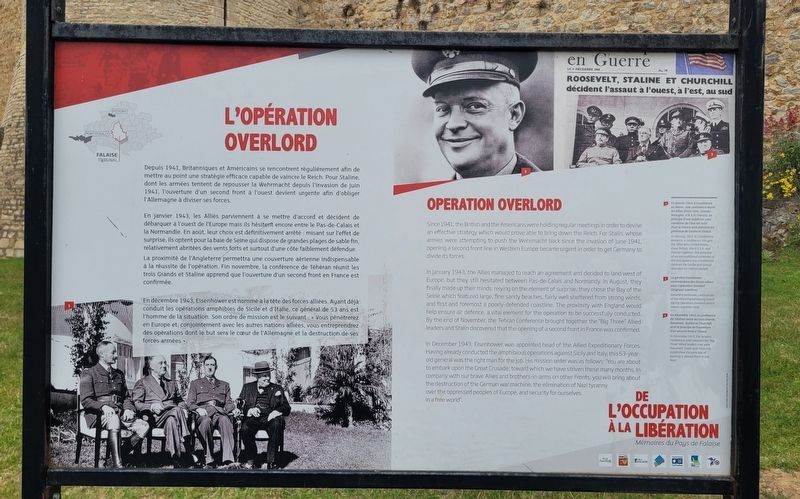
Depuis 1941, Britanniques et Américains se rencontrent régulièrement afin de mettre au point une stratégie efficace capable de vaincre le Reich. Pour Staline, dont les armées tentent de repousser la Wehrmacht depuis l'invasion de juin 1941, l'ouverture d'un second front à l'ouest devient urgente afin d'obliger l'Allemagne à diviser ses forces.
En janvier 1943, les Alliés parviennent à se mettre d'accord et décident de débarquer à l'ouest de l'Europe mais ils hésitent encore entre le Pas-de-Calais et la Normandie. En août, leur choix est définitivement arrêté: misant sur l'effet de surprise, ils optent pour la baie de Seine qui dispose de grandes plages de sable fin, relativement abritées des vents forts et surtout d'une côte faiblement défendue.
La proximité de l'Angleterre permettra une couverture aérienne indispensable à la réussite de l'opération. Fin novembre, la conférence de Téhéran réunit les trois Grands et Staline apprend que l'ouverture d'un second front en France est confirmée.
En décembre 1943, Eisenhower est nommé à la tête des forces alliées. Ayant déjà conduit les opérations amphibies de Sicile et d'Italie, ce général de 53 ans est l'homme de la situation. Son ordre de mission est le suivant : «Vous pénétrerez en Europe et, conjointement avec les autres nations alliées, vous entreprendrez des opérations dont le but sera le cœur de l'Allemagne et la destruction de ses forces armées».
Légendes
(Photo #1) En janvier 1943, à Casablanca au Maroc, une conférence réunit les Alliés (Etats-Unis, Grande-Bretagne, U.R.S.S.; France). Le principe d'une reddition sans condition de l'Axe est acté. Pour la France sont présents les généraux de Gaulle et Giraud.
(Photo #2) Le général Eisenhower, commandant des forces alliées pour l'opération Overlord (Seigneur suprême)
(Photo #3) En décembre 1943, la conférence de Téhéran entre les trois Grands, Roosevelt, Staline et Churchill, acte le principe de l'ouverture d'un second front à l'Ouest.
From Occupation to Liberation, Memories of the Falaise Region
Since 1941, the British and the Americans were holding regular meetings in order to devise an effective strategy which would prove able to bring down the Reich. For Stalin, whose armies were attempting to push the Wehrmacht back since the invasion of June 1941, opening a second front line in Western Europe became urgent in order to get Germany to divide its forces.
In January 1943, the Allies managed to reach an agreement and decided to land west of Europe, but they still hesitated between Pas-de-Calais and Normandy. In August, they finally made up their minds: relying on the element of surprise, they chose the Bay of the Seine which featured large, fine sandy beaches, fairly well sheltered from strong winds, and first and foremost a poorly-defended coastline. The proximity with England would help ensure air defence, a vital element for the operation to be successfully conducted. By the end of November, the Tehran Conference brought together the "Big Three" Allied leaders and Stalin discovered that the opening of a second front in France was confirmed.
In December 1943, Eisenhower was appointed head of the Allied Expeditionary Forces. Having already conducted the amphibious operations against Sicily and Italy, this 53-year-old general was the right man for the job. His mission order was as follows: "You are about to embark upon the Great Crusade, toward which we have striven these many months. In company with our brave Allies and brothers-in-arms on other Fronts, you will bring about the destruction of the German war machine, the elimination of Nazi tyranny over the oppressed peoples of Europe, and security for ourselves in a free world".
Captions
(Photo #1) In January 1943, in Casablanca, Morocco, a conference brought the Allies (the United States, Great Britain, the U.S.S.R. and France) together. The principle of an unconditional surrender of the Axis powers was established. Generals De Gaulle and Giraud attended on France's behalf.
(Photo #2) General Eisenhower, commander of the Allied Expeditionary Forces during Operation Overlord (which means supreme Lord).
(Photo #3) In December 1943, the Teheran Conference held between the "Big Three" Allied leaders that were Roosevelt, Stalin and Churchill, established the principle of opening a second front in the West.
Erected by Mairie
this page online
Topics. This historical marker is listed in this topic list: War, World II. A significant historical month for this entry is January 1943.
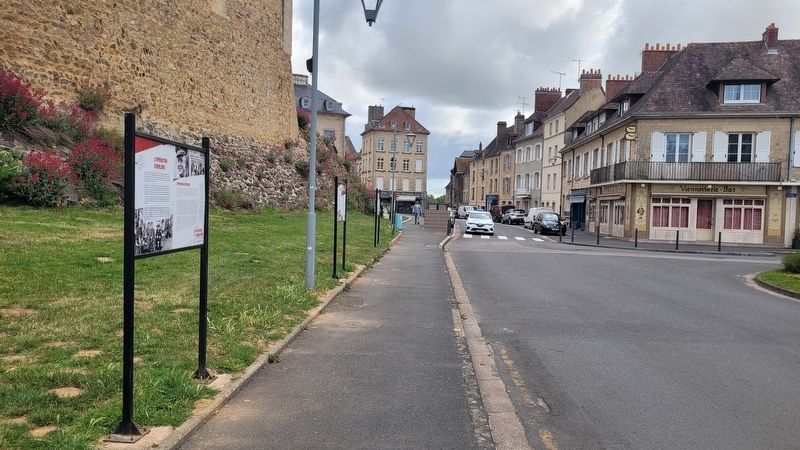
Location. 48° 53.575′ N, 0° 12.148′ W. Marker is in Falaise, Normandie (Normandy), in Calvados. It is at the intersection of Rue de la Porte du Château and Route D511, on the right when traveling west on Rue de la Porte du Château. The marker is located on the south side of the Château Guillaume-le-Conquérant near the parking lot. Touch for map. Marker is in this post office area: Falaise, Normandie 14700, France. Touch for directions.

Regionally, it is in the North Atlantic Region, Europe, the European Union, Atlantic Europe, the Schengen Area, Western Europe, a coastal Mediterranean country, and the Western World. Historically, it finds itself in what was once a French colony and also the Roman Empire.
Other nearby markers. At least 8 other markers are within walking distance of this marker: Falaise sous la botte allemande / Falaise under the German boot (here, next to this marker);
Photographed by James Hulse, June 2, 2025
2. L’Opération Overlord / Operation Overlord Marker
Also see . . . Operation Overlord. Wikipedia
Operation Overlord was the codename for the Battle of Normandy, the Allied operation that launched the successful liberation of German-occupied Western Europe during World War II. The operation was launched on 6 June 1944 (D-Day) with the Normandy landings (Operation Neptune). A 1,200-plane airborne assault preceded an amphibious assault involving more than 5,000 vessels. Nearly 160,000 troops crossed the English Channel on 6 June, and more than two million Allied troops were in France by the end of August.(Submitted on June 19, 2025, by James Hulse of Medina, Texas.)
Credits. This page was last revised on June 19, 2025. It was originally submitted on June 19, 2025, by James Hulse of Medina, Texas. This page has been viewed 120 times since then and 24 times this year. Photos: 1, 2. submitted on June 19, 2025, by James Hulse of Medina, Texas.
