Piqua in Miami County, Ohio — The American Midwest (Great Lakes)
Fort Piqua Plaza
Sign of the Past
Photographed by Craig Doda, June 7, 2025
1. Fort Piqua Plaza Marker
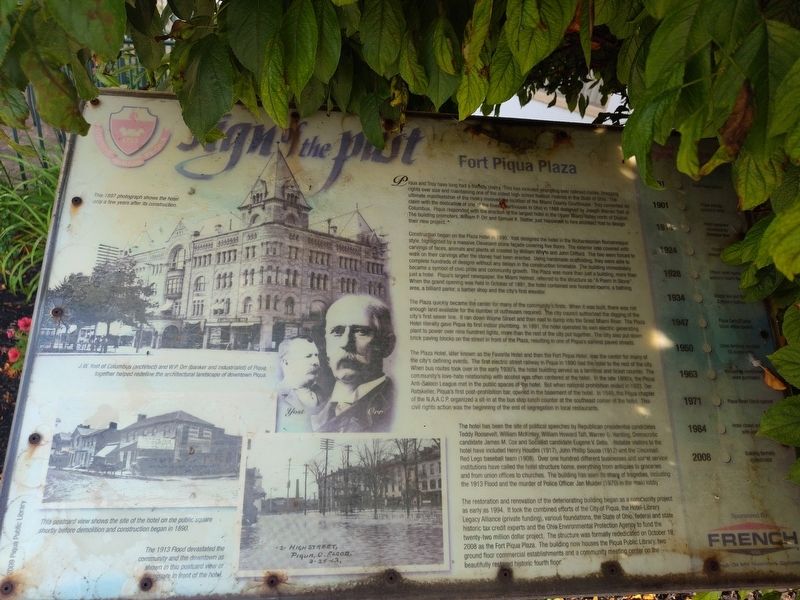
Construction began on the Plaza Hotel in 1890. Yost designed the hotel in the Richardsonian Romanesque style, highlighted by a massive Cleveland stone facade covering five floors. The exterior was covered with carvings of faces, animals and plants all created by William Whyte and John Clifford. The two were forced to work on their carvings after the stones had been erected. Using handmade scaffolding, they were able to complete hundreds of designs without any delays
this page online
The Plaza quickly became the center for many of the community's firsts. When it was built, there was not enough land available for the number of outhouses required. The city council authorized the digging of the city's first sewer line. It ran down Wayne Street and then east to dump into the Great Miami River. The Plaza Hotel literally gave Piqua its first indoor plumbing. In 1891, the hotel operated its own electric generating plant to power over nine hundred lights, more than the rest of the city put together, The city also put down brick paving blocks on the street in front of the Plaza, resulting in one of Piqua's earliest paved streets.
The Plaza Hotel, later known as the Favorite Hotel and then
Photographed by Craig Doda, June 7, 2025
2. Fort Piqua Plaza Marker
The hotel has been the site of political speeches by Republican presidential candidates Teddy Roosevelt, William McKinley, William Howard Taft, Warren G. Harding, Democratic candidate James M. Cox and Socialist candidate Eugene V. Debs. Notable visitors to the hotel have included Henry Houdini (1917), John Phillip Sousa (1912) and the Cincinnati
Photographed by Craig Doda, June 7, 2025
3. Fort Piqua Plaza Marker
The restoration and renovation of the deteriorating building began as a community project as early as 1994. It took the combined efforts of the City of Piqua, the Hotel-Library Legacy Alliance (private funding), various foundations, the State of Ohio, federal and state. historic tax credit experts and the Ohio Environmental Protection Agency to fund the twenty-two million dollar project. The structure was formally rededicated on October 19, 2008 as the Fort Piqua Plaza. The building now houses the Piqua Public Library, two ground floor commercial establishments and a community meeting center on the beautifully restored historic fourth floor.
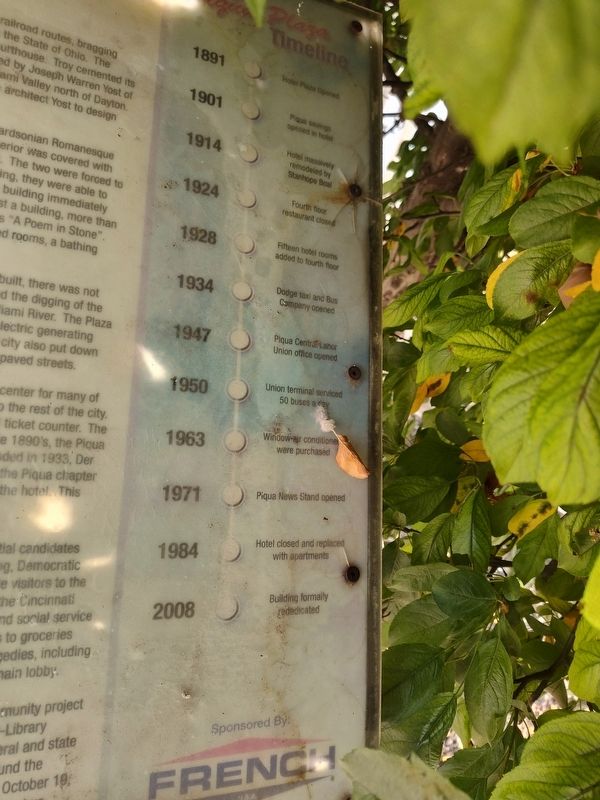
Fort Piqua Plaza Timeline
1891 Hotel Plaza Opened
1901 Piqua savings opened in hotel
1914 Hotel massively remodeled by Stanhope Boat
1924 Fourth floor restaurant closed
1928 Fifteen hotel rooms added to fourth floor
1934 Dodge taxi and Bus Company opened
1947 Piqua Central Labor Union office opened
1950 Union terminal serviced 50 buses a day
1963 Window air conditioner were purchased
1971 Piqua News Stand opened
1984 Hotel closed and replaced with apartments
2008 Building formally rededicated
Topics. This historical marker is listed in these topic lists: Industry & Commerce • Settlements & Settlers. A significant historical month for this entry is October 1891.
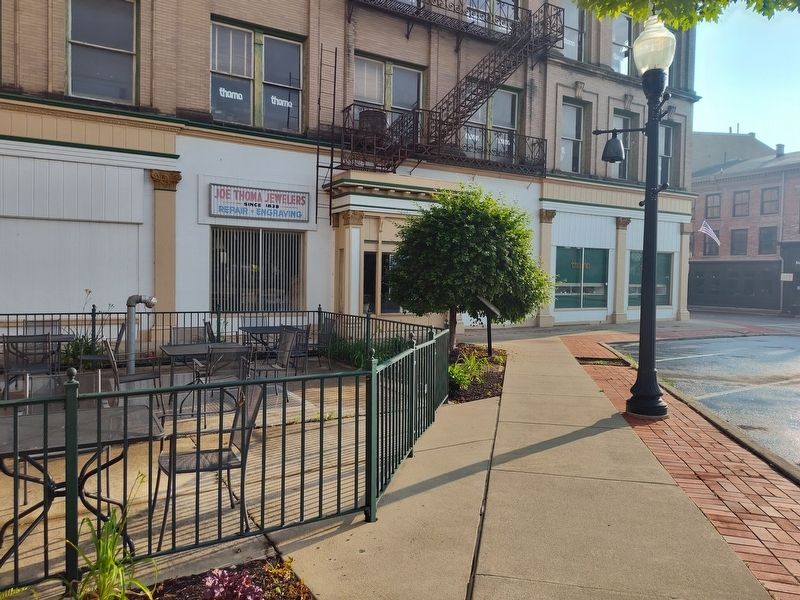
Location. 40° 8.933′ N, 84° 14.383′ W. Marker is in Piqua, Ohio, in Miami County. It is at the intersection of North Main Street and High Street, on the right when traveling south on North Main Street. Touch for map. Marker is at or near this postal address: 110 High St, Piqua OH 45356, United States of America. Touch for directions.

Regionally, this marker is in the Dayton Metro, in the Miami Valley, and in the Till Plains. It is also in the American Midwest and in the Corn Belt. Globally, it is in North America, the Western Hemisphere, the Western World, and the Anglosphere. Historically, it finds itself in what was once the Haudenosaunee (Iroquois) Confederacy, the territory of the Mississippian Culture, and the Northwest Territory.
Other nearby markers. At least 8 other markers are within walking distance of this marker: Great Miami River (within shouting distance of this marker); a different marker also named Great Miami River (within shouting distance of this marker); The Mills Brothers (within shouting distance of this marker); a different marker also named Great Miami River (within shouting distance of this marker); Piqua Veterans Memorial (within shouting distance of this marker); a different marker also named Great Miami River (within shouting distance of this marker); McCulloch (within shouting distance of this marker); Capt. Don Gentile (within shouting distance of this marker). Touch for a list and map of all markers in Piqua.
Credits. This page was last revised on July 10, 2025. It was originally submitted on June 19, 2025, by Craig Doda of Napoleon, Ohio. This page has been viewed 226 times since then and 74 times this year. Photos: 1, 2, 3. submitted on June 19, 2025, by Craig Doda of Napoleon, Ohio. • Bill Pfingsten was the editor who published this page.
