Piqua in Miami County, Ohio — The American Midwest (Great Lakes)
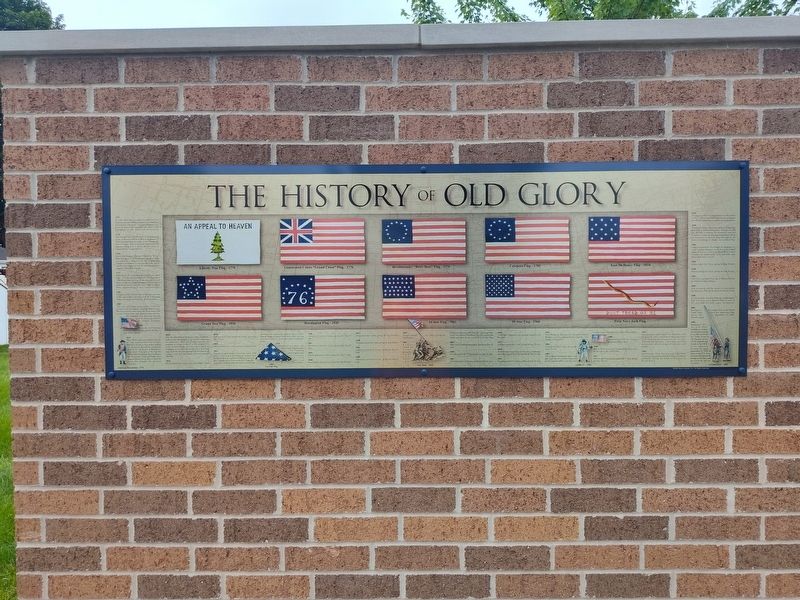
The History of Old Glory
Photographed by Craig Doda, June 14, 2025
1. The History of Old Glory Marker
Liberty Tree Flag - 1775
Revolutionary "Betsy Ross" Flag - 1776
Fort McHenry Flag - 1814
Continental Colors "Grand Union" Flag - 1776
Cowpens Flag - 1781
Grand Star Flag - 1818
34 Star Flag - 1861
Bennington Flag - 1826
50 Star Flag - 1960
First Navy Jack Flag
1775
The Pine Tree Flag, a traditional symbol of New England, was the first flag adopted by an American Government. The motto "Appeal to Heaven” was flown by ships in the Massachusetts Navy at the beginning of the American Revolution.
1776
The Grand Union flag flown by the Continental Army on Prospect Hill near Boston on January 1, 1776 demonstrated the unity of the 13 colonies with 13 stripes. The Union Jack represented the colonies allegiance to Great Britain prior to independence being declared.
1776
Historians disagree whether Elizabeth “Betsy” Ross, the keeper of a Philadelphia upholstery shop, was asked by a committee of the Continental Congress to make a 13 star flag like this one or whether she suggested that the stars should have 5 points rather than 6 points.
1777
Enacted by the Continental Congress on June 14th, 1777, the Act establishing
this page online
1781
On January 17, General Daniel Morgan won one of the most brilliant victories of the Revolutionary War at the battle of Cowpens, South Carolina.
1787
The stars and stripes were carried around the world for the first time by Captain Robert Gray. He discovered a river along the Northwest coast of the United States and named it after his ship, The Columbia His discovery was the basis of America's claim to the Oregon Territory.
1795
Kentucky and Vermont joined the Union, giving the flag 15 stars and 15 stripes.
1814
Mary Pickersgill, who learned the art of flag making from her mother Rebecca Young, a flag maker during the American Revolution, made this flag for Ft. McHenry in Baltimore, Maryland. The sight of the flag still flying after the British bombardment on September 13th and 14th, 1814 inspired Francis Scott Key to write the poem that became the national anthem.
American Revolution - 1776
1818
After the
Photographed by Craig Doda, June 14, 2025
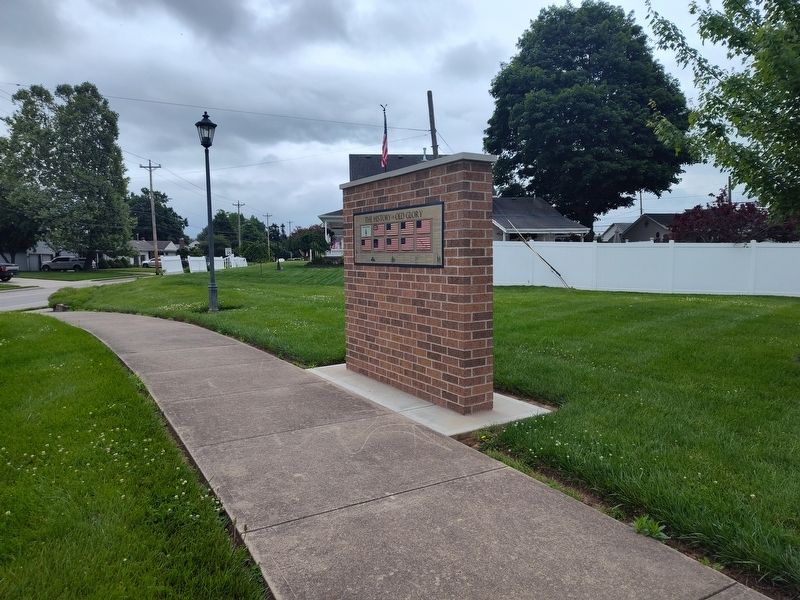
2. The History of Old Glory Marker
1819
Illinois joined the Union, giving the flag 21 stars.
1820
Alabama and Maine joined the Union, giving the flag 23 stars.
1822
Missouri joined the Union, giving the flag 24 stars.
1824
Captain Stephen Driver coined the name “Old Glory" when he gave it to a flag his mother made for him which he carried during his career at sea. Captain Driver, who settled in Nashville, Tennessee, kept the flag safe from Confederate partisans who came to his house to take it. When federal troops occupied Nashville in 1862, the flag was flown from the Tennessee capitol building's dome.
1826
Historians now agree, the Bennington Flag first flew in the 1820's celebrating the 50th anniversary of the American Revolution.
1903 Tri-Fold Flag
1836
Arkansas joined the Union, giving the flag 25 stars.
1837
Michigan joined the Union, giving the flag 26 stars.
1845
Florida joined the Union, giving the flag 27 stars.
1846
Texas joined the Union, giving the flag 28 stars.
1847
Iowa joined the Union, giving the flag 29 stars.
1848
Wisconsin joined the Union, giving the flag 30 stars.
1851
California joined the Union, giving the flag 31 stars.
1858
Minnesota joined the Union, giving the flag 32 stars.
1859
Oregon joined flag 33 stars.
1861
Kansas joined the Union, giving the flag 34 stars after the Union, giving the Southern states seceded from the Union and the Civil War began, President Lincoln would not allow any stars to be removed from the flag.
Iwo Jima - 1945
1863
West Virginia joined the Union, giving the flag 35 stars.
1865
Nevada joined the Union, giving the flag 36 stars.
1867
Nebraska joined the Union, giving the flag 37 stars.
1869
"Old Glory" appeared on a postage stamp for the first time.
1877
Colorado joined the Union, giving the flag 38 stars.
1890
North Dakota, South Dakota, Montana, Washington and Idaho joined the Union, giving the flag 43 stars.
1891
Wyoming joined the Union, giving the flag 44 stars.
1892
The "Pledge of Allegiance", written by Francis Bellamy, was first published in the magazine "The Youth's Companion."
1896
Utah joined the Union, giving the flag 45 stars.
1903
The tradition of folding the flag in a tri- fold shape (like the tri-corner hats worn by the colonial soldiers) was first used in honor and remembrance of the fallen soldier.
Apollo 11-1969
1908
Oklahoma joined the Union, giving the flag 46 stars.
1909
Robert Peary placed the United States flag sewn by his wife at the North Pole.
1912
Arizona and New Mexico joined the Union, giving the flag 48 stars.
1912
An executive order signed by President Taft on June 24, 1912, established the proportions of the flag and the arrangement of the stars. This was the first time a President specified the precise, official design of the stars and stripes.
1945
On February 23rd, Marines and a US Navy Corpsman raised the American Flag on Mount Surbachi, during the battle of Iwo Jima in World War II.
1945
The flag that flew over Pearl Harbor on December 7, 1941, is flown over the White House on August 14, when the Japanese accepted surrender terms.
1949
President Truman signed the resolution designating June 14th as National Flag Day. Though it is still not officially a holiday, the resolution asks the President to make an annual proclamation calling on Americans to observe Flag Day and for all Federal buildings to display the national flag.
1954
Congress amended The Pledge of Allegiance to read, "I pledge allegiance to the flag of the United States of America, and to the Republic for which it stands; one nation, under God, indivisible, with liberty and justice for all."
1959
Alaska joined the Union, giving the flag 49 stars.
1960
Hawaii joined the Union, giving the flag 50 stars.
1963
Old Glory was placed on top of Mount Everest by American Barry Bishop.
1969
Neil Armstrong and the Apollo 11 crew placed the American Flag on the moon for the first time.
1996
A custom-made American Flag (the world's largest flag) was hung across Hoover Dam as part of the pre-1996 Olympic game ceremonies.
2001
Firefighters Trade Center shortly after terrorists attack at Ground Zero of the World raised the American Flag the September 11, 2001.
2002
Beginning in 1977, the U.S. Navy established a tradition that the oldest warship in the fleet should fly the "Don't Tread On Me'flag from its bow (which originally was thought to have flown in the American Revolution), Since September 11, 2002 all ships in the U.S. Navy have been instructed to fly this flag on their bow until the end of the war on terrorism.
Ground Zero - 2001
Topics and series. This historical marker is listed in these topic lists: Communications • Military • Settlements & Settlers. In addition, it is included in the Vexillology series list. A significant historical date for this entry is January 1, 1776.
Location. 40° 9.844′ N, 84° 15.32′ W. Marker is in Piqua, Ohio, in Miami County. It is at the intersection of Broadway (Ohio Route 66) and Washington Avenue, on the right when traveling east on Broadway. Touch for map. Marker is at or near this postal address: 1796 Broadway, Piqua OH 45356, United States of America. Touch for directions.

Regionally, this marker is in the Dayton Metro, in the Miami Valley, and in the Till Plains. It is also in the American Midwest and in the Corn Belt. Globally, it is in North America, the Western Hemisphere, the Western World, and the Anglosphere. Historically, it finds itself in what was once the Haudenosaunee (Iroquois) Confederacy, the territory of the Mississippian Culture, and the Northwest Territory.
Other nearby markers. At least 8 other markers are within walking distance of this marker: Tuskegee Airmen Memorial (a few steps from this marker); Piqua's Vietnam Home Front / William H. Pitsenbarger (a few steps from this marker); Honor Log (a few steps from this marker); Airman First Class Pitsenbarger (a few steps from this marker); Piqua Veterans Memorial (within shouting distance of this marker); William H. Pitsenbarger (within shouting distance of this marker); Operation Silent Witness (within shouting distance of this marker); Piqua (within shouting distance of this marker). Touch for a list and map of all markers in Piqua.
Credits. This page was last revised on April 4, 2026. It was originally submitted on June 19, 2025, by Craig Doda of Napoleon, Ohio. This page has been viewed 151 times since then and 43 times this year. Photos: 1. submitted on June 19, 2025, by Craig Doda of Napoleon, Ohio. 2. submitted on June 20, 2025, by Craig Doda of Napoleon, Ohio. • Bill Pfingsten was the editor who published this page.
