
Falaise in Calvados, Normandy, France — Western Europe
La Basse Cour
⎯⎯⎯
The Lower Yard
Photographed by James Hulse, June 2, 2025
1. La Basse Cour Marker - French text

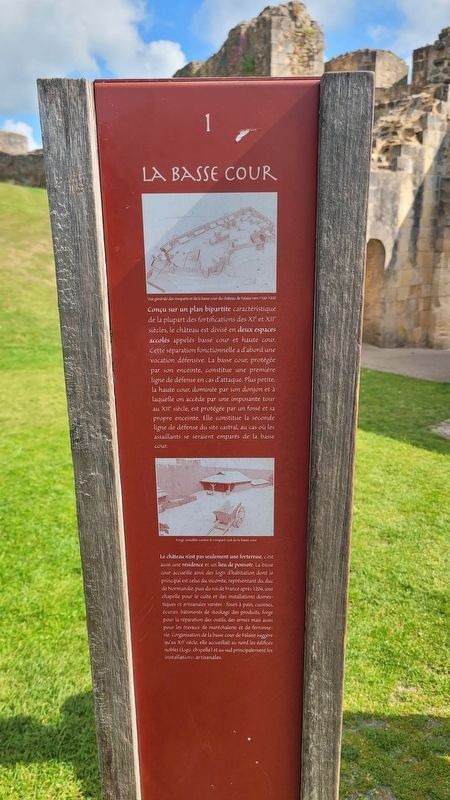
Conçu sur un plan bipartite caractéristique de la plupart des fortifications des XIe et XII siècles, le château est divisé en deux espaces accolés appelés basse cour et haute cour. Cette séparation fonctionnelle a d'abord une vocation défensive. La basse cour, protégée par son enceinte, constitue une première ligne de défense en cas d'attaque. Plus petite, la haute cour, dominée par son donjon et à laquelle on accède par une imposante tour au XIIe siècle, est protégée par un fossé et sa propre enceinte. Elle constitue la seconde ligne de défense du site castral, au cas où les assaillants se seraient emparés de la basse cour.
Le château n'est pas seulement une forteresse, c'est aussi une résidence et un lieu de pouvoir. La basse cour accueille ainsi des logis d'habitation dont le principal est celui du vicomte, représentant du duc de Normandie, puis du roi de France après 1204, une chapelle pour le culte et des installations domestiques et artisanales variées : fours à pain, cuisines, écuries, bâtiments de stockage des produits, forge pour la réparation des outils, des armes mais aussi pour les travaux de maréchalerie et de ferronnerie. L'organisation de la basse cour de Falaise suggère qu'au XIIe siècle, elle accueillait au nord les édifices nobles (logis, chapelle) et au sud principalement les installations artisanales.
Légendes
(Photo #1) Vue générale des remparts et de la basse cour du château de Falaise vers 1160-1200.
(Photo #2) Forge installée contre le rempart sud de la basse cour.
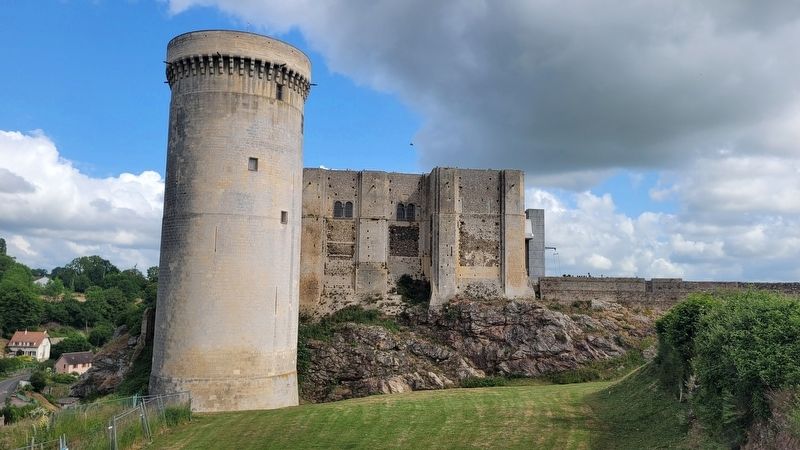
Designed according to a bipartite plan, typical of the majority of 11th and 12th century fortifications, the castle is divided into two adjoining areas, referred to as the lower yard and the upper yard. The aim of this functional separation was, first and foremost, defensive. Protected by its enclosure, the lower yard offered the first line of defence in the case of attack. The smaller upper yard, dominated by the keep, was accessible via an imposing 12th century tower and was protected by a ditch and its own enclosure. The upper yard was the castle's second line of defence, should assailants have succeeded in seizing the lower yard.
The castle was not only a fortress; it was also a place of residence and a seat of power. The lower yard housed residential quarters, the most important of which was the Viscount's house. The Viscount represented the Duke of Normandy, then the King of France after 1204. The yard also had a chapel for worship and a variety of domestic or trade and craft facilities: bread ovens, kitchens, stables, storage buildings, a forge for repairing tools or weapons and for farriery and ironwork. The physical arrangement of the lower yard suggests that, in the 12th century, it housed noble buildings (houses, chapel) to the north and essentially trade and craft facilities to the south.
Captions
(Photo #1) Bird's eye view of Falaise Castle ramparts and the lower yard around 1160-1200.
(Photo #2) Forge established against the south rampart in the lower yard.
Erected by Conseil
this page online
Topics. This historical marker is listed in this topic list: Forts and Castles. A significant historical year for this entry is 1204.
Location. 48° 53.586′ N, 0° 12.145′ W. Marker is in Falaise, Normandie (Normandy), in Calvados. It is at the intersection of Pl. Guillaume le Conquérant and Rue Blacher on Pl. Guillaume le Conquérant. The marker is located on the grounds of the Château Guillaume-le-Conquérant. Touch for map. Marker is in this post office area: Falaise, Normandie 14700, France. Touch for directions.

Regionally, it is in the North Atlantic Region, Europe, the European Union, Atlantic Europe, the Schengen Area, Western Europe, a coastal Mediterranean country, and the Western World. Historically, it finds itself in what was once a French colony and also the Roman Empire.
Other nearby markers. At least 8 other markers are within walking distance of this marker: Objectif Falaise / Objective Falaise (a few steps from this marker); «Bombes et mitraille pleuvaient de toutes parts» / Bombs and bullets hailed down in every direction

Photographed by James Hulse, June 2, 2025
2. The Lower Yard Marker - English Text
Also see . . . History. Chateau Guillaume-le-Conquerant
The site of Falaise, situated on the edge of the first foothills of the Armorican massif, has been occupied by man since at least the Mesolithic Age (around 7000 BC). Different types of settlement succeeded one another over the centuries, and it seems that a fortification already exists on the rock in the Carolingian era.(Submitted on June 21, 2025, by James Hulse of Medina, Texas.)
Taking advantage of this protection, the town develops on the rocky spur formed by the two valleys of the Ante and Marescot rivers. The beginning ofthe 10th century saw the creation of the dukedom of Normandy (the land of the northmen) after the Viking chief Rollo was granted land by Charles III “the simple”, king of franks, in 911. In this new political scene, the town and castle develop and change greatly and Falaise was to become one of the first cities of the new duchy.Photographed by James Hulse, June 2, 20253. The view of the Lower Yard and Marker

Photographed by James Hulse, June 2, 2025
4. The view of the upper yard and tower
Credits. This page was last revised on June 21, 2025. It was originally submitted on June 20, 2025, by James Hulse of Medina, Texas. This page has been viewed 77 times since then and 5 times this year. Photos: 1, 2, 3, 4. submitted on June 20, 2025, by James Hulse of Medina, Texas.
