Piqua in Miami County, Ohio — The American Midwest (Great Lakes)
The Piqua Nuclear Power Facility
Photographed by Craig Doda, June 7, 2025
1. The Piqua Nuclear Power Facility Marker
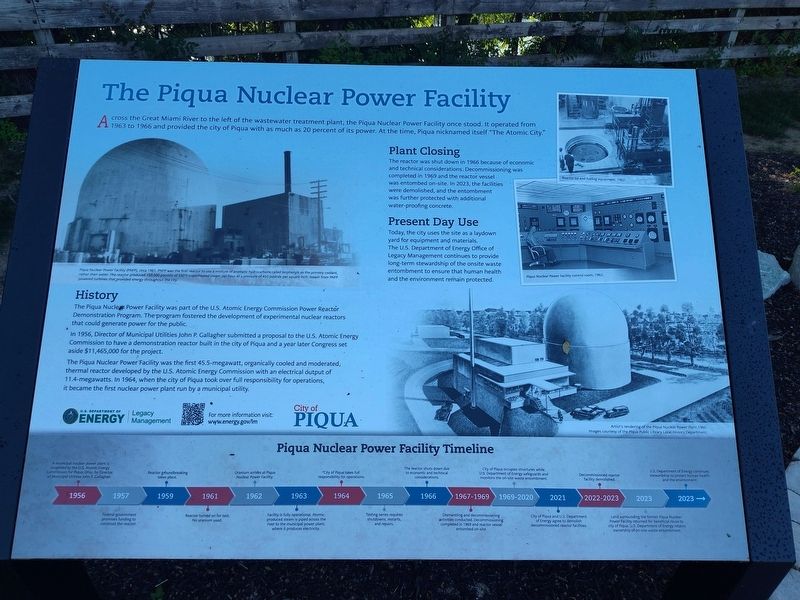
Across the Great Miami River to the left of the wastewater treatment plant, the Piqua Nuclear Power Facility once stood. It operated from 1963 to 1966 and provided the city of Piqua with as much as 20 percent of its power. At the time, Piqua nicknamed itself "The Atomic City."
Piqua Nuclear Power Facility (PNFP), circa 1961. PNFP was the first reactor to use a mixture of aromatic hydrocarbons called terphenyls as the primary coolant, rather than water. The reactor produced 150,000 pounds of 550°F superheated steam per hour at a pressure of 450 pounds per square inch. Steam from PNFP powered turbines that provided energy throughout the city.
History
The Piqua Nuclear Power Facility was part of the U.S. Atomic Energy Commission Power Reactor Demonstration Program: The program fostered the development of experimental nuclear reactors that could generate power for the public.
In 1956, Director of Municipal Utilities John P. Gallagher submitted a proposal to the U.S. Atomic Energy Commission to have a demonstration reactor built in the city of Piqua and a year later Congress set aside $11,465,000 for the project.
The
this page online
Plant Closing
The reactor was shut down in 1966 because of economic and technical considerations. Decommissioning was completed in 1969 and the reactor vessel was entombed on-site. In 2023, the facilities were demolished, and the entombment was further protected with additional water-proofing concrete.
Present Day Use
Today, the city uses the site as a laydown yard for equipment and materials. The U.S. Department of Energy Office of Legacy Management continues to provide long-term stewardship of the onsite waste entombment to ensure that human health and the environment remain protected.
Piqua Nuclear Power Facility Timeline
1956
A municipal nuclear power plant is proposed to the U.S. Atomic Energy Commission for Piqua, Ohio, by Director of Municipal Utilities John P. Gallagher.
1957
Federal
Photographed by Craig Doda, June 7, 2025
2. The Piqua Nuclear Power Facility Marker
1959
Reactor groundbreaking takes place.
1961
Reactor turned on for test.
No uranium used.
1962
Uranium arrives at Piqua Nuclear Power Facility.
1963
Facility is fully operational. Atomic- produced steam is piped across the river to the municipal power plant, where it produces electricity.
1964
City of Piqua takes full responsibility for operations.
1965
Testing series requires shutdowns, restarts, and repairs.
1966
The reactor shuts down due to economic and technical considerations.
1967-1969
Dismantling and decommissioning activities conducted. Decommissioning completed in 1969 and reactor vessel entombed on-site.
1969-2020
City of Piqua occupies structures while. U.S. Department of Energy safeguards and monitors the on-site waste entombment.
2021
City of Piqua and U.S. Department of Energy agree to demolish decommissioned reactor facilities.
2022-2023
Decommissioned reactor facility demolished.
2023
Land surrounding the former Piqua Nuclear Power Facility returned for beneficial reuse to city of Piqua. U.S. Department of Energy retains ownership of on-site
Photographed by Craig Doda, June 14, 2025
3. The Piqua Nuclear Power Facility
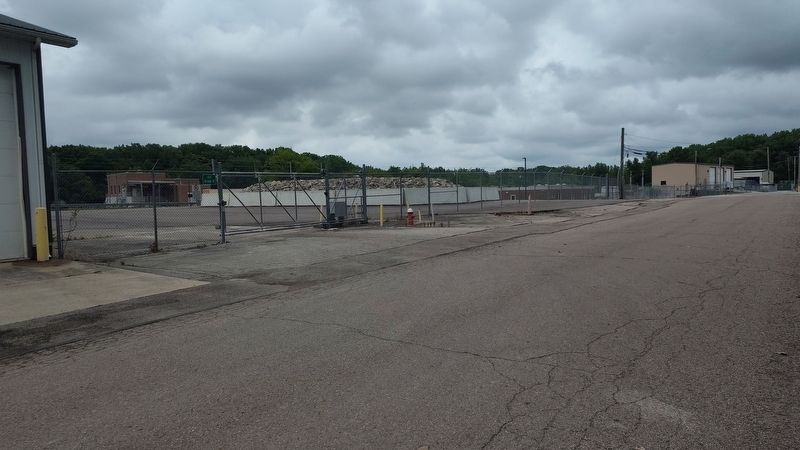
It is now a pile of stone behind cement barricades. There is a stone with writing on top, however I couldn't reach anyone about getting closer to it. It is fenced off with cameras and padlocks around the entire water treatment facility.
2023
U.S. Department of Energy continues stewardship to protect human health and the environment.
Erected by U.S. Department of Energy Legacy Management / City of Piqua.
Topics. This historical marker is listed in these topic lists: Architecture • Industry & Commerce • Landmarks. A significant historical year for this entry is 1963.
Location. 40° 7.964′ N, 84° 14.196′ W. Marker is in Piqua, Ohio, in Miami County. It is at the intersection of South Main Street (U.S. 75) and Hemm Road, on the right when traveling north on South Main Street. Touch for map. Marker is at or near this postal address: 1019 S Main St, Piqua OH 45356, United States of America. Touch for directions.

Regionally, this marker is in Ohio’s Dayton Metro, in the Miami Valley, and in the Till Plains. It is also in the American Midwest and in the Corn Belt. Globally, it is in North America, the Western Hemisphere, the Western World, and the Anglosphere. Historically, it finds itself in what was once the Haudenosaunee (Iroquois) Confederacy, the territory of the Mississippian Culture, and the Northwest Territory.
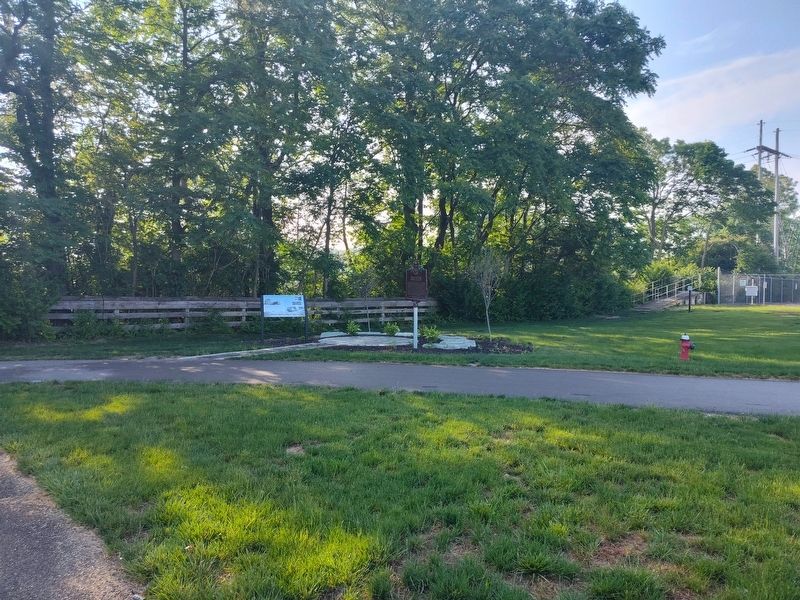
Other nearby markers. At least 8 other markers are within walking distance of this marker: A different marker also named Piqua Nuclear Power Facility (here, next to this marker); Piqua (approx. 0.2 miles away); Piqua's Early African-American Heritage (approx. ¼ mile away); The Village of Huntersville (approx. 0.9 miles away); Vice Admiral Stephen Clegg Rowan (approx. 0.9 miles away); Shawnee Bridge (approx. 0.9 miles away); a different marker also named Shawnee Bridge (approx. 0.9 miles away); a different marker also named Shawnee Bridge (approx. one mile away). Touch for a list and map of all markers in Piqua.
Credits. This page was last revised on July 10, 2025. It was originally submitted on June 20, 2025, by Craig Doda of Napoleon, Ohio. This page has been viewed 161 times since then and 44 times this year. Photos: 1, 2, 3. submitted on June 20, 2025, by Craig Doda of Napoleon, Ohio. • Devry Becker Jones was the editor who published this page.
