
Falaise in Calvados, Normandy, France — Western Europe
La Chapelle Castrale
⎯⎯⎯
The Castel Chapel
Photographed by James Hulse, June 2, 2025
1. La Chapelle Castrale Marker - French Text

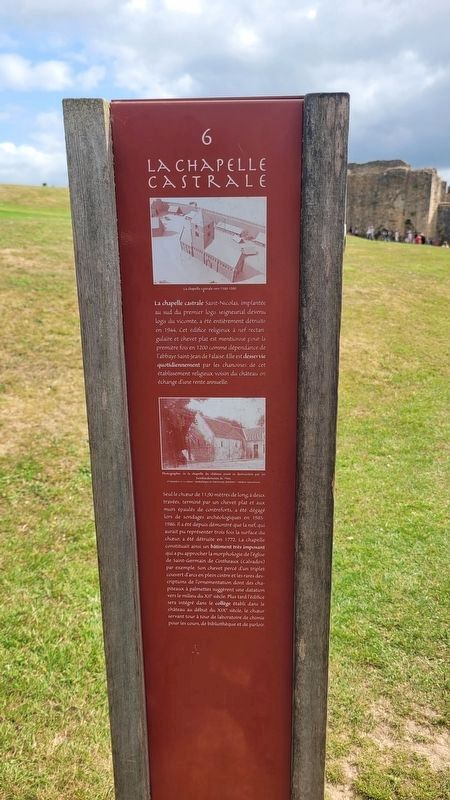
La chapelle castrale Saint-Nicolas, implantée au sud du premier logis seigneurial devenu logis du vicomte, a été entièrement détruite en 1944. Cet édifice religieux à nef rectangulaire et chevet plat est mentionné pour la première fois en 1200 comme dépendance de l'abbaye Saint-Jean de Falaise. Elle est desservie quotidiennement par les chanoines de cet établissement religieux voisin du château en échange d'une rente annuelle.
Seul le chœur de 11,90 mètres de long, à deux travées, terminé par un chevet plat et aux murs épaulés de contreforts, a été dégagé lors de sondages archéologiques en 1985-1986. Il a été depuis démontré que la nef, qui aurait pu représenter trois fois la surface du chœur, a été détruite en 1772. La chapelle constituait ainsi un bâtiment très imposant qui a pu approcher la morphologie de l'église de Saint-Germain de Cintheaux (Calvados) par exemple. Son chevet percé d'un triplet couvert d'arcs en plein cintre et les rares descriptions de l'ornementation dont des chapiteaux à palmettes suggèrent une datation vers le milieu du XIIe siècle. Plus tard l'édifice sera intégré dans le collège établi dans le château au début du XIXe siècle, le chœur servant tour à tour de laboratoire de chimie pour les cours, de bibliothèque et de parloir.
Légendes
(Photo #1) La chapelle castrale vers 1160-1200.
(Photo #2) Photographie de la chapelle du château avant sa destruction par les bombardements de 1944. ©Ministère de la culture - Médiathèque du Patrimoine, dist RAMN/Médéric Mieusement.
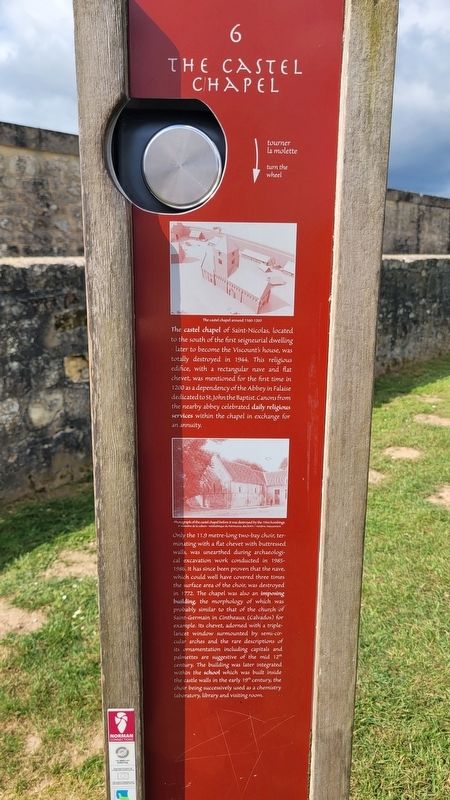
The castel chapel of Saint-Nicolas, located to the south of the first seigneurial dwelling later to become the Viscount's house, was totally destroyed in 1944. This religious edifice, with a rectangular nave and flat chevet, was mentioned for the first time in 1200 as a dependency of the Abbey in Falaise dedicated to St. John the Baptist. Canons from the nearby abbey celebrated daily religious services within the chapel in exchange for an annuity.
Only the 11.9 metre-long two-bay choir, terminating with a flat chevet with buttressed walls, was unearthed during archaeological excavation work conducted in 1985-1986. It has since been proven that the nave, which could well have covered three times the surface area of the choir, was destroyed in 1772. The chapel was also an imposing building, the morphology of which was probably similar to that of the church of Saint-Germain in Cintheaux (Calvados) for example. Its chevet, adorned with a triple-lancet window surmounted by semi-circular arches and the rare descriptions of its ornamentation including capitals and palmettes are suggestive of the mid 12th century. The building was later integrated within the school which was built inside the castle walls in the early 19th century, the choir being successively used as a chemistry laboratory, library and visiting room.
Captions
(Photo #1) The castel chapel around 1160-1200.
(Photo #2) Photograph of the castel chapel before it was destroyed by the 1944 bombings. ©Ministère de la culture - Médiathèque du Patrimoine, dist. RMN/Médéric Mieusement.
Erected by Conseil
this page online
Topics. This historical marker is listed in these topic lists: Forts and Castles • Religion & Religious Structures. A significant historical year for this entry is 1944.
Location. 48° 53.578′ N, 0° 12.179′ W. Marker is in Falaise, Normandie (Normandy), in Calvados. It is at the intersection of Place Guillaume le Conquérant and Rue Blacher on Place Guillaume le Conquérant. The marker is located on the grounds of the Château Guillaume-le-Conquérant. Touch for map. Marker is at or near this postal address: 1 Pl Guillaume le Conquérant, Falaise, Normandie 14700, France. Touch for directions.

Regionally, it is in the North Atlantic Region, Europe, the European Union, Atlantic Europe, the Schengen Area, Western Europe, a coastal Mediterranean country, and the Western World. Historically, it finds itself in what was once a French colony and also the Roman Empire.
Other nearby markers. At least 8 other markers are within walking distance of this marker: Falaise sous la botte allemande / Falaise under the German boot (within shouting
Photographed by James Hulse, June 2, 2025
2. The Castel Chapel Marker - English Text
Also see . . . History. Chateau Guillaume-le-Conquerant
The site of Falaise, situated on the edge of the first foothills of the Armorican massif, has been occupied by man since at least the Mesolithic Age (around 7000 BC). Different types of settlement succeeded one another over the centuries, and it seems that a fortification already exists on the rock in the Carolingian era.(Submitted on June 21, 2025, by James Hulse of Medina, Texas.)
Taking advantage of this protection, thetown develops on the rocky spur formed by the two valleys of the Ante and Marescot rivers. The beginning of the 10th century saw the creation of the dukedom of Normandy (the land of the northmen) after the Viking chief Rollo was granted land by Charles III “the simple”, king of franks, in 911. In this new political scene, the town and castle develop and change greatly and Falaise was to become one of the first cities of the new duchy.Photographed by James Hulse, June 2, 20253. The view of the marker in the lower yard

Photographed by James Hulse, June 2, 2025
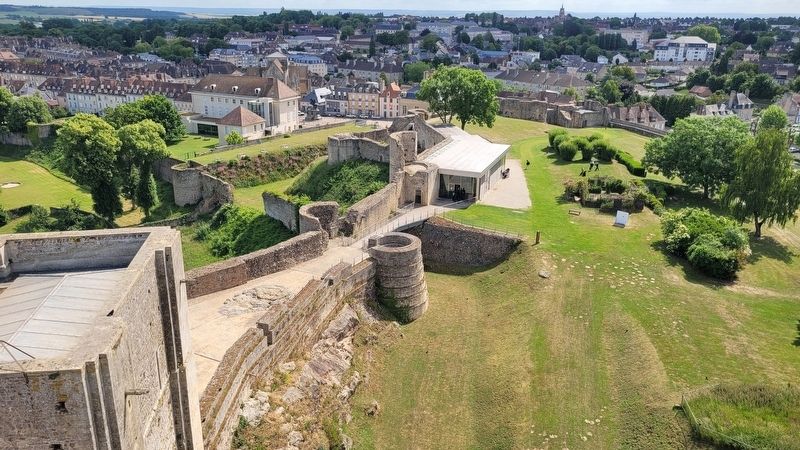
4. The view of the Castel Chapel foundation at the garden on the right side
Credits. This page was last revised on June 21, 2025. It was originally submitted on June 20, 2025, by James Hulse of Medina, Texas. This page has been viewed 94 times since then and 13 times this year. Photos: 1, 2, 3, 4. submitted on June 20, 2025, by James Hulse of Medina, Texas.
