
Falaise in Calvados, Normandy, France — Western Europe
L'église de la Sainte Trinité
⎯⎯⎯
The Church of the Holy Trinity

Photographed by James Hulse, June 2, 2025
1. L'église de la Sainte Trinité / The Church of the Holy Trinity Marker

L'église de la Sainte Trinité, bâtie vers 840 au pied du château qui la protège, est la paroisse la plus ancienne de Falaise.
Malmenée par les sièges de 1204 (rattachement de la Normandie au royaume de France) et de 1417 (occupation anglaise de la guerre de Cent Ans) ainsi que par les bombardements de 1944, elle est composée de parties dont les périodes de construction s'étalent du XIIIe siècle au XVIe siècle. Sur un plan en croix latine hérité de l'édifice roman s'élèvent ainsi un transept du XIIIe siècle, une nef gothique du XVe siècle, un chœur et un portail du XVIe siècle. Le chœur agrandi de 1510 à 1540 présente un décor d'une grande richesse caractéristique du style «gothique flamboyant». D'un niveau plus haut que la nef, il comporte une abside et un déambulatoire. Ce chœur est aujourd'hui couvert d'une magnifique voûte en châtaignier. Détail invisible depuis l'intérieur, le déambulatoire «enjambe» la ruelle située en contrebas créant ainsi la rue dite «de dessous l'arche». Le porche occidental de 1484 dont la forme rappelle celle d'une proue de navire est encore visible de l'extérieur. Condamné puis réaffecté en baptistère au XVIe siècle, il a été remplacé par un porche style «Renaissance», daté de 1545, dont la forme en arc de triomphe s'inspire des modèles antiques.
Les chapiteaux de la nef
Certains des chapiteaux de la nef côté sud, exécutés peu avant 1450, sont historiés. Certains illustrent la vie du Christ et des Saints d'autres plus pittoresques représentent des scènes de la vie courante reprenant les activités des corporations d'artisans et de commerçants ayant contribués à la reconstruction de l'église.
Légendes
(Photo #1) Dessin de la rue dite "de dessous de l'arche".
(Photo #2) Cartes postales, archives de la Médiathèque du Pays de Falaise.
(Photo #3) Dessin de l'église de la Trinité par Trolonge, architecte. Inventaire DRAC de Basse Normandie.
The church of Sainte Trinité (the Holy Trinity), built around the year 840 at the foot of the castle that protects it, is Falaise's oldest parish church.
Having suffered much misfortune during the sieges in 1204 (when Normandy was incorporated within the Kingdom of France) and in 1417 (the English occupation during the Hundred Years' War), together with the 1944 bombings, the church now comprises elements dating progressively from the 13th to the 16th century. In the form of the original Romanesque Latin cross, it comprises a 13th century transept, 15th century Gothic nave and 16th century portal. The choir, which was extended from 1510 to 1540, comprises exceptional decorative features typical of the Flamboyant Gothic style. On a level above the nave, the church also comprises an apse and an ambulatory. Today, this choir supports a magnificent chestnut vault. The ambulatory, invisible from inside the church, spans over the lane below, hence its name "Rue de Dessous l'Arche" (street from under the arch). The western porch dates from 1484 and its shape is reminiscent of a ship's bow. It can still be seen outside the church. Initially walled in, before being transformed into a baptistery in the 16th century, it was replaced by a Renaissance-style porch dating from 1545, in the form of a triumphal arch of classical inspiration.
The capitals of the nave
Certain capitals on the south side of the nave, executed shortly prior to 1450, are adorned with narrative scenes. Some depict the life of Christ and Saints, others are more picturesque, showing scenes from everyday life, including the activities of the craftsmen and traders who contributed to the church's reconstruction.
Captions
(Photo #1) Drawing of the street known as "under the arch".
(Photo #2) Postcards, archives of the Pays de Falaise Media Library.
(Photo #3) Drawing of the Trinity Church by Trolonge, architect. DRAC inventory of Lower Normandy.
Erected by Ville
this page online
Topics. This historical marker is listed in this topic list: Religion & Religious Structures. A significant historical year for this entry is 1204.
Location. 48° 53.669′ N, 0° 12.083′ W. Marker is in Falaise, Normandie (Normandy), in Calvados. It is at the intersection of Rue Rollon and Les Trois Châteaux on Rue Rollon. The marker is located infront ofthe church. Touch for map. Marker is at or near this postal address: 9 Rue Rollon, Falaise, Normandie 14700, France. Touch for directions.

Regionally, it is in the North Atlantic Region, Europe, the European Union, Atlantic Europe, the Schengen Area, Western Europe, a coastal Mediterranean country, and the Western World. Historically, it finds itself in what was once a French colony and also the Roman Empire.
Other nearby markers. At least 8 other markers are within walking distance of this marker: Ce 17 août, les Canadiens / On August 17, Canadian Forces (a few steps from this marker); Guillaume le Conquérant / William the Conqueror (within shouting distance of this marker); L'Hôtel de Ville / The Town Hall (within shouting distance of this marker); La bataille de Normandie / The Battle of Normandy (about 90 meters away, measured in a direct line); Château Guillaume-le-Conquérant / William the Conqueror’s Castle

Photographed by James Hulse, June 2, 2025
2. The Church of the Holy Trinity and Marker

Photographed by James Hulse, June 2, 2025
3. The front facade of the Church of the Holy Trinity

Photographed by James Hulse, June 2, 2025
4. The north view of the Church of the Holy Trinity
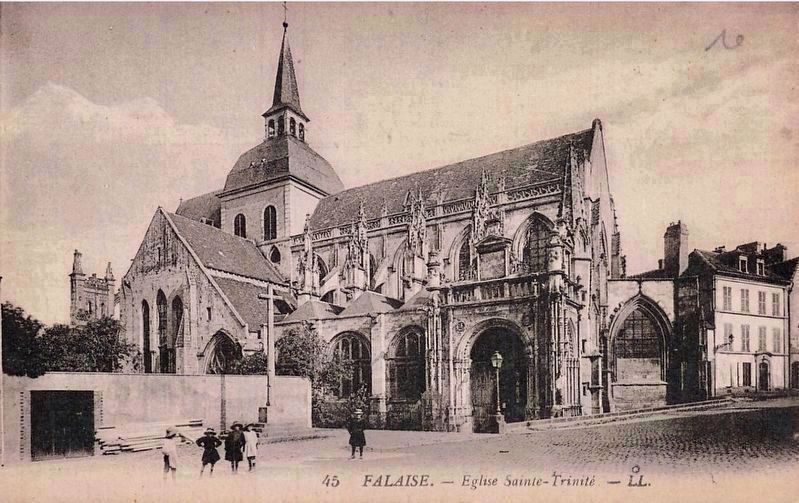
Photographed by Levy Fils et Cie, Paris, circa 1900
5. Église Sainte-Trinité
North view, as it appeared before WWII.

Photographed by James Hulse, June 2, 2025
6. The nave of the Church of the Holy Trinity
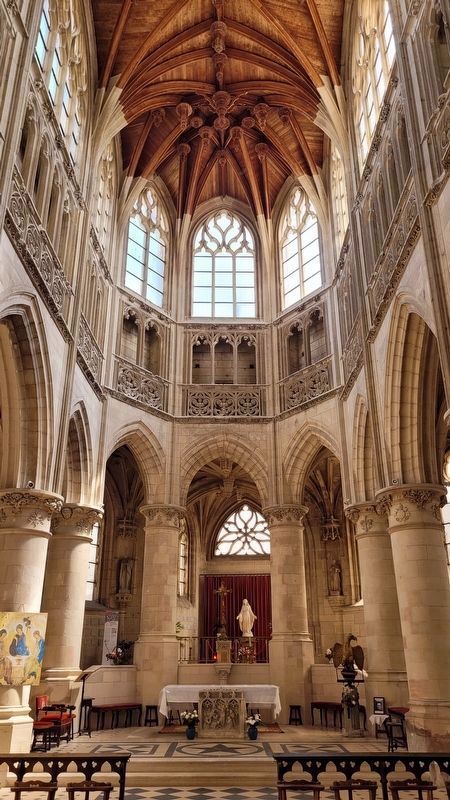
Photographed by James Hulse, June 2, 2025
7. The Altar of the Church of the Holy Trinity
Credits. This page was last revised on June 21, 2025. It was originally submitted on June 21, 2025, by James Hulse of Medina, Texas. This page has been viewed 126 times since then and 21 times this year. Photos: 1, 2, 3, 4. submitted on June 21, 2025, by James Hulse of Medina, Texas. 5. submitted on June 21, 2025. 6, 7. submitted on June 21, 2025, by James Hulse of Medina, Texas.
