Virginia Zoo in Norfolk, Virginia — The American South (Mid-Atlantic)
Oyster Restoration on the Lafayette River
Animals Beyond our Fences
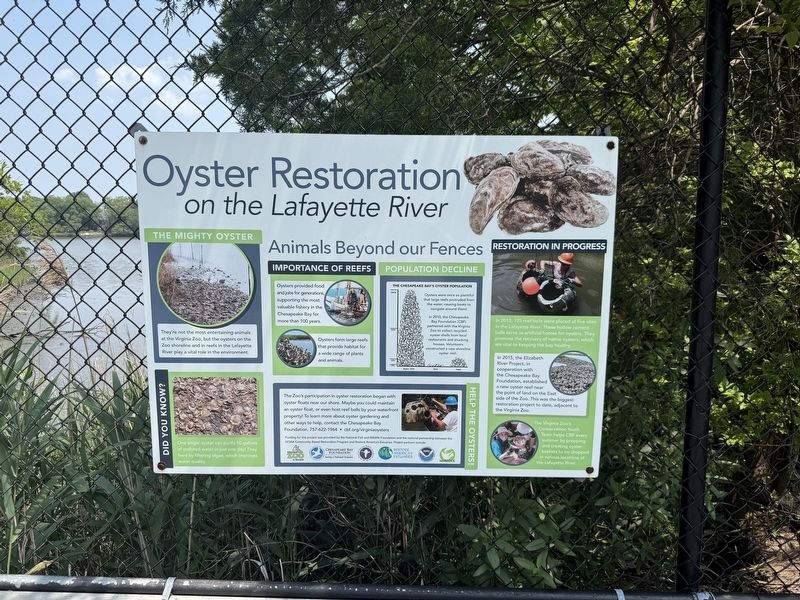
The Mighty Oyster
They're not the most entertaining animals at the Virginia Zoo, but the oysters on the Zoo shoreline and in reefs in the Lafayette River play a vital role in the environment.
Importance of Reefs
Oysters provided food and jobs for generations, supporting the most valuable fishery in the Chesapeake Bay for more than 100 years.
Population Decline
The Chesapeake Bay's Oyster Population
Oysters were once so plentiful that large reefs protruded from the water, causing boats to navigate around them!
In 2010, the Chesapeake Bay Foundation (CBF) partnered with the Virginia Zoo to collect recycled oyster shells from local restaurants and shucking houses. Volunteers constructed a new shoreline oyster reef.
Did You Know?
One single oyster can purify 50 gallons of polluted water in just one day! They feed by filtering algae, which improves water quality.
Help the Oysters!
The Zoo's participation in oyster restoration began with oyster floats near our shore. Maybe you could maintain an oyster float, or even host reef balls by your waterfront property! To learn more about oyster gardening and other
this page online
Restoration in Progress
In 2013, 125 reef balls were placed at five sites in the Lafayette River. These hollow cement balls serve as artificial homes for oysters. They promote the recovery of native oysters, which are vital to keeping the bay healthy.
In 2015, the Elizabeth River Project, in cooperation with the Chesapeake Bay Foundation, established a new oyster reef near the point of land on the East side of the Zoo. this was the biggest restoration project to date, adjacent to the Virginia Zoo.
The Virginia Zoo's Conservation Youth Team helps CBF every summer by prepping and creating oyster baskets to be dropped in various locations of the Lafayette River.
Erected by Virginia Zoo; Chesapeake Bay Foundation; National Fish and Wildlife Foundation; Restore America's Sanctuaries; National Oceanographic and Atmospheric Administration, U.S. Department of Commerce; the City of Norfolk, Virginia.
Topics. This historical marker is listed in these topic lists: Animals • Environment. A significant historical year for this entry is 2010.
Location. 36° 52.664′ N,
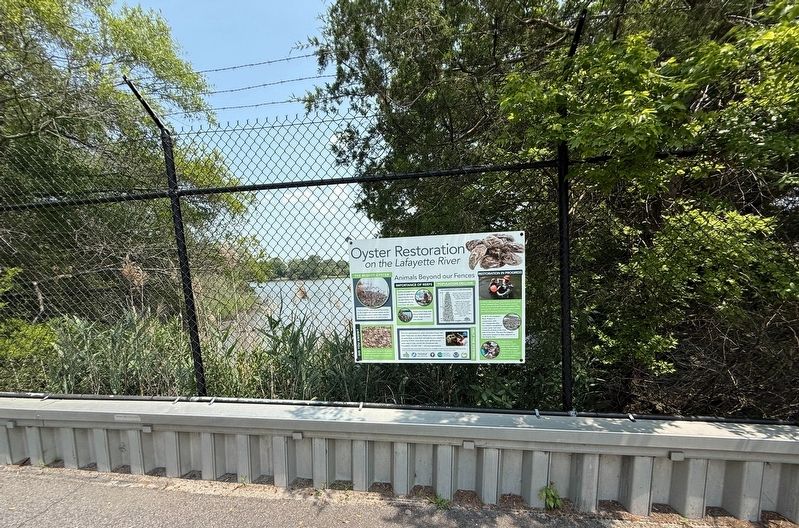

Regionally, this marker is in Virginia’s Hampton Roads, specifically in Coastal Virginia, and in the Hampton Roads Metropolitan Area. It is also in the American South, specifically in the Upper South, in the Tidewater, and on the Eastern Seaboard. Globally, it is in the North Atlantic Region, North America, the Western Hemisphere, the Western World, and the Anglosphere. Historically, it finds itself in what was once the territory of the Mississippian Culture, one of the original Thirteen Colonies, one of the Confederate States of America, and the Antebellum South.
Other nearby markers. At least 8 other markers are within walking distance of this marker: Endangered Species Success Story (a few steps from this marker); The Bottle Tree (about 400 feet away, measured in a direct line); Miniature Zebu Cow (about 500 feet away); Southdown Babydoll sheep (about 600 feet away); a different marker also named Miniature Zebu Cow (about 600 feet away); African Village Garden (about 800 feet away); Village of Xaxaba: Island of the Tall Trees (approx. 0.2 miles away); Village Life: Survival Strategies (approx. 0.2 miles away). Touch for a list and map of all markers in Norfolk.
Credits. This page was last revised on August 21, 2026. It was originally submitted on June 21, 2025, by Devry Becker Jones of Washington, District of Columbia. This page has been viewed 99 times since then and 14 times this year. Photos: 1, 2. submitted on June 21, 2025, by Devry Becker Jones of Washington, District of Columbia.
