Workington in Cumberland, England, United Kingdom — Northwestern Europe (the British Isles)
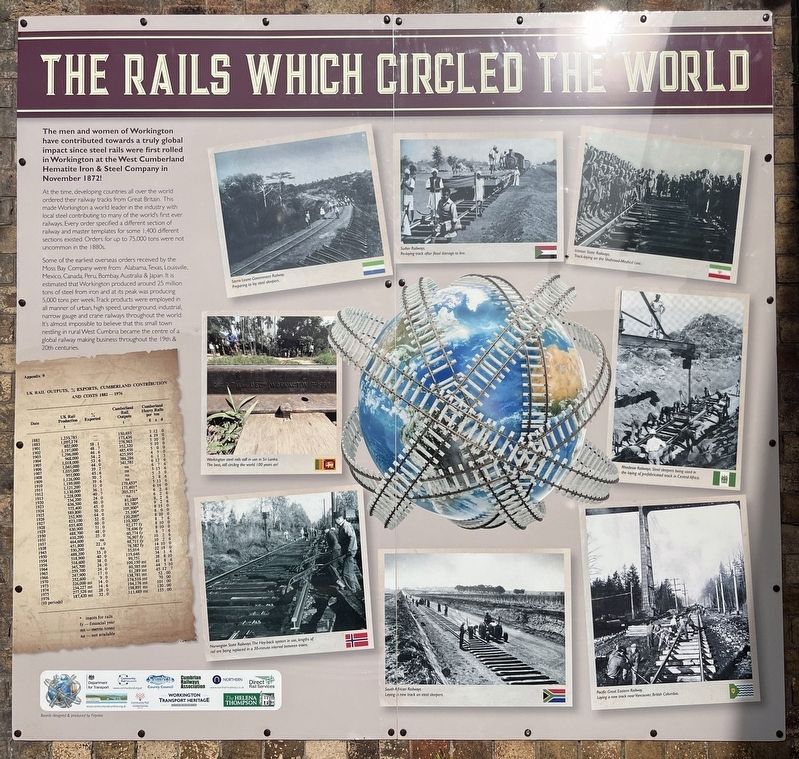
The Rails Which Circled the World
Photographed by Ray Gurganus, April 11, 2025
1. The Rails Which Circled the World Marker
At the time, developing countries all over the world ordered their railway tracks from Great Britain. This made Workington a world leader in the industry with local steel contributing to many of the world's first ever railways. Every order specified a different section of railway and master templates for some 1,400 different sections existed. Orders for up to 75,000 tons were not uncommon in the 1880s.
Some of the earliest overseas orders received by the Moss Bay Company were from Alabama, Texas, Louisville, Mexico, Canada, Peru, Bombay, Australia & Japan. It is estimated that Workington produced around 25 million tons of steel from iron and at its peak was producing 5,000 tons per week. Track products were employed in all manner of urban high speed, underground, industrial, narrow gauge and crane railways throughout the world. It's almost impossible to believe that this small town nesting in rural West Cumbria became
this page online
Erected by Cumbria County Council.
Topics. This historical marker is listed in these topic lists: Industry & Commerce • Railroads & Streetcars. A significant historical year for this entry is 1872.
Location. 54° 38.694′ N, 3° 33.545′ W. Marker is in Workington, England, in Cumberland. It can be reached from Belle Isle Place. On the Workington train station platform. Touch for map. Marker is at or near this postal address: 20 Belle Isle Pl, Workington, England CA14 2XG, United Kingdom. Touch for directions.

Regionally, this marker is in North West England. Globally, it is on the Atlantic Ocean, in the North Atlantic Region, in Europe, in Atlantic Europe, on one of the British Isles, in the Western World, and in the Anglosphere. Historically, it finds itself in what was once the Roman Empire.
Other nearby markers. At least 8 other markers are within walking distance of this marker: Shipping Throughout the Years (here, next to this marker); Memories of the Bessemer (here, next to this marker); The Bessemer Impact (a few steps from this marker); Workington Iron and Steel (a few steps from this marker); The Steel Making Process (a few steps from this marker); The Rail Making Process (a few steps from this marker); Decline of the Local Coal Industry (within shouting distance of this marker); A Local History of Coal Mining (within shouting distance of this marker). Touch for a list and map of all markers in Workington.
Credits. This page was last revised on June 22, 2025. It was originally submitted on June 22, 2025, by Ray Gurganus of Washington, District of Columbia. This page has been viewed 228 times since then and 26 times this year. Photo 1. submitted on June 22, 2025, by Ray Gurganus of Washington, District of Columbia. • Andrew Ruppenstein was the editor who published this page.
