
Falaise in Calvados, Normandy, France — Western Europe
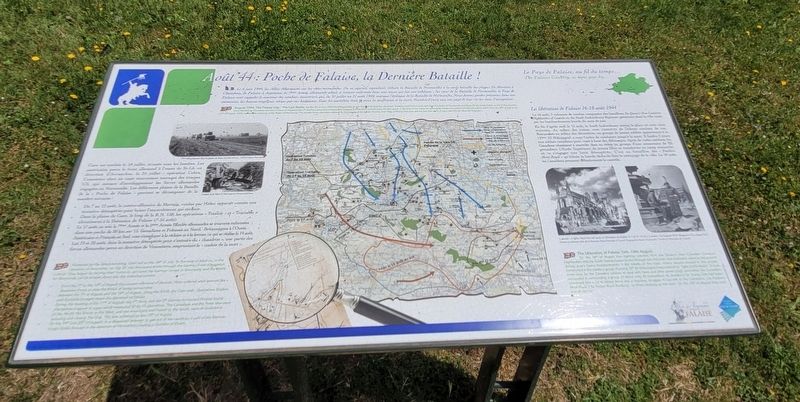
Août 44 : Poche de Falaise, la Dernière Bataille!
Le Pays de Falaise, au fil du temps...
⎯⎯⎯
August ’44: Falaise Pocket, the Final Battle!
The Falaise Country, as time goes by...
Photographed by James Hulse, June 2, 2025
1. Août 44 : Poche de Falaise, la Dernière Bataille! / August ’44: Falaise Pocket, the Final Battle! Ma

Le 6 juin 1944, les Alliés débarquent sur les côtes normandes. On ne saurait, cependant, réduire la Bataille de Normandie à la seule bataille des plages. De Mertain à Chambois, de Falaise à Argentan, la 7ᵉᵐᵉ Armée allemande allait se trouver enfermée dans une nasse qui fut son tombeau. Au cœur de la Bataille de Normandie, le Pays de Falaise veut rappeler le souvenir des combats meurtriers qui, du 30 juillet au 21 août 1944, marque l'épilogue de la Bataille de Normandie. Nous devons garder présentes dans nos mémoires, les heures tragiques vécues par ses habitants, Leur lot quotidien était peur, la souffrance et la mort. Nombre d'entre eux ont payé de leur vie les mois d'occupation.
Caen est tombée le 18 juillet, écrasée sous les bombes. Les américains perce le front allemand à l'ouest de St-Lô, en direction d'Avranches, le 25 juillet opération Cobra. Commence alors un vaste mouvement tournant des troupes US, qui menace d'enveloppement les forces allemandes engagées en Normandie. Les différentes phases de la Bataille de la «Poche de Falaise» peuvent se décomposer de la manière suivante:
this page online
• Dans la plaine de Caen, le long de la R.N. 158, les opérations Totalize et Tractable aboutissent à la libération de Falaise (7-16 août).
• Le 17 août, au soir, la 7ᵉᵐᵉ Armée et la 5ᵉᵐᵉ Armée Blindée allemandes se trouvent enfermées dans une poche de 30 km sur 15. Canadiens et Polonais au Nord, Britanniques à l'Ouest, Américains et Français au Sud, vont s'employer à la réduire et à la fermer, ce qui se réalise le 19 août.
• Les 19 et 20 août, dans la tentative désespérée pour s'extraire du «chaudron», une partie des forces allemandes perce en direction de Vimoutiers, empruntant le «couloir de la mort».
La libération de Falaise 16-18 août 1944
Le 16 août, 2 colonnes de combat composées des bataillons du Queen's Own Cameron Highlanders of Canada et, du South Saskatchewan Regiment, pénètrent dans la ville rasée par les bombardements lourds du mois de juin.
En fin d'après midi le 16 août, le South Saskatchewan atteint la place où nous
Photographed by James Hulse, June 2, 2025
2. Août 44 : Poche de Falaise, la Dernière Bataille! / August ’44: Falaise Pocket, the Final Battle! Ma
Légendes
(Photo #1) 1ʳᵉ DB polonaise dans la plaine de Caen ©John Steven ARCIS Bass-Normandie
(Photo #2) Couloir de la Mort ©Mémorial de Montormel /Denis
(Photo #3) A gauche L'église Saint-Gervais après la Libération de Falaise ©Coll. W. Theffo / à droite: Le Caporal M.W Musgrave et le sergent E.O Hanna se relaxant près de la fontaine Saint-Gervais ©Conseil Régional de Basse-Normandie / Archives Nationales du Canada
Aug 1944, The Falaise Gap - The Last Battle. On the 6th of June 1944 the Allies landed on the Normandy Beaches. However, nobody could have known then that the Battle of Normandy would just be the single battle on the D-Day beaches. From Mortain to Chambois and from Falaise to Argentan the 7th German Army found themselves trapped in net which turned out to be their grave. In the heat of the battle for Normandy, Falaise remembers the bloody battles which from 27th of July to the 21st of August 1944, marked the outcome of the Battle of Normandy. The terrible times that were endured by the people of the Falaise Country, their daily suffering, their fear and the fact that
Photographed by James Hulse, June 2, 2025
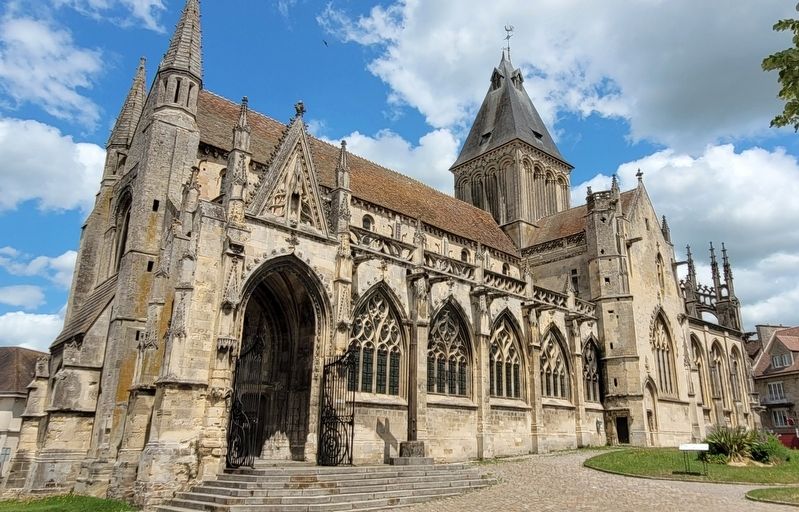
3. The cathedral with the marker
Flattened by the Allied bombing, Caen fell on the 18th of July. To the west of Saint-Lo, in the direction of Avranches, on July 25, the Americans broke through the German Front (Operation Cobra). They began by turning their forces to surround the German troops in Normandy and the Battle for Normandy can be broken down into the following actions.
• From the 7th to the 12th of August the counter offensive of Mortain, Hitler ordered what seemed like a desperate move to stop the threat of being surrounded.
• Between the 7th of August and the 16th of August, along the N158, the Caen plain. Operations Totalize and Tractable brought about the liberation of Falaise.
• During the evening of the 17th of August, the 7th Army and the 5th German Armoured Division found themselves trapped in a gap which measured 30 by 15 kilometres. The Canadians and the Poles who were to the North, the British to the West, and the Americans and French to the South, were all involved in reducing and closing The Gap. This was achieved on the 19th of August.
• On the 19th and 20th of August, in a desperate attempt to get out of the cauldron, a part of the German troops broke through in the direction of Vimoutiers creating a Corridor of Death
The Liberation of Falaise 16th-18th August
On the 16th of August two fighting columns from the Queen's Own Canadian Cameron Highlanders and the South Saskatchewan broke through into the town that had been razed to the ground during June's heavy bombardments. In the middle of the ruins, violent attacks ensued in the streets. Entrenched in the rubble a group of young 12th SS Hitlerjugend was ordered to "fight to the death". It took three days for the Canadian soldiers to deal with them and after some tough skirmishes the Canadians succeeded in surrounding a group of about sixty SS Grenadiers. An Academy for Young Girls had been converted into a camp where there was a hopeless struggle. It was left to the Canadians, Les Fusiliers, Mont-Royal (The Mount Royal Fusiliers), to finish cleaning up the town. On the 18th of August they took overall control.
Captions
(Photo #1) 1st Polish Armoured Division in the Caen plain ©John Steven ARCIS Basse-Normandy
(Photo #2) Death Row ©Montormel Memorial/Denis
(Photo #3) Left: Saint-Gervais Church after the Liberation of Falaise ©Coll. W. Theffo / Right: Corporal M.W. Musgrave and Sergeant E.O. Hanna relaxing near the Saint-Gervais fountain ©Conseil Régional de Basse-Normandie / National Archives of Canada
Erected by Office de Tourisme du Pays de Falaise.
Topics. This historical marker is listed in this topic list: War, World II. A significant historical date for this entry is August 16, 1944.
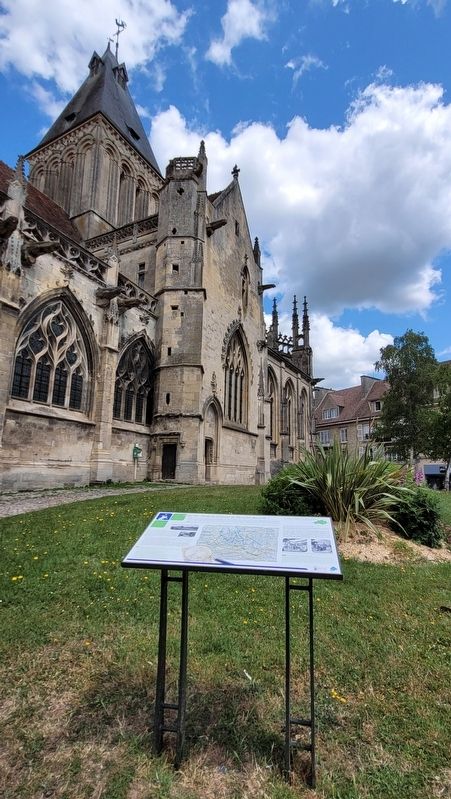
Location. 48° 53.872′ N, 0° 11.939′ W. Marker is in Falaise, Normandie (Normandy), in Calvados. It is at the intersection of Rue de Brebisson (Normandie Route D658) and Rue de Brebisson, on the right when traveling west on Rue de Brebisson. The marker is located on the south side of the cathedral. Touch for map. Marker is at or near this postal address: 10 Rue de Brebisson, Falaise, Normandie 14700, France. Touch for directions.

Regionally, it is in the North Atlantic Region, Europe, the European Union, Atlantic Europe, the Schengen Area, Western Europe, a coastal Mediterranean country, and the Western World. Historically, it finds itself in what was once a French colony and also the Roman Empire.
Other nearby markers. At least 8 other markers are within walking distance of this marker: Place et Église Saint-Gervais / Square and Church "Saint-Gervais" (here, next to this marker); a different marker also named Place et Église Saint-Gervais / Square and Church "Saint-Gervais (a few steps from this marker); a different marker also named Place et Église Saint-Gervais / Square and Church "Saint-Gervais (a few steps from this marker); L'église Saint Gervais / Saint Gervais Church (within shouting distance of this marker); La Porte des Cordeliers / The Cordeliers Gate (about 150 meters away, measured in a direct line); Ce 17 août, les Canadiens / On August 17, Canadian Forces (approx. 0.4 kilometers away); L'église de la Sainte Trinité / The Church of the Holy Trinity (approx. 0.4 kilometers away); Guillaume le Conquérant / William the Conqueror (approx. half a kilometer away). Touch for a list and map of all markers in Falaise.
Also see . . . Falaise pocket. Wikipedia
The Falaise pocket or battle of the Falaise pocket (German: Kessel von Falaise; 12–21 August 1944) was the decisive engagement of the Battle of Normandy in the Second World War. Allied forces formed a pocket around Falaise, Calvados, in which German Army Group B, consisting of the 7th Army and the Fifth Panzer Army (formerly Panzergruppe West), were encircled by the Western Allies. The battle resulted in the destruction of most of Army Group B west of the Seine, which opened the way to Paris and the Franco-German border.(Submitted on June 26, 2025, by James Hulse of Medina, Texas.)
Credits. This page was last revised on June 26, 2025. It was originally submitted on June 22, 2025, by James Hulse of Medina, Texas. This page has been viewed 104 times since then and 16 times this year. Photos: 1, 2, 3. submitted on June 26, 2025, by James Hulse of Medina, Texas.
