Mendon in Cache County, Utah — The American Mountains (Southwest)
Restoration of the James G. Willie Home
Photographed by Vincent Cascio, July 7, 2011
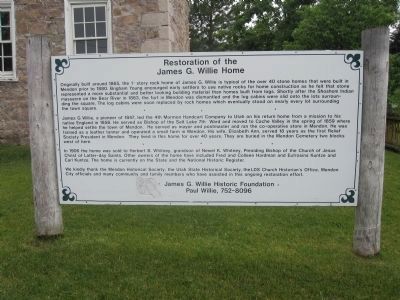
1. Restoration of James G. Willie Home Marker
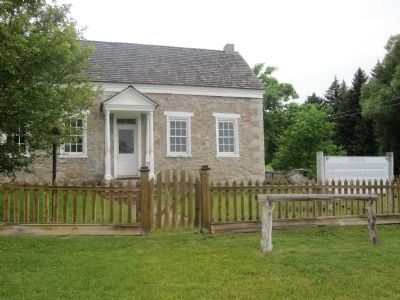
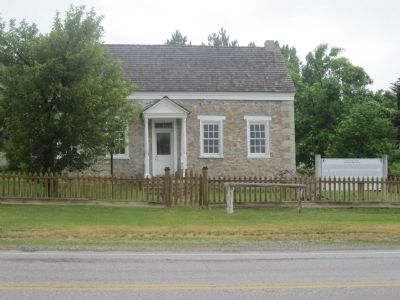
Originally built around 1865, the 1½ story rock home of James G. Willie is typical of the over 40 stone homes that were built in Mendon prior to 1880. Brigham Young encouraged early settlers to use native rocks for home construction as he felt that stone represented a more substantial and better looking material than homes built from logs. Shortly after the Shoshoni Indian massacre on the Bear River in 1863, the fort in Mendon was dismantled and the log homes were slid onto the lots surrounding the square. The log cabins were soon replaced by rock homes which eventually stood on nearly every lot surrounding the town square.
James G Willie, a pioneer of 1847, led the 4th Mormon Handcart Company to Utah on his return home from a mission to his native England in 1856. He served as Bishop of the Salt Lake 7th Ward and moved to Cache Valley in the spring of 1859 where he helped settle the town of Mendon. He served as mayor and postmaster and ran the co-operative store in Mendon. He was trained as a leather tanner and operated a small farm in Mendon. His wife, Elizabeth Ann, served 18 years as the first Relief Society President
this page online
In 1906 the home was sold to Herbert B. Whitney, grandson of Newel K. Whitney, Presiding Bishop of the Church of Jesus Christ Of Latter-day Saints. Other owners of the home have included Fred and Colleen Hardman and Eufrosina Kuntze and Carl Kuntze. The home is currently on the State and the National Historic Register.
We kindly thank the Mendon Historical Society, the Utah State Historical Society, the LDS Church Historian's Office, Mendon City officials and many community and family members who have assisted in this ongoing restoration effort.
Paul Willie, 752-8096
Erected by James G. Willie Historic Foundation.
Topics. This historical marker is listed in these topic lists: Religion & Religious Structures • Settlements & Settlers. A significant historical year for this entry is 1865.
Location. Marker has been permanently removed. It was located near 41° 42.589′ N, 111° 58.764′ W. Marker was in Mendon, Utah, in Cache County. It was at the intersection of North 100
Photographed by Vincent Cascio, July 7, 2011
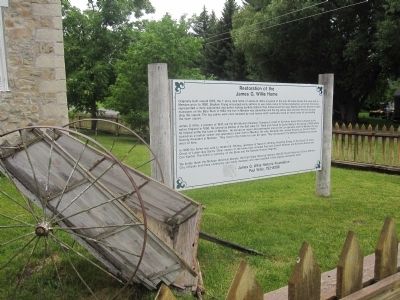
2. James G Willie Home Marker
We have been informed that this marker is no longer there and will not be replaced. This page is an archival view of what was.
Regionally, this marker was in the Cache Valley. It was also in the American Mountain West and on the Colorado Plateau. Globally, it was in North America, the Rocky Mountains, the Western Hemisphere, the Western World, and the Anglosphere. Historically, it found itself in what was once New Spain and also Mexico’s Alta California.

Other nearby markers. At least 8 other markers are within 7 miles of this location, measured as the crow flies: Ole Peder Sorensen Pioneer Cabin (within shouting distance of this marker); Wellsville Pioneers (approx. 5½ miles away); Mountain Man (approx. 5½ miles away); Wellsville Tabernacle (approx. 5.6 miles away); Wellsville Schools (approx. 5.6 miles away); Hansen Dairy (approx. 6.1 miles away); The Bear River Crossing (approx. 6½ miles away); Hansen Cooperative Dairy

Photographed by Jeremy Snow, June 22, 2025
3. Restoration of the James G. Willie Home Marker
Photo showing marker has been removed
Photographed by Vincent Cascio, July 7, 2011
4. James G Willie Home
Photographed by Vincent Cascio, July 7, 2011
5. James G Willie Home
Credits. This page was last revised on June 27, 2025. It was originally submitted on July 10, 2011, by Vincent Cascio of Logan, Utah. This page has been viewed 1,173 times since then and 39 times this year. Last updated on June 22, 2025, by Jeremy Snow of Cedar City, Utah. Photos: 1, 2. submitted on July 10, 2011, by Vincent Cascio of Logan, Utah. 3. submitted on June 22, 2025, by Jeremy Snow of Cedar City, Utah. 4, 5. submitted on July 10, 2011, by Vincent Cascio of Logan, Utah. • Devry Becker Jones was the editor who published this page.
