Elizabeth City in Pasquotank County, North Carolina — The American South (South Atlantic)
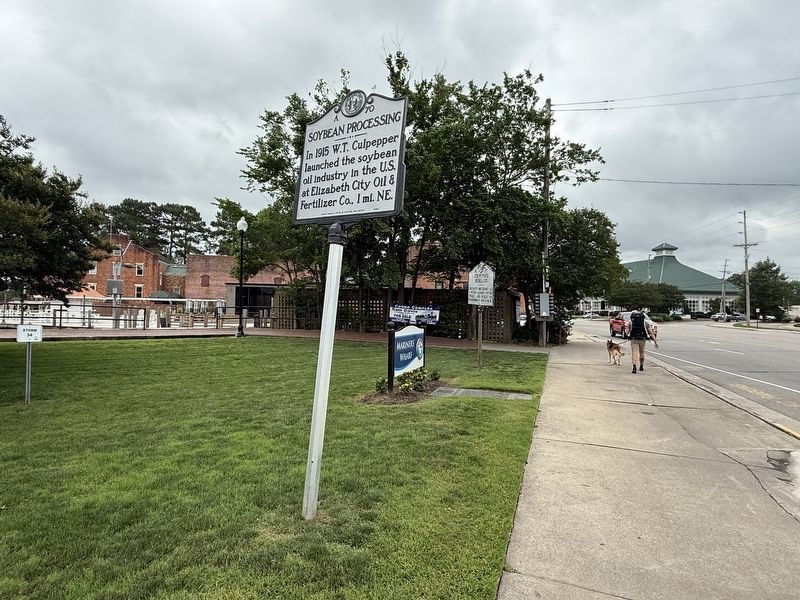
Soybean Processing

Erected 2022 by North Carolina Office of Archives and History. (Marker Number A-70.)
Topics and series. This historical marker is listed in this topic list: Industry & Commerce. In addition, it is included in the North Carolina Division of Archives and History series list. A significant historical year for this entry is 1915.
Location. 36° 17.896′ N, 76° 13.132′ W. Marker is in Elizabeth City, North Carolina, in Pasquotank County. It is at the intersection of South Water Street and East Church Street, on the right when traveling north on South Water Street. Touch for map. Marker is at or near this postal address: 214 S Water St, Elizabeth City NC 27909, United States of America. Touch for directions.

Regionally, this marker is in North Carolina’s Coastal Plain. It is also in the American South, specifically in the Upper South, in the Tidewater, and on the Eastern Seaboard. Globally, it is in the North Atlantic Region, North America, the Western Hemisphere, the Western World, and the Anglosphere.
this page online
Other nearby markers. At least 8 other markers are within walking distance of this marker: Rev. Edward M. Forbes (a few steps from this marker); Culpeper’s Rebellion (a few steps from this marker); Wright Brothers in the Albemarle (within shouting distance of this marker); Elizabeth City (within shouting distance of this marker); Wild's Raid (within shouting distance of this marker); a different marker also named Wright Brothers in the Albemarle (about 300 feet away, measured in a direct line); a different marker also named Wright Brothers in the Albemarle (about 400 feet away); Battle of Elizabeth City (about 500 feet away). Touch for a list and map of all markers in Elizabeth City.
Related marker. Click here for another marker that is related to this marker. This marker has replaced the linked marker.
Also see . . . Soybean Processing (A-70).
With the boll weevil taking its toll on North Carolina’s cotton industry,(Submitted on June 22, 2025, by Devry Becker Jones of Washington, District of Columbia.)the Elizabeth City Oil and Fertilizer Company, incorporated to manufacture cottonseed oil and other cotton by-products, tried its hand at a new commodity on December 13, 1915. At that time, under the management of William Thomas Culpepper, the company crushed approximately 20,000 bushels of soybeans, generating the first commercially produced domestic soybean oil in the country. The manufacture of the soybean oil was completed without a single alteration in existing equipment. Both the oil and the residual “cake,” usually ground into meal, were highly marketable. Other oil mills, in towns such as Winterville, New Bern, Farmville, and Wilson, began working with soybean oil shortly thereafter. The advent of domestic soybean processing made the easily grown plant popular throughout North Carolina.
The soybean was first planted in America in the late 1800s as forage for livestock. In 1904, George Washington Carver discovered that soybeans were a good source of protein and oil. He also learned, in experimenting with crop rotation, that planting soybeans for two years helped improve the soil conditions for later cotton crops. Following such research, soybean production increased. The plants flourish in North Carolina’s hot, humid summers, and as of 2002, the state ranks fifteenth in the nation in soybean yields. At the time of the first processing in Elizabeth City, North Carolina was the leading producer of the legume.
The oil processing plant was located near the intersection of North Poindexter Street and East Ward and Kramer Streets in Elizabeth City. It is no longer standing.
References:
Biennial Report of the North Carolina Department of Agriculture, 1914-1916
United States Department of Agriculture, Yearbook (1917)
(Elizabeth City) The Advance, November 30 and December 17, 1915
R. W. Judd and A. H. Probst, Soybeans: Improvement, Production, and Uses (1973)
North Carolina Soybean Producers Association website: http://www.ncsoy.org
Credits. This page was last revised on June 22, 2025. It was originally submitted on June 22, 2025, by Devry Becker Jones of Washington, District of Columbia. This page has been viewed 141 times since then and 23 times this year. Photos: 1, 2. submitted on June 22, 2025, by Devry Becker Jones of Washington, District of Columbia.
