
10 in Hiroshima, Japan — 日本国 (East Asia)
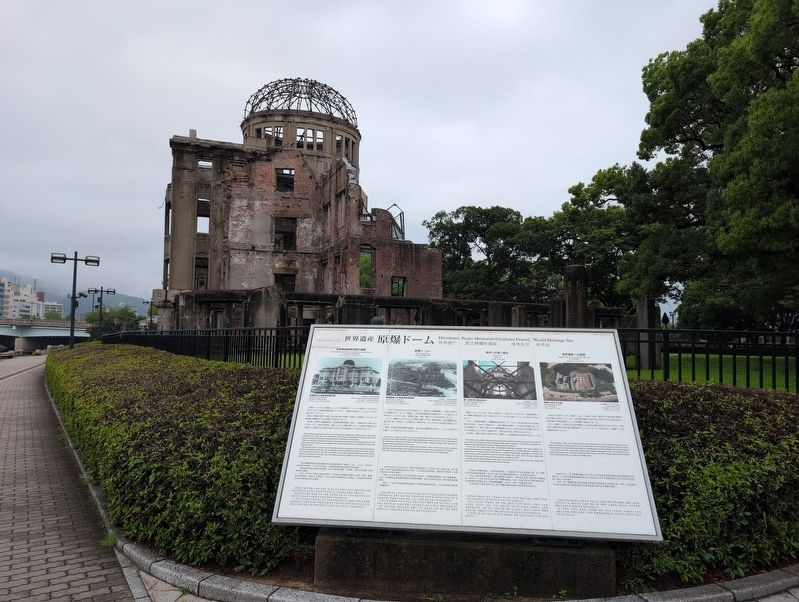
Hiroshima Peace Memorial (Genbaku Dome), World Heritage Site
Hiroshima A-Bomb Dome
Photographed by Chris Martz
1. Hiroshima Peace Memorial (Genbaku Dome) Marker

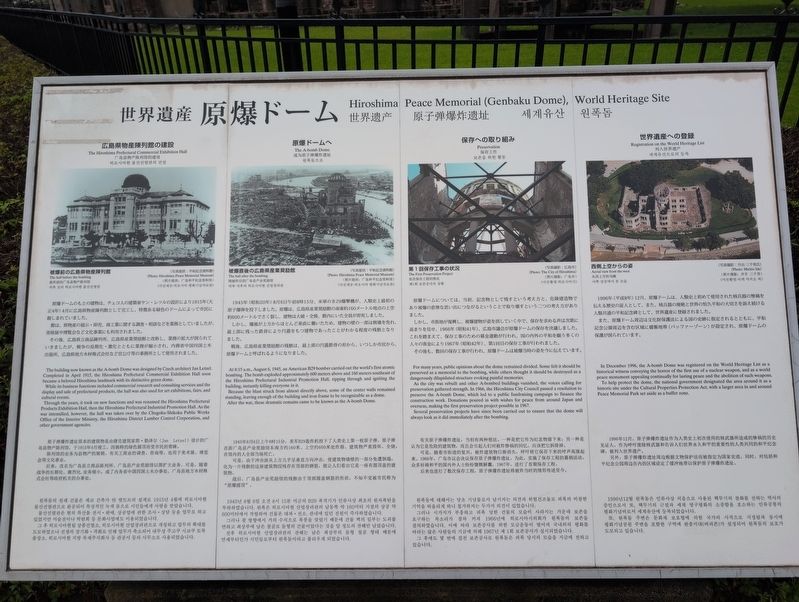
広島県物産陳列館の建設
被爆前の広島県物産陳列館
(写真提供:平和記念資料館)
原爆ドームのもとの建物は、チェコ人の建築家ヤン・レツルの設計により1915年(大正4年)4月に広島県物産陳列能として完工し、特徴ある緑色のドームによって市民に親しまれていました。
館は、県物産の展示・即売、商工業に関する調査・相談などを業務としていましたが、美術展や博覧会など文化事業にも利用されました。
その後、広島県立商品陳列所、広島県産業期奨励館と改称し、業務の拡大が図られていきましたが、戦争の長期化・激化とともに業務が縮小され、内務省中国四国土木出張所、広島県地方木材株式会社など官公庁等の事務所として使用されました。
this page online
原爆ドームへ
被爆直後の広島県産業奨励館
(写真提供:平和記念資料館)
1945年(昭和20年)8月6日午前8時15分、米軍のB29爆撃機が、人類史上最初の原子爆弾を投下しました。原爆は、広島県産業奨励館の南東約160メートル地点の上空約600メートルでさく裂し、建物は大破・全焼、館内にいた全員が即死しました。
しかし、爆風が上方からほとんど垂直に働いたため、建物の壁の一部は倒壊を免れ、最上部に残った鉄骨により円蓋をもつ建物であったことがわかる程度の残骸となりました。
戦後、広島県産業奨励館の残骸は、最上部の円蓋鉄骨の形から、いつしか市民から、原爆ドームと呼ばれるようになりました。
保存への取り組み
第1回保存工事の状況
(写真撮影:広島市)
原爆ドームについては、当初、記念物として残すという考え方と、危険建造物であり被爆の悲惨な思い出につながるということで取り壊すという二つの考え方がありました。
しかし、市街地が復興し、被爆建物が姿を消していく中で、保存を求める声は次第に高まりを見せ、1966年(昭和41年)、広島市議会が原爆ドームの保存を決議しました。これを踏まえて、保存工事のための募金運動が行われ、国の内外の平和を願う多くの人々の寄金により1967年(昭和42年)、第1回目の保存工事が行われました。
その後も、数回の保存工事が行われ、原爆ドームは被爆当時の姿を今に伝えています。
世界遺産への登録
西側上空からの姿
(写真撮影:井出
Photographed by Chris Martz
2. Hiroshima Peace Memorial (Genbaku Dome) Marker
1996年(平成8年)12月、原爆ドームは、人類史上初めて使用された核兵器の修を伝える歴史の証人として、また、核兵器の廃絶と世界の恒久平和の大切さを訴え続ける人類共通の平和記念碑として、世界遺産に登録されました。
また、原爆ドーム周辺は文化財保護法による国の史跡に指定されるとともに、平和記念公園周辺を含む区域に緩衝地帯(バッファーゾーン)が設定され、原爆ドームの保護が図られています。
The Hiroshima Prefectural Commercial Exhibition Hall
The hall before the bombing
(Photo: Hiroshima Peace Memorial Museum)
The building now known as the A-bomb Dome was designed by Czech architect Jan Letzel. Completed in April 1915, the Hiroshima Prefectural Commercial Exhibition Hall soon became a beloved Hiroshima landmark with its distinctive green dome.
While its business functions included commercial research and consulting services and the display and sale of prefectural products, the hall was also used for art exhibitions, fairs, and cultural events.
Through the years, it took on new functions and was renamed the Hiroshima Prefectural Products Exhibition Hall, then the Hiroshima Prefectural Industrial Promotion Hall. As the war intensified, however, the hall was taken over by the Chugoku-Shikoku Public Works Office of the Interior Ministry, the Hiroshima District Lumber Control Corporation, and other government agencies.
The A-Bomb Dome
The hall after the bombing
(Photo: Hiroshima Peace Memorial Museum)
At 8:15 a.m., August 6, 1945, an American B29 bomber carried out the world's first atomic bombing. The bomb exploded approximately 600 meters above and 160 meters southeast of the Hiroshima Prefectural Industrial Promotion Hall, ripping through and igniting the building, instantly killing everyone in it.
Because the blast struck from almost directly above, some of the center walls remained standing, leaving enough of the building and iron frame to be recognizable as a dome.
After the way, these dramatic remains came to be known as the A-bomb Dome.
Preservation
The First Preservation Project
(Photo: The City of Hiroshima)
For many years, public opinions about the dome remained divided. Some felt it should be preserved as a memorial to the bombing, while others thought it should be destroyed as a dangerously dilapidated structure evoking painful memories.
As the city was rebuilt and other A-bombed buildings vanished, the voices calling for preservation gathered strength. In 1966, the Hiroshima City Council passed a resolution to preserve the A-bomb Dome, which led to a public fundraising campaign to finance the construction work. Donations poured in with wishes for peace from around Japan and overseas, making the first preservation project possible in 1967.
Several preservation projects have since been carried out to ensure that the dome will always look as it did immediately after the bombing.
Registration on the World Heritage List
Aerial view from the west
(Photo: Michio Ide)
In December 1996, the A-bomb Dome was registered on the World Heritage List as a historical witness conveying the horror of the first use of a nuclear weapon, and as a world peace monument appealing continually for lasting peace and the abolition of such weapons.
To help protect the dome, the national government designated the area around it as a historic site under the Cultural Properties Protection Act, with a larger area in and around Peace Memorial Park set aside as a buffer zone.
广岛县物陈产列馆的建设
被炸前广岛县物产陈列馆
(照片提供:广岛和平纪念资料馆)
原子弹爆炸遗址原本的建筑物是由捷克建筑家简・勒泽尔(Jan Letzel)设计的广岛县物产陈列馆,于1915年4月竣工。因独特的绿色圆项而受市民的青睐。
陈列馆的业务为县物产的展销、有关工商业的调查、咨询等。也用于美术展、博览会等文化事业。
后米,改名为广岛县立商品陈列所、广岛县产业奖励馆以图扩大业务。可是,随着战争的长期化、激烈化,业务缩小,成了内务省中国四国士木办事处、广岛县地方木材株式会社等政府机关的办事处。
成为原子弹爆炸遗址
刚被炸后的广岛县产业奖励馆
(照片提供:广岛和平纪念资料馆)
1945年8月6日上午8时15分,美军B29轰炸机投下了人类史上第一枚原子弹。原子弹在距广岛县产业奖励馆东南方约160米、上空约600米处炸裂。建筑物严重毁坏、全烧,在馆内的人全部当场死亡。
可是,由于冲击波从上方几乎呈垂直方向冲击,使建筑物墙壁的一部分免遭倒塌。化为一片残骸的这座建筑物因残存在项部的钢筋,能让人们看出它是一座有圆顶盖的建筑物。
战后,广岛县产业奖励馆的残骸由于顶部圆盖钢筋的形状,不知不觉被市民称为”原爆圆项“。
保存工作
首次保存工程的情况
(照片摄影:广岛市)
有关原子弹爆炸遗址,当初有两种想法。一种是把它作为纪念物留下来;另一种是认为它是危险的建筑物,而且会引起人们对被炸惨祸的回忆,应该把它拆除掉。
可是,随着市街道的复兴,被炸建筑物日渐消失,呼吁将它保存下来的呼声高涨起来。1966年,广岛市议会决议保存原子弹爆炸遗址。沩此,实施了保存工程的募捐活动。众多祈祷和平的国内外人士纷纷慷慨解囊,1967年,进行了首期保存工程。
后来也进行了数次保存工程,原子弹爆炸遗址将被炸当时的情形传述至今。
列入世界遗产
从西上空的鸟瞰
(照片摄影:井手 三千男)
1996年12月,原子弹爆炸遗址作为人类史上初次使用的核武器所造成的惨祸的历史见证人,作为呼吁废除核武器和告诉人们世界永久和平的重要性的人类共同的和平纪念碑,被列入世界遗产。
另外,原子弹爆炸遗址周边根据文物保护法而被指定为国家史迹,同时,对包括和平纪念公园周边在内的区域设定了缓冲地带以保护原子弹爆炸遗址。
히로시마현 물산진열관의 건설
피폭 전의 히로시마현 물산진열관
(사진제공:히로시마 평화기념자료관)
원폭동의 원래 건물은 체코 건축가 얀 렛트르의 설계로 1915년 4월에 히로시마현 물산진열관으로 완공되어 특징적인 녹색 돔으로 시민들에게 사랑을 받았습니다.
물산진열관은 현의 특산물 전시 • 판매, 상공업에 관한 조사 • 상담 등을 업무로 하고 있었지만 미술전이나 박람회 등 문화사업에도 이용되었습니다.
그 후 히로시마현립 상품진열소, 히로시마현 산업장려관으로 개칭하고 업무의 확대를 도모하였으나 전쟁의 장기화 • 격화로 인해 업무가 축소되어 내무성 주고쿠 시코쿠 토목 출장소, 히로시마현 지방 목재주식회사 등 관공서 등의 사무소로 사용되었습니다.
원폭돔으로
피폭 직후의 히로시마현 산업장려관
(사진제공:히로시마 평화기념자료관)
1945년 8월 6일 오전 8시 15분 미군의 B29 폭격기가 인류사상 최초의 원자폭탄을 투하하였습니다. 원폭은 히로시마현 산업장려관의 남동쪽 약 160미터 지점의 상공 약 600미터에서 작렬하여 건물은 대파 • 전소, 관내에 있던 전원이 즉사하였습니다.
그러나 윗 방향에서 거의 수직으로 폭풍을 맞았기 때문에 건물 벽의 일부는 도괴를 면하고 최상부에 남은 철골로 돔형의 건물이었다는 것을 알 정도의 잔해만 남았습니다.
전후 히로시마현 산업장려관의 잔해는 남은 최상부의 동형 철골 형태 때문에 언제부터인가 시민들로부터 원폭돔이라고 불리우게 되었습니다.
보존을 위한 활동
제1회 보존공사의 상황
(사진촬영:히로시마시)
원폭돔에 대해서는 당초 기념물로서 남기자는 의견과 위험건조물로 피폭의 비참한 기억을 떠올리게 하니 철거하자는 두가지 의견이 있었습니다.
그러나 시가지가 부홍하고 피폭 당한 건물의 모습이 사라지는 가운데 보존을 요구하는 목소리가 점차 커져 1966년에 히로시마시의회가 원폭돔의 보존을 결의하였습니다. 이에 따라 보존공사를 위한 모금운동이 벌어져 국내외의 평화를 바라는 많은 사람들의 기금에 의해 1967년 제 1회 보존공사가 실시되었습니다.
그 후에도 몇 번에 걸친 보존공사로 원폭돔은 피폭 당시의 모습을 지금에 전하고 있습니다.
세계유산으로의 등록
서쪽 상공에서 본 모습
(사진촬영:이데 미치오 씨)
1996년12원 원폭돔은 인류사상 처음으로 사용된 핵무기의 참화를 전하는 역사의 증인으로서 또, 핵무기의 근절과 세계 영구평화의 소중함을 호소하는 인류공통의 평화기념비로서 세계유산에 등록되었습니다.
또, 원폭돔 주변은 문화재 보호법에 의한 국가의 사적으로 지정됨과 동시에 평화기념공원 주변을 포함한 구역에 완충지대(버퍼존)가 설정되어 원폭돔의 보호가 도모되고 있습니다.
Topics. This memorial is listed in this topic list: War, World II. A significant historical date for this entry is August 6, 1945.
Location. 34° 23.701′ N, 132° 27.214′ E. Memorial is in Hiroshima. It is in 10. It is on Doro. Touch for map. Memorial is at or near this postal address: Doro, Hiroshima 730-0051, Japan. Touch for directions.

Regionally, it is in Asia, specifically in East Asia, in the Pacific Ocean, in North Pacific, on the Ring of Fire, in the Pacific Rim, and in the Western World.
Other nearby markers. At least 3 other markers are within walking distance of this marker: The Hiroshima Prefectural Industrial Promotion Hall (within shouting distance of this marker); Hypocenter (about 120 meters away, measured in a direct line in Hiroshima Prefecture); Aioi Bridge (about 120 meters away in Hiroshima Prefecture).
Also see . . .
1. Hiroshima Peace Memorial (Genbaku Dome). (Submitted on July 11, 2025, by Brandon D Cross of Flagler Beach, Florida.)
2. Hiroshima Peace Memorial (Genbaku Dome). (Submitted on July 11, 2025, by Brandon D Cross of Flagler Beach, Florida.)
Credits. This page was last revised on January 14, 2026. It was originally submitted on June 24, 2025, by Chris Martz of Warrenton, Virginia. This page has been viewed 163 times since then and 54 times this year. Photos: 1, 2. submitted on June 24, 2025, by Chris Martz of Warrenton, Virginia. • Bill Pfingsten was the editor who published this page.
