Pigeon Forge in Sevier County, Tennessee — The American South (East South Central)
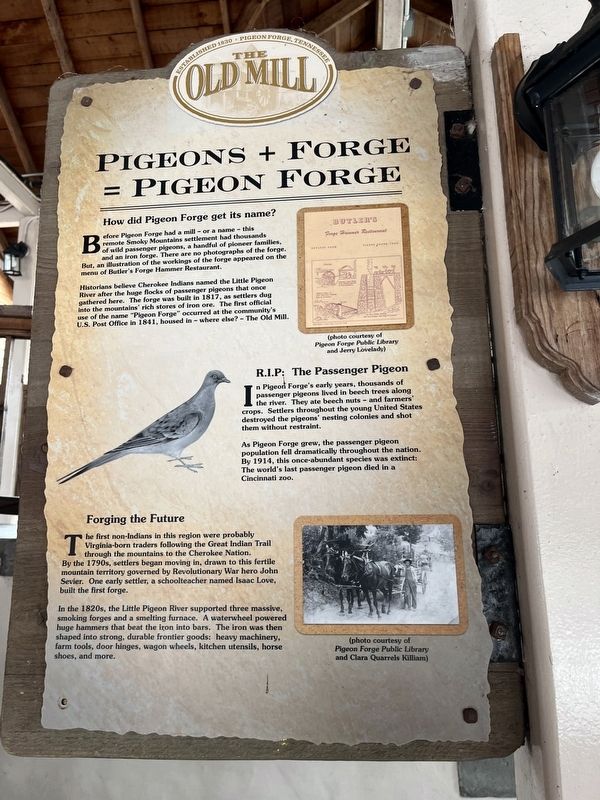
Pigeons + Forge = Pigeon Forge
| — | The Old Mill | — |
Photographed by Thomas Smith, June 9, 2025
1. Pigeons + Forge = Pigeon Forge Marker
Before Pigeon Forge had a mill- or a name - this remote Smoky Mountains settlement had thousands of wild passenger pigeons, a handful of pioneer families, and an iron forge. There are no photographs of the forge. But, an illustration of the workings of the forge appeared on the menu of Butler's Forge Hammer Restaurant.
Historians believe Cherokee Indians named the Little Pigeon River after the huge flocks of passenger pigeons that once gathered here. The forge was built in 1817, as settlers dug into the mountains' rich stores of iron ore. The first official use of the name "Pigeon Forge" occurred at the community's U.S. Post Office in 1841, housed in - where else? - The Old Mill.
R.I.P: The Passenger Pigeon
In Pigeon Forge's early years, thousands of passenger pigeons lived in beech trees along the river. They ate beech nuts and farmers crops. Settlers throughout the young United States destroyed the pigeons' nesting colonies and shot them without restraint.
As Pigeon Forge grew, the passenger pigeon population fell dramatically throughout the nation. By
this page online
Forging the Future
The first non-Indians in this region were probably Virginia-born traders following the Great Indian Trail through the mountains to the Cherokee Nation. By the 1790s, settlers began moving in, drawn to this fertile mountain territory governed by Revolutionary War hero John Sevier. One early settler, a schoolteacher named Isaac Love, built the first forge.
In the 1820s, the Little Pigeon River supported three massive, smoking forges and a smelting furnace. A waterwheel powered huge hammers that beat the iron into bars. The iron was then shaped into strong, durable frontier goods: heavy machinery, farm tools, door hinges, wagon wheels, kitchen utensils, horse shoes, and more.
Captions
(Photo #1) (Photo Courtesy of the Pigeon Forge Public Library and Jerry Lovelady)
(Photo #2) (Photo Courtesy of the Pigeon Forge Public Library and Clara Quarrels Killiam)
Topics. This historical marker is listed in these topic lists: Animals • Settlements & Settlers. A significant historical year for this entry is 1817.
Location. 35° 47.298′ N,
Photographed by Thomas Smith, June 9, 2025
2. Pigeons + Forge = Pigeon Forge Marker

Regionally, this marker is in East Tennessee and in the Great Smoky Mountains. It is also in the American South, specifically in the Upper South, in Appalachia, and specifically in Southern Appalachia. Globally, it is in North America, the Western Hemisphere, the Western World, and the Anglosphere. Historically, it finds itself in what was once the original Cherokee Nation, the territory of the Mississippian Culture, one of the Confederate States of America, the State of Franklin, and the Antebellum South.
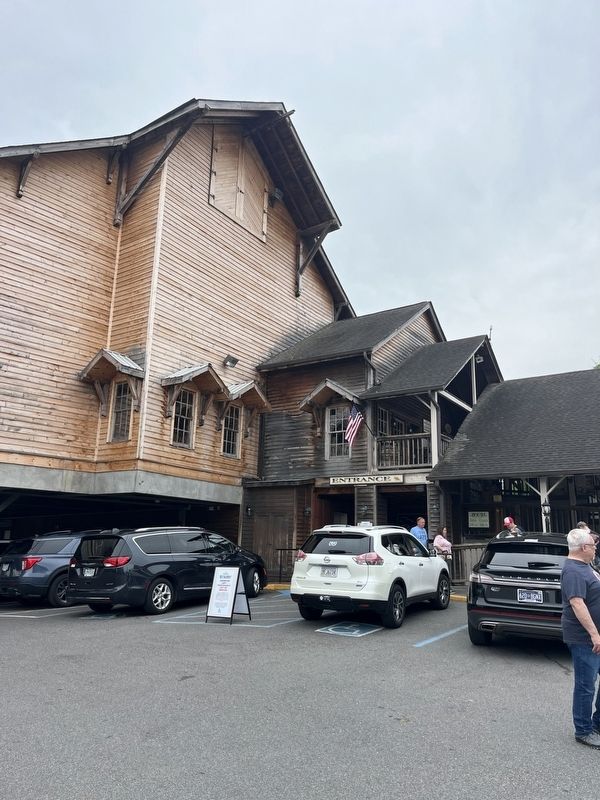
Other nearby markers. At least 8 other markers are within walking distance of this marker: Welcome to The Old Mill (here, next to this marker); Exploring The Old Mill (here, next to this marker); Antebellum Tennessee: A State Divided (here, next to this marker); Farming The Frontier (here, next to this marker); Grist Mills: What a Grind (here, next to this marker); Pigeon Forge Pottery (here, next to this marker); Good Times Through The Years (here, next to this marker); A Civil War Secret (here, next to this marker). Touch for a list and map of all markers in Pigeon Forge.
Credits. This page was last revised on July 9, 2025. It was originally submitted on June 24, 2025, by Thomas Smith of Waterloo, Ill. This page has been viewed 124 times since then and 26 times this year. Photos: 1, 2. submitted on June 24, 2025, by Thomas Smith of Waterloo, Ill. • James Hulse was the editor who published this page.
