Apalachicola in Franklin County, Florida — The American South (South Atlantic)
Odd Fellows Hall
| — | Apalachicola Black History Trail | — |
Photographed by Brandon D Cross, June 18, 2025
1. Odd Fellows Hall Marker
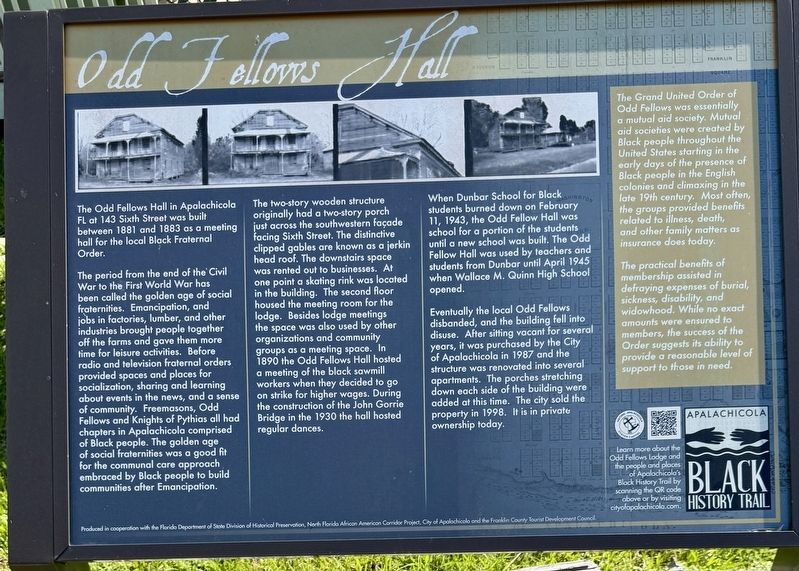
The period from the end of the Civil War to the First World War has been called the golden age of social fraternities. Emancipation, and jobs in factories, lumber, and other industries brought people together off the farms and gave them more time for leisure activities. Before radio and television fraternal orders provided spaces and places for socialization, sharing and learning about events in the news, and a sense of community. Freemasons, Odd Fellows and Knights of Pythias all had chapters in Apalachicola comprised of Black people. The golden age of social fraternities was a good fit for the communal care approach embraced by Black people to build communities after Emancipation.
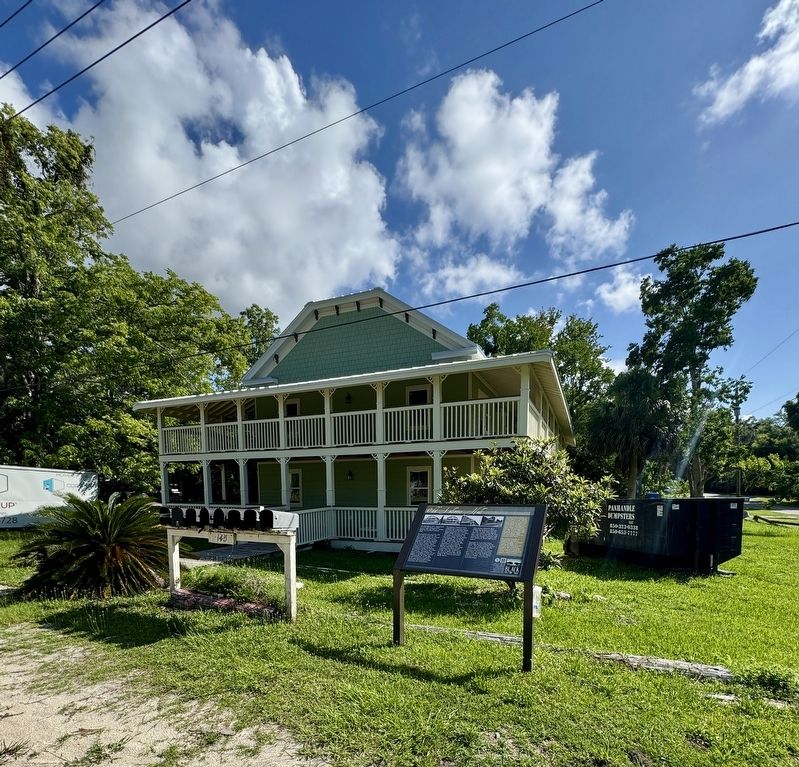
The two-story wooden structure originally had a two-story porch just across the southwestern façade facing Sixth Street. The distinctive clipped gables are known as a jerkin head roof. The downstairs space was rented out to businesses. At one point a skating rink was located in the building.
this page online
When Dunbar School for Black students burned down on February 11, 1943, the Odd Fellow Hall was school for a portion of the students until a new school was built. The Odd Fellow Hall was used by teachers and students from Dunbar until April 1945 when Wallace M. Quinn High School opened.
Eventually the local Odd Fellows disbanded, and the building fell into disuse. After sitting vacant for several years, it was purchased by the City of Apalachicola in 1987 and the structure was renovated into several-apartments. The porches stretching down each side of the building were added at this time. The city sold the property in 1998. It is in private ownership today.
(sidebar)
The Grand United Order of Odd Fellows was essentially a mutual aid society.
Photographed by Brandon D Cross, June 18, 2025
2. Odd Fellows Hall Marker
The practical benefits of membership assisted in defraying expenses of burial, sickness, disability, and widowhood. While no exact amounts were ensured to members, the success of the Order suggests its ability to provide a reasonable level of support to those in need.
Learn more about the Odd Fellows Lodge and the people and places of Apalachicola's Black History Trail by scanning the QR code above or by visiting cityofapalachicola.com
Erected by Produced in cooperation with the Florida Department of State Division of Historical Resources, North Florida African American Corridor Project, City of Apalachicola and the Franklin County Tourist Development Council.
Topics. This historical marker is listed in these topic lists: Entertainment • Fraternal or Sororal Organizations • Notable Buildings. A significant historical year for this entry is 1881.
Location. 29° 43.687′ N, 84° 59.376′ W. Marker is in Apalachicola, Florida, in Franklin County. It is on 6th Street near Avenue H, on the left when traveling east. Touch for map. Marker is at or near this postal address: 145 6th St, Apalachicola FL 32320, United States of America. Touch for directions.

Regionally, this marker is on the Florida Panhandle. It is also in the American South, specifically in the Deep South, and on the Gulf Coast. Globally, it is in the North Atlantic Region, North America, a Gulf of Mexico state, the Western Hemisphere, the Western World, and the Anglosphere. Historically, it finds itself in what was once New Spain, the territory of the Mississippian Culture, one of the Confederate States of America, and the Antebellum South.
Other nearby markers. At least 8 other markers are within walking distance of this marker: St. Paul African Methodist Episcopal Church (about 300 feet away, measured in a direct line); Three Soldiers Statue Vietnam Veterans Memorial (approx. 0.2 miles away); Apalachicola During the Civil War (approx. 0.2 miles away); Veterans Memorial (approx. 0.2 miles away); The Hanserd-Fry House (approx. 0.2 miles away); Dr. Alvin Wentworth Chapman (approx. 0.2 miles away); Steamboats on the Apalachicola River (approx. 0.2 miles away); The Dr. Alvan W. Chapman House (approx. ¼ mile away). Touch for a list and map of all markers in Apalachicola.
Also see . . .
1. Apalachicola Black History Trail. (Submitted on June 26, 2025, by Brandon D Cross of Flagler Beach, Florida.)
2. Apalachicola Historic Landmarks. (Submitted on June 26, 2025, by Brandon D Cross of Flagler Beach, Florida.)
Credits. This page was last revised on June 26, 2025. It was originally submitted on June 26, 2025, by Brandon D Cross of Flagler Beach, Florida. This page has been viewed 191 times since then and 49 times this year. Photos: 1, 2. submitted on June 26, 2025, by Brandon D Cross of Flagler Beach, Florida. • J. J. Prats was the editor who published this page.
