Workington in Cumberland, England, United Kingdom — Northwestern Europe (the British Isles)
Memories of the Bessemer
Photographed by Ray Gurganus, April 11, 2025
1. Memories of the Bessemer Marker
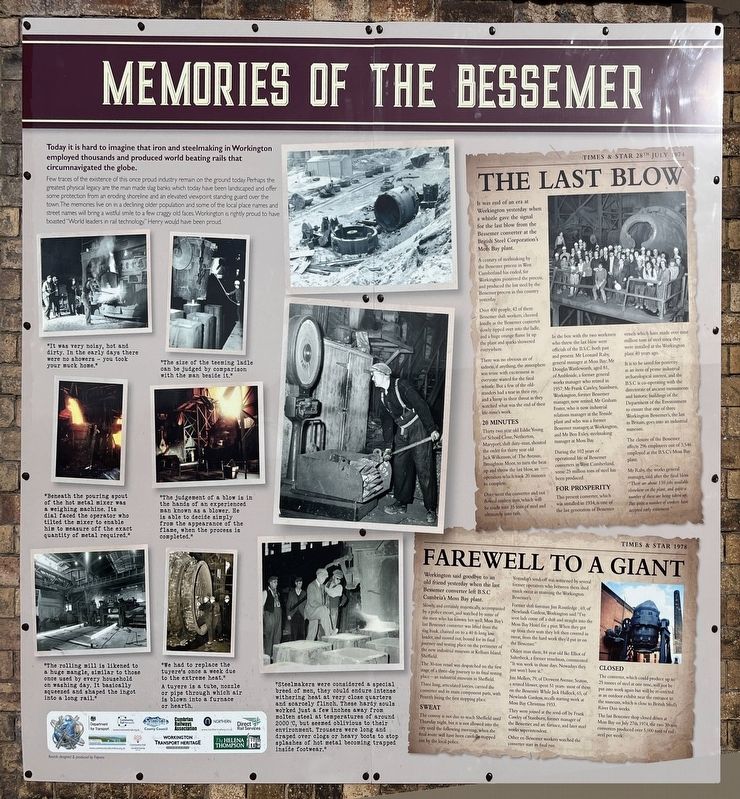
Few traces of the existence of this once proud industry remain on the ground today. Perhaps the greatest physical legacy are the man made slag banks which today have been landscaped and offer some protection from an eroding shortline and an elevated viewpoint standing guard over the town. The memories live on in a declining older population and some of the local place names and street names will bring a wistful smile to a few craggy old faces. Workington is rightly proud to have boasted "World leaders in rail technology". Henry would have been proud.
Times & Star, 28 July 74
The Last Blow
It was end of an era at Workington yesterday when a whistle gave the signal for the last blow from the Bessemer converter at the British Steel Corporation's Moss Bay plant.
A century of steelmaking by the Bessemer process in West Cumberland has ended, for Workington pioneered the process, and produced the last steel by the Bessemer process in this country yesterday. Over 400
this page online
There was no obvious air of sadness, if anything, the atmosphere was tense with excitement as everyone waited for the final whistle. But a few of the old-standers had a tear in their eye, and a lump in their throat as they watched what was the end of their life-time's work.
20 Minutes
Thirty two year old Eddie Young of School Close Netherton, Maryport, shift duty-man, shouted the order for thirty year old Jack Wilkinson, of The Avenue, Broughton Moor, to turn the heat up and throw the last blow, an operation which took 20 minutes to complete.
Over went the converter and out flowed molten iron, which will be made into 35 tons of steel and ultimately into rails.
In the box with the two workmen who threw the last blow were officials of the B.S.C. both past and present. Mr Leonard Raby, general manager at Moss Bay; Mr Douglas Wattleworth, aged 81, of Ambleside, a former general works manager who retired in 1957; Mr Frank Cawley, Stainburn, Workington, former Bessemer manager, now retired; Mr Graham Foster, who is now industrial relations manager at the Teeside plant and who was a former Bessemer manager, at Workington, and Mr Ben Exley, steelmaking manager at Moss Bay.
During the 102 years of operational life of Bessemer converters in West Cumberland, some 25 million tons of steel has been produced.
For Prosperity
This present converter, which was installed in 1934, is one of the last generation of Bessemer vessels which have made over nine million tons of steel since they were installed at the Workington plant 40 years ago.
It is to be saved for posterity as an item of prime industrial archaeological interest, and the B.S.C is co-operating with the directorate of ancient monuments and historic buildings of the Department of the Environment to ensure that one of three Workington Bessemer's, the last in Britain, goes into an industrial museum.
The closure of the Bessemer affects 296 employees out of 3,546 employed at the B.S.C.'s Moss Bay plant. Mr Raby, the works general manager, said after the final blow "There are about 150 jobs available elsewhere on the plant, and quite a number of these are being taken up. But quite a number of workers have accepted early retirement."
Times & Star 1978
Farewell to a Giant
Workington said goodbye to an old friend yesterday when the last Bessemer converter left B.S.C Cumbria's Moss Bay plant. Slowly, and certainly majestically, accompanied by a police escort, and watched by some of the men who has known her well, Moss Bay's last Bessemer converter was lifted from the slag bank, chained on to a 40 ft-long low loader, and moved out, bound for its final journey and resting place on the perimeter of the new industrial museum at Kelham Sheffield. The 30-ton vessel was despatched on the first stage of a three-day journey to its final resting place — an industrial museum in Sheffield. Three long, articulated lorries, carried the converter and its main component parts, with Penrith being the first stopping place.
Sweat
The convoy is not due to reach Sheffield until Thursday night, but it is not allowed into the city until the following morning, when the final route will have been carefully mapped out by the local police.
Yesterday's send-off was witnessed by several former operatives who between them shed much sweat in manning the Workington Bessemer's. Former shift foreman Jim Routledge, 69, of Newlands Gardens, Workington said: "I've seen lads come off a shift and straight into the Moss Bay Hotel for a pint. When they got up from their seats they left then covered in sweat, from the hard work they'd put in on the Bessemer." Oldest man there, 84 year old Ike Elliot of Salterbeck, a former vesselman, commented: "It was work in those days. Nowadays they just won't have it." Jim Mellers, 79, of Dement Avenue, Seaton, a retired blower, spent 51 years - most of them on the Bessemer. While Jack Hullock, 65, of Newlands Gardens, recalls starting work at Moss Bay Christmas 1933. They were joined at the send-off by Frank Cawley of Stainburn, former manager of the Bessemer, and arc furnace, and later steel works superintendent. Other ex-Bessemer workers watched the converter start its final run.
Closed
The converter, which could produce up to 25 tonnes of steel at one time, will not be put into work again but will be re-erected as an outdoor exhibit near the entrance to the museum, which is close to British Steel's River Don works. The last Bessemer shop closed down at Moss Bay on July 27th 1974, the two 30-ton converters produced over 5,000 tons of rail steel per week.
Erected by Cumbria County Council.
Topics. This historical marker is listed in this topic list: Industry & Commerce. A significant historical year for this entry is 1974.
Location. 54° 38.692′ N, 3° 33.549′ W. Marker is in Workington, England, in Cumberland. It can be reached from Belle Isle Place. On the platform at the Workington train station. Touch for map. Marker is at or near this postal address: 20 Belle Isle Place, Workington, England CA14 2XF, United Kingdom. Touch for directions.

Regionally, this marker is in North West England. Globally, it is on the Atlantic Ocean, in the North Atlantic Region, in Europe, in Atlantic Europe, on one of the British Isles, in the Western World, and in the Anglosphere. Historically, it finds itself in what was once the Roman Empire.
Other nearby markers. At least 8 other markers are within walking distance of this marker: Shipping Throughout the Years (here, next to this marker); The Bessemer Impact (here, next to this marker); Workington Iron and Steel (here, next to this marker); The Rails Which Circled the World (here, next to this marker); The Steel Making Process (a few steps from this marker); The Rail Making Process (a few steps from this marker); Decline of the Local Coal Industry (a few steps from this marker); A Local History of Coal Mining (a few steps from this marker). Touch for a list and map of all markers in Workington.
Credits. This page was last revised on June 28, 2025. It was originally submitted on June 26, 2025, by Ray Gurganus of Washington, District of Columbia. This page has been viewed 90 times since then and 28 times this year. Photo 1. submitted on June 26, 2025, by Ray Gurganus of Washington, District of Columbia. • Andrew Ruppenstein was the editor who published this page.
