
Caen in Calvados, Normandy, France — Western Europe
La salle de l'Échiquier
⎯⎯⎯
The Dukes of Normandy's Great Hall
Photographed by James Hulse, June 2, 2025
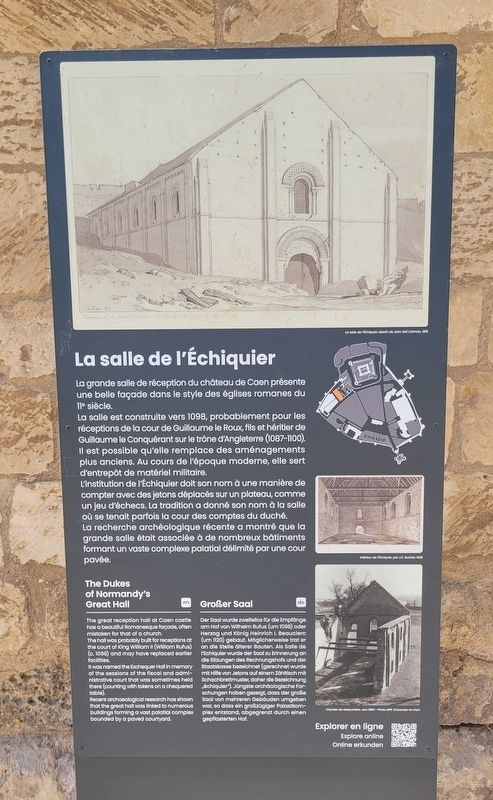
1. La salle de l'Échiquier / The Dukes of Normandy's Great Hall Marker

La salle de l'Échiquier
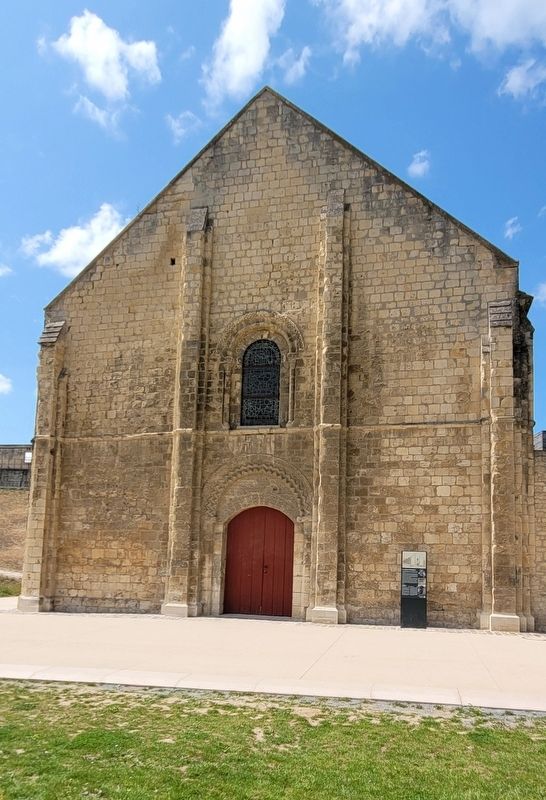
La grande salle de réception du château de Caen présente une belle façade dans le style des églises romanes du 11e siècle.
La salle est construite vers 1098, probablement pour les réceptions de la cour de Guillaume le Roux, fils et héritier de Guillaume le Conquérant sur le trône d'Angleterre (1087-1100). Il est possible qu'elle remplace des aménagements plus anciens. Au cours de l'époque moderne, elle sert d'entrepôt de matériel militaire.
L'institution de l'Échiquier doit son nom à une manière de compter avec des jetons déplacés sur un plateau, comme un jeu d'échecs. La tradition a donné son nom à la salle où se tenait parfois la cour des comptes du duché. La recherche archéologique récente a montré que la grande salle était associée à de nombreux bâtiments formant un vaste complexe palatial délimité par une cour pavée.
Légendes
(Photo #1) La salle de réchiquiers, dessin de John Sell Cotman, 1819
(Photo #2) Intérieur de l'Échiquier, par J.C.
Buckler, 1836 (Photo #3) Chantier de restauration, vers 1960-Photo MPP, Charenton-le-Pont
The Dukes of Normandy's Great Hall
The great reception hall at Caen castle has a beautiful Romanesque façade, often mistaken for that of a church.
The hall was probably built for receptions at the court of King William II (William Rufus) (c. 1098) and may have replaced earlier facilities.
It was named the Exchequer Hall in memory of the sessions of the fiscal and administrative court that was sometimes held there (counting with tokens on a chequered table).
Recent archaeological research has shown that the great hall was linked to numerous buildings forming a vast palatial complex bounded by a paved courtyard.
Captions
(Photo #1) The Chestroom, drawing by John Sell Cotman, 1819
(Photo #2) Interior of the Exchequer, by J.C. Buckler, 1836
(Photo #3) Restoration site, circa 1960 - Photo MPP, Charenton-le-Pont
Großer Saal
Der Saal wurde zweifellos für die Empfänge am Hof von Wilhelm Rufus (um 1098) oder Herzog und König Heinrich I. Beauclerc (um 1120) gebaut. Möglicherweise trat er an die Stelle älterer Bauten. Als Salle de l'Echiquier wurde der Saal zu Erinnerung an die Sitzungen des Rechnungshofs und der Staatskasse bezeichnet (gerechnet wurde mit Hilfe von Jetons auf einem Zähltisch mit Schachbrettmuster, daher die Bezeichnung „échiquier"). Jüngste archäologische Forschungen haben gezeigt, dass der große Saal von mehreren Gebäuden umgeben war, so dass ein großzügiger Palastkomplex entstand, abgegrenzt durch einen gepflasterten Hof.
Bildunterschriften
(Foto #1) Die Truhe, Zeichnung von John Sell Cotman, 1819
(Foto #2) Innenansicht des Schatzamtes, von J.C. Buckler, 1836
(Foto #3) Restaurierungsstelle, ca. 1960 – Foto MPP, Charenton-le-Pont
Erected by Château
this page online
Topics. This historical marker is listed in these topic lists: Forts and Castles • Religion & Religious Structures.
Location. 49° 11.192′ N, 0° 21.835′ W. Marker is in Caen, Normandie (Normandy), in Calvados. It is at the intersection of Av. de la Libération and Rue Montoir Poissonnerie on Av. de la Libération. The marker is located on the grounds of the Château de Caen. Touch for map. Marker is at or near this postal address: Château de Caen, Caen, Normandie 14000, France. Touch for directions.

Regionally, it is in the North Atlantic Region, Europe, the European Union, Atlantic Europe, the Schengen Area, Western Europe, a coastal Mediterranean country, and the Western World. Historically, it finds itself in what was once a French colony and also the Roman Empire.
Other nearby markers. At least 8 other markers are within walking distance of this marker: Le Vieux Palais / The Old Palace (within shouting distance of this marker); Le Donjon / From the Anglo-Norman keep to the French chatelet (within shouting distance of this marker); Les tours du côté des champs / The Field-side Tower
Photographed by James Hulse, June 2, 2025
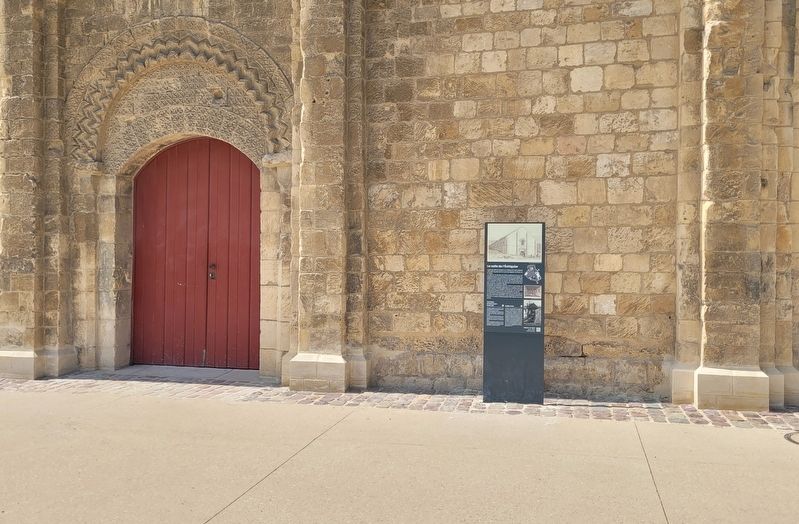
2. La salle de l'Échiquier / The Dukes of Normandy's Great Hall Marker
Also see . . . The Échiquier Hall. (Submitted on June 28, 2025, by James Hulse of Medina, Texas.)
Photographed by James Hulse, June 2, 2025
3. The front facade of the Dukes of Normandy's Great Hall
Photographed by James Hulse, June 2, 2025
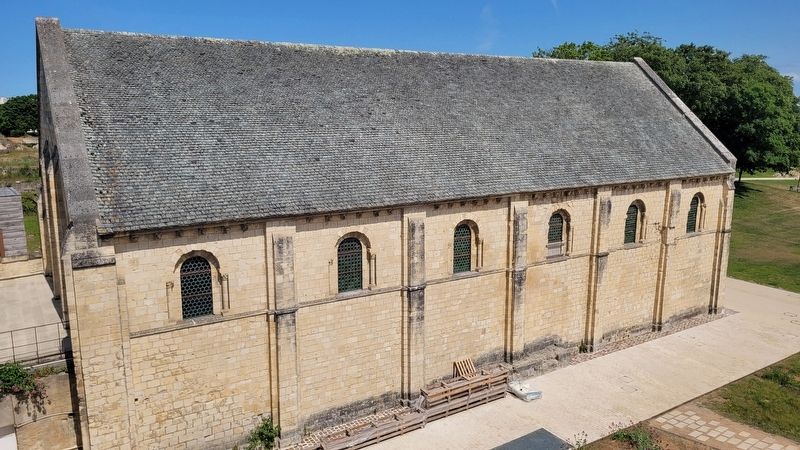
4. A side view of the Dukes of Normandy's Great Hall
Credits. This page was last revised on June 28, 2025. It was originally submitted on June 27, 2025, by James Hulse of Medina, Texas. This page has been viewed 136 times since then and 26 times this year. Photos: 1, 2, 3, 4. submitted on June 28, 2025, by James Hulse of Medina, Texas.
