
Nether Poppleton in York, England, United Kingdom — Northwestern Europe (the British Isles)
Poppleton Tithe Barn and the surrounding area
Photographed by Ray Gurganus, April 18, 2025
1. Poppleton Tithe Barn Marker
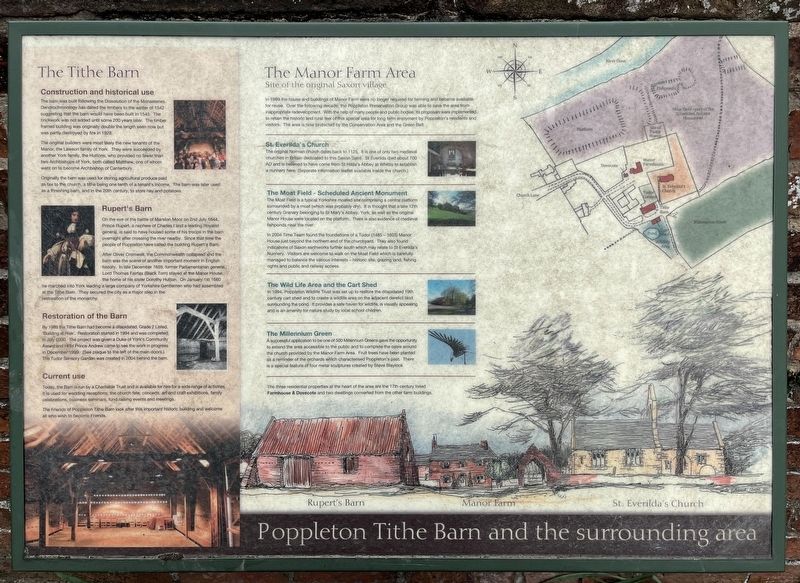
The Tithe Barn
Construction and historical use
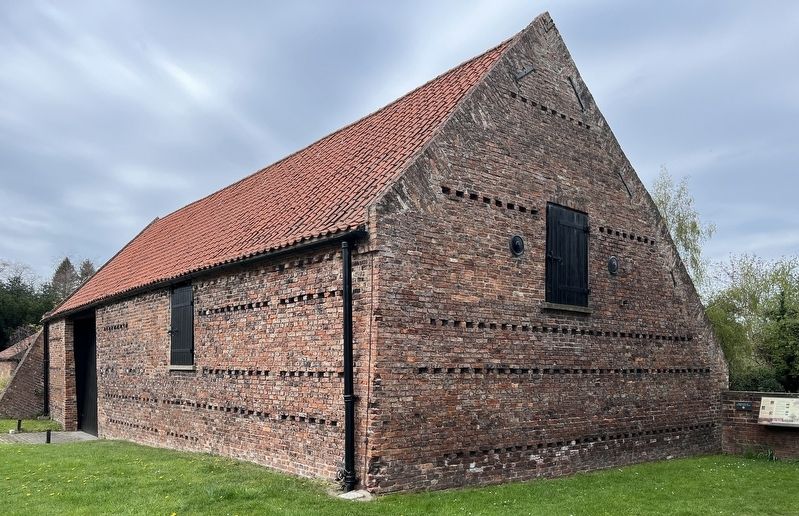
The barn was built following the Dissolution of the Monasteries. Dendrochronology has dated the timbers to the winter of 1542 suggesting that the barn would have been built in 1543. The brickwork was not added until some 200 years later. The timber framed building was originally double the length seen now but was partly destroyed by fire in 1928.
The original builders were most likely the new tenants of the Manor, the Lawson family of York. They were succeeded by another York family, the Huttons, who provided no fewer than two Archbishops of York, both called Matthew, one of whom went on to become Archbishop of Canterbury.
Originally the barn was used for storing agricultural produce paid as tax to the church, a tithe being one tenth of a tenant's income.
The barn was later used as a threshing barn, and in the 20th century, to store hay and potatoes.
Rupert's Barn
On the eve of the battle of Marston Moor on 2nd July 1644, Prince Rupert, a nephew of Charles I and a leading Royalist general, is said to have housed some of his troops in the barn overnight after
this page online
After Oliver Cromwell, the Commonwealth collapsed and the barn was the scene of another important moment in English history. In late December 1659, former Parliamentarian general, Lord Thomas Fairfax (Black Tom) stayed at the Manor House, the home of his sister Dorothy Hutton. On January 1st 1660 he marched into York leading a large company of Yorkshire Gentlemen who had assembled at the Tithe Barn. They secured the city as a major step in the restoration of the monarchy.
Restoration of the Barn
By 1989 the Tithe Barn had become a dilapidated, Grade 2 Listed, 'Building at Risk'. Restoration started in 1994 and was completed in July 2000. The project was given a Duke of York's Community Award and HRH Prince Andrew came to see the work in progress in December' 1999. (See plaque to the left of the main doors.) The Tudor Sensory Garden was created in 2004 behind the barn.
Current use
Today, the Barn is run by a Charitable Trust and is available for hire for a wide range of activities. It is used for wedding receptions, the
Photographed by Ray Gurganus, April 18, 2025
2. Poppleton Tithe Barn and Marker
The Friends of Poppleton Tithe Barn look after this important historic building and welcome all who wish to become Friends.
The Manor Farm Area
Site of the original Saxon village
In 1989 the house and buildings of Manor Farm were no longer required for farming and became available for reuse. Over the following decade, the Poppleton Preservation Group was able to save the area from inappropriate redevelopment. With the help of many people and public bodies, its proposals were implemented to retain the historic and rural feel of this special area for long term enjoyment by Poppleton's residents and visitors. The area is now protected by the Conservation Area and the Green Belt.
Everilda's Church
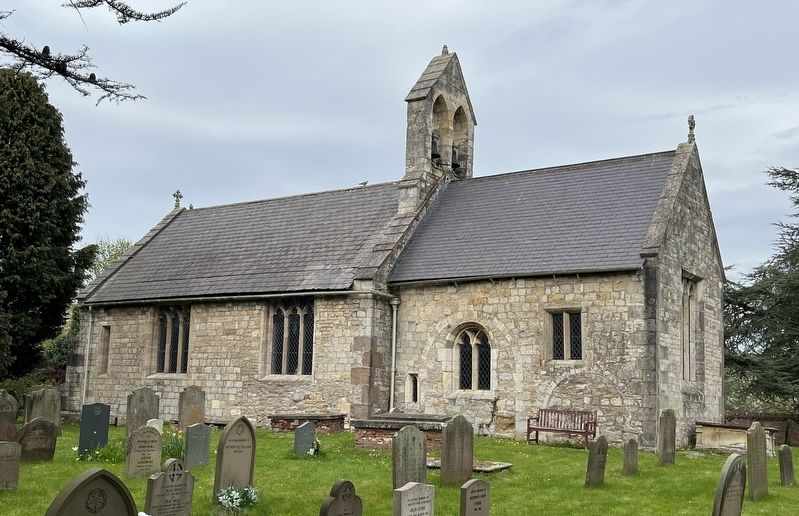
The original Norman church dates back to 1125. It is one of only two medieval churches in Britain dedicated to this Saxon Saint. St Everilda died about 700 AD and is believed to have come from St Hilda's Abbey at Whitby to establish a nunnery here. (Separate information leaflet available inside the church.)
The Moat Field - Scheduled Ancient Monument
The
Photographed by Ray Gurganus, April 18, 2025
3. St Everilda's Church
In 2004 Time Team found the foundations of a Tudor (1485 - 1603) Manor House just beyond the northern end of the churchyard. They also found indications of Saxon earthworks further south which may relate to St Everilda's Nunnery. Visitors are welcome to walk on the Moat Field which is carefully managed to balance the various interests - historic site, grazing land, fishing rights and public and railway access.
The Wild Life Area and the Cart Shed
In 1994, Poppleton Wildlife Trust was set up to restore the dilapidated 19th century cart shed and to create a wildlife area on the adjacent derelict land surrounding the pond. It provides a safe haven for wildlife, is visually appealing and is an amenity for nature study by local school children.
The Millennium Green
A successful application to be one of 500 Millennium Greens gave the opportunity to extend the area accessible to the public and to complete the oasis around the church provided by the Manor Farm Area. Fruit trees have been planted as a reminder of the orchards which characterised Poppleton's past. There is a special feature of four metal sculptures created by Steve Blaylock.
The three residential properties at the head of the area are the 17th century listed Farmhouse & Dovecote and two dwellings converted from the other farm buildings.
Topics. This historical marker is listed in this topic list: Religion & Religious Structures. A significant historical date for this entry is January 1, 1660.
Location. 53° 59.289′ N, 1° 8.452′ W. Marker is in Nether Poppleton, England, in York. It is on Church Lane. Touch for map. Marker is at or near this postal address: 29 Church Lane, Nether Poppleton, England YO26 6LF, United Kingdom. Touch for directions.

Regionally, this marker is in England’s Yorkshire & The Humber. Globally, it is on the Atlantic Ocean, in the North Atlantic Region, in Europe, in Atlantic Europe, on one of the British Isles, in the Western World, and in the Anglosphere. Historically, it finds itself in what was once the Roman Empire.
Other nearby markers. At least 8 other markers are within 5 kilometers of this marker, measured as the crow flies: W. H. Auden (1907-1973) (approx. 4.4 kilometers away); St Mary’s Abbey (approx. 4.5 kilometers away); Bootham (approx. 4.6 kilometers away); Yorkshire Philosophical Society (approx. 4.6 kilometers away); William Etty R.A. (approx. 4.6 kilometers away); Afghanistan War Memorial (approx. 4.6 kilometers away); Exhibition Square (approx. 4.6 kilometers away); Foundation of York Fountain (approx. 4.6 kilometers away).
Credits. This page was last revised on July 1, 2025. It was originally submitted on June 28, 2025, by Ray Gurganus of Washington, District of Columbia. This page has been viewed 126 times since then and 20 times this year. Photos: 1, 2, 3. submitted on June 28, 2025, by Ray Gurganus of Washington, District of Columbia. • Andrew Ruppenstein was the editor who published this page.
