Pittsville in Wood County, Wisconsin — The American Midwest (Great Lakes)
History of the Bataan Death March Memorial

Photographed by Susan Van Den Bosch, May 25, 2024
1. Bataan Death March Memorial
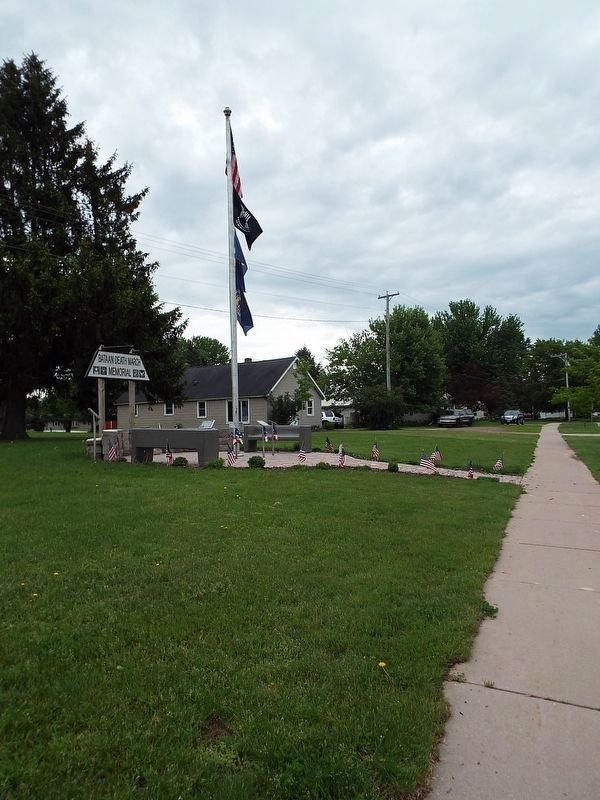
World War II came to the Philippines the same day it came to Hawaii (December 7, 1941) and in the same manner-a surprise air attack. In the case of the Philippines, however, this initial strike was followed by a full-scale invasion of the main island of Luzon three days later. By early January, the America and Filipino defenders were forced to retreat to a slim defensive position on the island's wester Bataan Peninsula.
The American and Filipino forces fought from an untenable position until formally surrendering to the Japanese on April 9, 1942. The Japanese immediately began to march some 76,000 prisoners (20,000 American, the remainder Filipinos) northward into captivity along a route of death. When three American officers escaped a year later, the world learned the unspeakable atrocities along the 60 mile journey that became known as the Bataan March.
Japanese butchery, disease, exposure to the blazing sun, lack of food, and lack of water took the lives of approximately 5,200 American along the way. Many prisoners were bayoneted, shot, beheaded or just left to die on the side of the road. "A Japanese soldier
this page online
The ordeal lasted five days for some and up to twelve days for thers. Although the Japanese were unprepared for the large number of prisoners in their care, the root of the brutality lay in the Japanese attitude that a soldier should die rather than surrender. A warrior's surrender meant the forfeiture of all rights to treatment as a human being. Of the 20,000 American troops surrendering only 1,700 survived.
Four of the American soldiers who survived the inhuman treatment of the Bataan Death March were from Wood County, Wisconsin, namely: Elmer Blonien of Rudolph, Clinton Guelzow of Wisconsin Rapids, Floyd Dotter of Pittsville, and Peter Karaliunas of Blenker. Blonien died following the contracting of malaria and eventual infection of his spleen. A Japanese doctors attempt to remove his infected spleen resulted in his death in the prison camp in Cabanatuan, in the Philippines.
Photographed by Susan Van Den Bosch, May 25, 2024
2. Bataan Death March Memorial
Following the dropping of the atomic bomb on Hiroshima on August 6, 1945 and Nagasaki, Japan on August 9, 1945, the eventual date of surrender took place on August 15, 1945, hence freedom for all the prisoners of war.
The United State of America used the atomic bomb against those who attacked us without warning at Pearl Harbor, against those who had starved, beaten or executed American prisoners of war. It was used in order to shorten the agony of war and in order to save the live of thousands and thousands of young Americans.
Erected 2021.
Topics. This memorial is listed in these topic lists: Patriots & Patriotism • War, World II. A significant historical date for this entry is April 9, 1942.
Location. 44° 26.045′ N, 90° 7.641′ W. Memorial is in Pittsville, Wisconsin, in Wood County. It is at the intersection of Wisconsin Route

Photographed by Susan Van Den Bosch, May 25, 2024
3. Clint Guelzow
Born: February 8, 1917 Died: April 9, 2012

Regionally, this memorial is in Northern Wisconsin. It is also in the American Midwest and in the Corn Belt. Globally, it is in North America, the Western Hemisphere, the Western World, and the Anglosphere. Historically, it finds itself in what was once the territory of the Mississippian Culture and also the Northwest Territory.
Other nearby markers. At least 8 other markers are within 10 miles of this marker, measured as the crow flies: Center of the State of Wisconsin (approx. 0.3 miles away); City Founders’ Cemetery (approx. 0.6 miles away); Gallagher Foundation (approx. 6.8 miles away); Indian Bill Cemetery (approx. 6.9 miles away); Geological History of Powers Bluff (approx. 7.1 miles away); Wallace B. Grange (approx. 7.2 miles away); Babcock (approx. 9.1 miles away); Cranberry Culture (approx. 9.4 miles away). Touch for a list and map of all markers in Pittsville.
Other markers no longer nearby.

Photographed by Susan Van Den Bosch, May 25, 2024
4. Elmer F. Blonien
Born: April 12, 1916 Died: October 20, 1942
Regarding History of the Bataan Death March Memorial. •Clint Guelzow
Born: February 8, 1917
Birthplace: Oakfield, Wisconsin (Fond du Lac County)
Family: Ferdinand & Marie Guelzow
Parents Children: Bernice, Kathy, Marie, Norma Bill, Clint, Don, Merlin, Ray, Robert, Wilbur
Clint’s Children: Julie, Karen, Mary, Mark
Occupation: Heating Business – After the war
Military Branch: U.S. Army
Unit: Co. “a” 31st Inf Philippine Division (Frontline Machine Gunner)
Where Stationed: Following enlistment – Directly to Manila in Philippines, only American infantry unit in Philippines when war started in ‘41
Service History:
Clint enlisted in the army in February of 1941 in anticipation he could pick a good place to serve his country. History would show that right after being sworn in his unit was sent to San Francisco and then shipped to the Philippines for infantry training. When the war began in December of 1941 their units were greatly outnumbered by Japanese who had invaded the

Photographed by Susan Van Den Bosch, May 25, 2024
5. Floyd H. Dotter
Born: May 6, 1919 Died: November 23, 1923
The allied troops had been receiving limited amounts of food and ammunition in their defensive efforts to thwart the advances of the Japanese who greatly outnumbered the American and Philippine soldier. Diseases and starvation began to take its toll.
The eventual surrender of the troops to the Japanese on April 9. 1942 was then followed by the “Bataan Death March” of thousands of prisoners in which many died from inhuman treatment which included beatings, bayoneting, being shot or merely dying or barely surviving die to lack of water, rest, food, and diseases. The March covered approximately 65 miles in 9 to 12 days before they reached their prison.
The captives that survived, included Clint Guelzow, were then placed in prisons where inhuman treatment continues. After two years of prison care together with a frail Lwt Clint Guelzow was among a large group of American soldiers that were shipped to mainland Japan to work in copper or coal mines. There they were told, “You are Americans and you are our enemy and will always be our enemy. You will work in our mines until you die.”
The dropping of the
Photographed by Susan Van Den Bosch, May 25, 2024
6. Peter B. Karaliunas
Born: June 29, 1915 Died: May 7 ,2008
Guelzow, who had been held captive for nearly 3.5 years along with many other soldiers was then released from prisons and were eventually flown home to be with their families and a deserving life of freedom.
Despite nearly dying in a prison camp, Guelzow recovered, married, helped raising four children, developed a profitable heating & air conditioning business and died on April 9, 2012 at the age of 95.
•Elmer F. Blonien
Born: April 12, 1916
Birthplace: Rudolph, Wisconsin
Parents: John K. BLonien & Katherine Blonien
Family: Three sisters & one brother
Occupation: Worked in family grocery store until being drafted April 7, 1941
Military Branch: U.S. Army Unit: “A” Co. 192nd Tank Battalion
Where Stationed: Basic training at Ft. Knox, Kentucky and combat in Philippines
Service History:
Following basic training Blinien was sent to Camp Polk, Louisiana for maneuvers training
before being sent to the Philippines on December 8, 1941. While being stationed at Clark
Field in the Philippines he survived the aerial attack by the Japanese and four months of combat against the Japanese in the jungles of Luzon, and island of the Philippines.
Then on April9 , 1941 after facing tremendous odds of military manpower the Filipino and American forces surrendered to the Japanese. Blonien was among the thousands of Flipino and American soldiers who were forced to march the 60 miles to prison camps.
The brutal conditions during the “Bataan Death March: took the lives of thousands of Filipino and American soldiers. Many of those who died where clubbed or bayoneted to death when, too weak to walk, stumbled or fell. The blazing sun, diseases, a limited amount of food and water also took its’ toll.
Blonien survived the march but later when he was imprisoned at the Cabanatuan Prison Camp in the Philippines, he became ill with malaria which resulted in him developing a spleen infection. A doctor on duty removed Blonien’s spleen without anesthesia, anesthetic or the proper medical equipment. Pvt. Blonien died after the surgery on October 20th 1942 and was buried at the camp cemetery at Cabanatuan in the Philippines.
After the war, the remains of Pvt. Elmer F. Blonien could not be identified. He is most likely buried at the American Military Cemetery outside the city of Mnaila, as an unknown. Since Elmer’s final resting place is unknown, his name appears on the tablets of the missing at the American Military Cemetery outside Manila.
The meaningful phrase, “all gave some-some gave all” was appropriately considered when the American Legion Post #485 of Rudolph honored Pvt. Elmer F. Blonien as their namesake.
•Floyd H. Dotter
Born: May 6, 1919
Birthplace: Tomahawk, Wisconsin
Parents: Henry & Anna Dotter
Married: 8-24-1946 to Ruth Hecht
Family: Daughter Gloria, sons George, Barry, Henry, Hal
Occupation: Mechanic & farming
Military Branch: U.S. Army
Unit: U.S. Army 31st Inf Co “D” Philippine
Where Stationed: Philippines & Japan
Service History:
Following his induction and basic training his unit was sent to the Philippines to stave off Japanese numerically numbered forces that has invaded the island of Luzon in the Philippines in the early part of 1942. The unbelievable number of Japanese forces overwhelmed the 64,000 Philippine and approximately 20,000 American Soldiers who were forced to surrender and become captives of the Japanese on April 9, 1942.
The captives were then forced to spend the next 10 days marching 60 miles to their initial prison camp. The brutal conditions during the “Bataan Death March” took the lives of thousands of Filipino and American soldiers. Many of those who died where clubbed or bayoneted to death when, too weak to walk, stumbled or fell. Others were ordered out of the ranks, beaten, tortured and killed.
Dotter survived the deadly 60 miles march and spent additional time in prison camps where he witnessed the loss of live due to starvation, disease, and brutality before eventually being shipped to Kyushu, Japan where he, along with many other prisoners spent the final year of their more than three years of Japanese captivity doing hard labor working in the coal mines.
Despite the brutality and lack of food and humane care, American soldier Floyd H. Dotter was a survivor when the war ended in 1945 and was able to return to civilian life in October of 1946 to enjoy the freedom that he sought for all Americans, get married and raise his family.
Dotter was never able to regain his good health and died at the age of 74 on 11-23-1993.
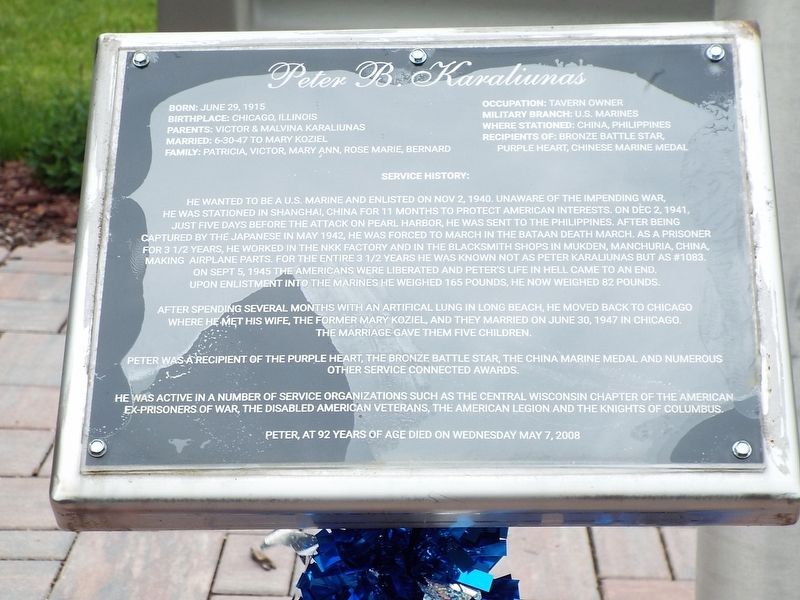
•Peter B. Karaliunas
Born: June 29, 1915
Birthplace: Chicago, Illinois
Parents: Victor & Malvina Karaliunas
Married: 6/30/47 to Mary Koziel
Family: Daughter Glori, sons George, Barry, Henry, Hal
Occupation: Tavern Owner
Military Branch: U.S. Marines
Where Stationed: China, Phillipines
Recipeint of: Bronze Battle Star, Purple Heart, Chinese Marine Medal
Service History:
He wanted to be a U.S. Marine and enlisted on Nov 2, 1940. Unaware of the impending war, He was stationed in Shanghai, China for 11 months to protect American interests. On Dec 2, 1941, just five days before the attack on Pearl Harbor, he was sent to the Philippines. After being captured by the Japanese in May 1942, he was forced to march in the Bataan Death March. As a prisoner for 3 ½ years, he worked in the NKK factory and the blacksmith shops in Mukden, Manchuria, China, making airplane parts. For the entire 3 ½ yers he was known not as Peter Karaliunas but as #1083. On Sept 5, 1945 the Americans were liberated and Peter’s life in hell came to an end. Upon enlistment into the Marines he weighted 165 pounds, he now weighed 82 pounds.
After spending several months with an artificial lung in Long Geach, he moved back to Chicago where he met his wife, the former Mary Koziel, and they married on June 30, 1947 in Chicago. The marriage gave them five children.
Peter was the recipient of the Purple Heart, the Bronze Battle Star, the China Marine Medal and numerous other service connected awards.
He was active in a number of service organizations such as the Central Wisconsin Capter of the American Ex-Prisoners of War. The Disabled American Veterans, the American Legion, and the Knights of Columbus.
Peter at 92 years of age died on Wednesday May 7, 2008.
Credits. This page was last revised on January 5, 2026. It was originally submitted on May 31, 2025, by Susan Van Den Bosch of Almond, Wisconsin. This page has been viewed 606 times since then and 141 times this year. Last updated on June 28, 2025, by Susan Van Den Bosch of Almond, Wisconsin. Photos: 1, 2, 3, 4, 5, 6. submitted on May 31, 2025, by Susan Van Den Bosch of Almond, Wisconsin. • J. Makali Bruton was the editor who published this page.
Editor’s want-list for this marker. Transcription of the other markers at the site. • Can you help?
