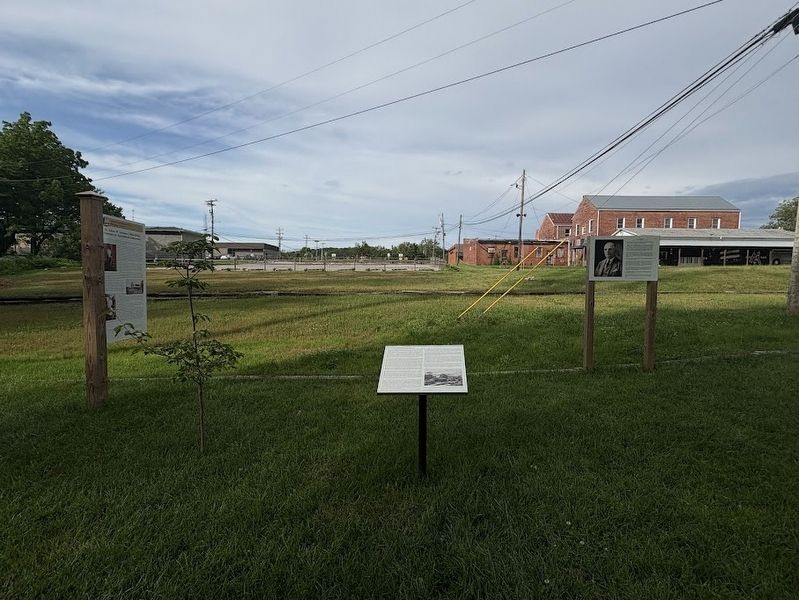
Tracy City in Grundy County, Tennessee — The American South (East South Central)
Tennessee Consolidated Coal Company
Photographed by Darren Jefferson Clay, June 18, 2025
1. Tennessee Consolidated Coal Company Marker
Inscription.
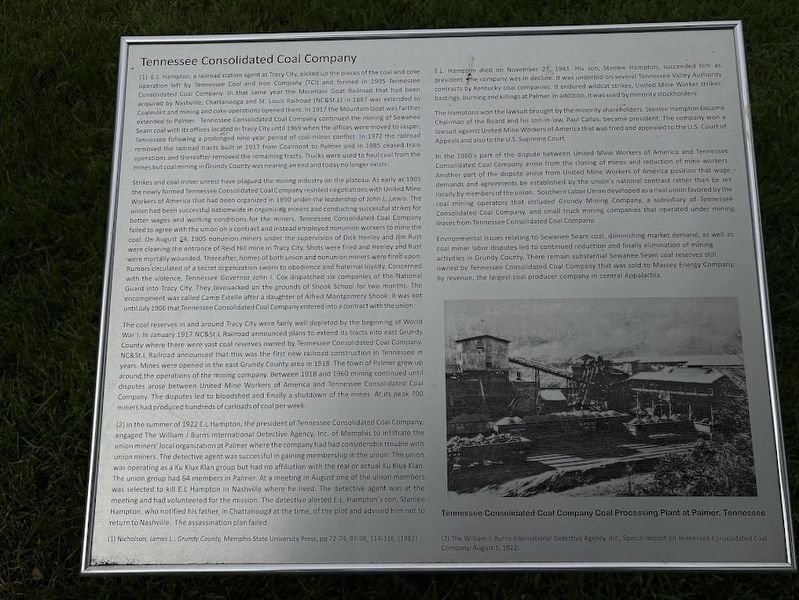
Tennessee Consolidated Coal Company. . (1) E.L. Hampton, a railroad station agent at Tracy City picked up the pieces at the coal and coke operation left by Tennessee Coal and Iron Company (TCI) and formed in 1905 Tennessee Consolidated Coal Company. In that same year the Mountain Goat Railroad that had been acquired by Nashville, Chattanooga and St. Louis Railroad (NC&St.L) in 1887 was extended to Coalmont and mining and cole operations opened there. In 1917 the Mountain Goat was further extended to Palmer. Tennessee Consolidated Coal Company continued the mining of Sewanee Seam coal with its offices located in Tracy City until 1969 when the offices were moved to Jasper, Tennessee following a prolonged nine-year period of coal miner conflict, in 1972 the railroad removed the railroad tracts built in 1917 from Coalmont to Palmer and in 1985 ceased train operations and thereafter removed the remaining tracts. Trucks were used to haul coal from the mines but coal mining in Grundy County was nearing an end and today no longer exists., Strikes and coal miner unrest have plagued the mining industry on the plateau. As early as 1905 the newly formed Tennessee Consolidated Coal Company resisted negotiations with United Mine Workers of America that had been organized in 1890 under the leadership of John Lewis. The union had been successful nationwide in organizing miners and conducting successful strikes for better wages and working conditions for the miners. Tennessee Consolidated Coal Company failed to agree with the union on a contract and instead employed nonunion workers to mine the coal. On August 24, 1905 nonunion miters under the supervision of Dick Henley and Jim Rust were cleaning the entrance of Reid Hill mine in Tracy City. Shots were fired and Henley and Rust were mortally wounded. Thereafter, homes of both union and nonunion miners were fired upon. Rumors circulated of a secret organization sworn to obedience and fraternal loyalty. Concerned with the violence, Tennessee Governor John I. Cox dispatched six companies of the National Guard into Tracy City. They bivouacked on the grounds of Shook School for two months. The encampment was called Camp Estelle after a daughter of Alfred Montgomery Shook. It was not until July 1906 that Tennessee Consolidated Coal Company entered onto a contract with the union., The coal reserves in and around Tracy City were fairly well depleted by the beginning of World War I, in January 1917 NC&St.L. Railroad announced plans to extend its tracts into east Grundy County where there were vast coal reserves owned by Tennessee Consolidated Coal Company. NC&St.L Railroad announced that this was the first new railroad construction in Tennessee in years. Mines were opened in the east Grundy County area in 1918. The town of Palmer grew up around the operations of the mining company. Between 1918 and 1960 mining continued until disputes arose between United Mine Workers of America and Tennessee Consolidated Coal Company. The disputes led to bloodshed and finally a shutdown of the mines. At its peak 700 miners had produced hundreds of carloads of coal per week., (2) In the summer of 1922 E.L Hampton, the president of Tennessee Consolidated Coal Company, engaged The William Burns International Detective Agency, Inc. of Memphis to infiltrate the union miners' local organization at Palmer where the company had had considerable trouble with union miners. The detective agent was successful in gaining membership in the union. The union was operating as a Ku Klux Klan group but had no affiliation with the real or actual Ku Klux Klan. The union group had 64 members in Palmer. At a meeting in August one of the union members was selected to kill E.L. Hampton in Nashville where he lived. The detective agent was at the meeting and had volunteered for the mission. The detective alerted E.L. Hampton's son, Stanlee Hampton, who notified his father, in Chattanooga at the time, of the plot and advised him not to return to Nashville. The assassination plan failed., E.L. Hampton died on November 27, 1941. His son, Stanlee Hampton, succeeded him as president. The company was in decline. It was underbid on several Tennessee Valley Authority contracts by Kentucky coal companies. It endured wildcat strikes, United Mine Worker strikes, bastings, burning and killings at Palmer. In addition, it was sued by minority stockholders., The Hamptons won the lawsuit brought by the minority shareholders. Stanlee Hampton became Chairman of the Board and his son-in-law, Paul Callas, became president. The company won a lawsuit against United Mine Workers of America that was tried and appealed to the U.S. Court of Appeals and also to the U.S. Supreme Court., In the 1960's part of the dispute between United Mine Workers of America and Tennessee Consolidated Coal Company arose from the closing of mines and reduction of mine workers. Another part of the dispute arose from United Mine Workers of America position that wage demands and agreements be established by the union's national contract rather than be set locally by members of the union. Southern Labor Union developed as a rival union favored by the coal mining operators that included Grundy Mining Company, a subsidiary of Tennessee Consolidated Coal Company, and small truck mining companies that operated under mining leases from Tennessee Consolidated Coal Company., Environmental issues relating to Sewanee Seam coal, diminishing market demand, as well as coal miner labor disputes led to continued reduction and finally elimination of mining activities in Grundy County. There remain substantial Sewanee Seam coal reserves still owned by Tennessee Consolidated Coal Company that was sold to Massey Energy Company, by revenue, the largest coal producer company in central Appalachia. , Photo caption: Tennessee Consolidated Coal Company Coal Processing Plant at Palmer, Tennessee , (1) Nicholson, James L., Grundy County, Memphis State University Press, pp 72-74.97-98, 114-116, (1982) , (2) The William J. Burns International Detective Agency, Inc., Special Report on Tennessee Consolidated Coal Company, August 1, 1922.
(1) E.L. Hampton, a railroad station agent at Tracy City picked up the pieces at the coal and coke operation left by Tennessee Coal and Iron Company (TCI) and formed in 1905 Tennessee Consolidated Coal Company. In that same year the Mountain Goat Railroad that had been acquired by Nashville, Chattanooga and St. Louis Railroad (NC&St.L) in 1887 was extended to Coalmont and mining and cole operations opened there. In 1917 the Mountain Goat was further extended to Palmer. Tennessee Consolidated Coal Company continued the mining of Sewanee Seam coal with its offices located in Tracy City until 1969 when the offices were moved to Jasper, Tennessee following a prolonged nine-year period of coal miner conflict, in 1972 the railroad removed the railroad tracts built in 1917 from Coalmont to Palmer and in 1985 ceased train operations and thereafter removed the remaining tracts. Trucks were used to haul coal from the mines but coal mining in Grundy County was nearing an end and today no longer exists.
Strikes and coal miner unrest have plagued the mining industry on the plateau. As early as 1905 the newly formed Tennessee Consolidated
Click or scan to see this page online
Coal Company resisted negotiations with United Mine Workers of America that had been organized in 1890 under the leadership of John Lewis. The union had been successful nationwide in organizing miners and conducting successful strikes for better wages and working conditions for the miners. Tennessee Consolidated Coal Company failed to agree with the union on a contract and instead employed nonunion workers to mine the coal. On August 24, 1905 nonunion miters under the supervision of Dick Henley and Jim Rust were cleaning the entrance of Reid Hill mine in Tracy City. Shots were fired and Henley and Rust were mortally wounded. Thereafter, homes of both union and nonunion miners were fired upon. Rumors circulated of a secret organization sworn to obedience and fraternal loyalty. Concerned with the violence, Tennessee Governor John I. Cox dispatched six companies of the National Guard into Tracy City. They bivouacked on the grounds of Shook School for two months. The encampment was called Camp Estelle after a daughter of Alfred Montgomery Shook. It was not until July 1906 that Tennessee Consolidated Coal Company entered onto a contract
Photographed by Darren Jefferson Clay, June 18, 2025
2. Tennessee Consolidated Coal Company Marker
with the union.
The coal reserves in and around Tracy City were fairly well depleted by the beginning of World War I, in January 1917 NC&St.L. Railroad announced plans to extend its tracts into east Grundy County where there were vast coal reserves owned by Tennessee Consolidated Coal Company. NC&St.L Railroad announced that this was the first new railroad construction in Tennessee in years. Mines were opened in the east Grundy County area in 1918. The town of Palmer grew up around the operations of the mining company. Between 1918 and 1960 mining continued until disputes arose between United Mine Workers of America and Tennessee Consolidated Coal Company. The disputes led to bloodshed and finally a shutdown of the mines. At its peak 700 miners had produced hundreds of carloads of coal per week.
(2) In the summer of 1922 E.L Hampton, the president of Tennessee Consolidated Coal Company, engaged The William Burns International Detective Agency, Inc. of Memphis to infiltrate the union miners' local organization at Palmer where the company had had considerable trouble with union miners. The detective agent was successful in gaining membership in the union. The union was operating as a Ku Klux Klan group but had no affiliation with the real or actual Ku Klux Klan. The union group had 64 members in Palmer. At a meeting in August one of the union members was selected to kill E.L. Hampton in Nashville where he lived. The detective agent was at the meeting and had volunteered for the mission. The detective alerted E.L. Hampton's son, Stanlee Hampton, who notified his father, in Chattanooga at the time, of the plot and advised him not to return to Nashville. The assassination plan failed.
E.L. Hampton died on November 27, 1941. His son, Stanlee Hampton, succeeded him as president. The company was in decline. It was underbid on several Tennessee Valley Authority contracts by Kentucky coal companies. It endured wildcat strikes, United Mine Worker strikes, bastings, burning and killings at Palmer. In addition, it was sued by minority stockholders.
The Hamptons won the lawsuit brought by the minority shareholders. Stanlee Hampton became Chairman of the Board and his son-in-law, Paul Callas, became president. The company won a lawsuit against United Mine Workers of America that was tried and appealed to the U.S. Court of Appeals and also to the U.S. Supreme Court.
In the 1960's part of the dispute between United Mine Workers of America and Tennessee Consolidated Coal Company arose from the closing of mines and reduction of mine workers. Another part of the dispute arose from United Mine Workers of America position that wage demands and agreements be established by the union's national contract rather than be set locally by members of the union. Southern Labor Union developed as a rival union favored by the coal mining operators that included Grundy Mining Company, a subsidiary of Tennessee Consolidated Coal Company, and small truck mining companies that operated under mining leases from Tennessee Consolidated Coal Company.
Environmental issues relating to Sewanee Seam coal, diminishing market demand, as well as coal miner labor disputes led to continued reduction and finally elimination of mining activities in Grundy County. There remain substantial Sewanee Seam coal reserves still owned by Tennessee Consolidated Coal Company that was sold to Massey Energy Company, by revenue, the largest coal producer company in central Appalachia.
Photo caption: Tennessee Consolidated Coal Company Coal Processing Plant at Palmer, Tennessee
(1) Nicholson, James L., Grundy County, Memphis State University Press, pp 72-74.97-98, 114-116, (1982)
(2) The William J. Burns International Detective Agency, Inc., Special Report on Tennessee Consolidated Coal Company, August 1, 1922.
Topics. This historical marker is listed in this topic list: Industry & Commerce.
Location. 35° 15.616′ N, 85° 44.278′ W. Marker is in Tracy City, Tennessee, in Grundy County. It can be reached from Railroad Avenue west of Depot St, on the left when traveling east. Touch for map. Marker is at or near this postal address: 345 Railroad Ave, Tracy City TN 37387, United States of America. Touch for directions.

Regionally, this marker is in Tennessee’s Cumberland Plateau and in the Highland Rim. It is also in the American South, specifically in the Upper South, in Appalachia, and specifically in Southern Appalachia. Globally, it is in North America, the Western Hemisphere, the Western World, and the Anglosphere. Historically, it finds itself in what was once the territory of the Mississippian Culture, one of the Confederate States of America, and the Antebellum South.
Credits. This page was last revised on July 1, 2025. It was originally submitted on June 30, 2025, by Darren Jefferson Clay of Duluth, Georgia. This page has been viewed 1,084 times since then and 351 times this year. Photos:1, 2. submitted on June 30, 2025, by Darren Jefferson Clay of Duluth, Georgia. • James Hulse was the editor who published this page.