Near Glenville in Schenectady County, New York — The American Northeast (Mid-Atlantic)
Vietnam War
1955-1975

Photographed by Steve Stoessel, June 30, 2025
1. Vietnam War Marker
The Vietnam War was one of America's longest wars and perhaps the most politically controversial as Cold War foreign policy was challenged by domestic social changes. But for the American service member it was about service to country, peers and self. After France failed to hold onto its colonial southeast empire in Asia, Vietnam was divided in half with communist North Vietnam and South Vietnam. The US as part of its Cold War containment policy, provided general financial and military support to South Vietnam.
By 1955, North Vietnam supported communist guerrilla forces, Viet Cong, in South Vietnam and provided direct support with actions by the North Vietnam Army, NVA, against the South Vietnam Army and US forces there. By 1959 North Vietnam was committed to unifying North and South Vietnam by force. President John F. Kennedy raised the US military advisor force from 1,000 in 1959 to 23,000 in 1964. North Korea was supported by China and the Soviet Union.
In August 1964, based on the Gulf of Tonkin Incident, the US Congress authorized President Lyndon B. Johnson "to take all necessary measures to repel any armed
this page online
This war involved ground, air and naval forces. The war was characterized by jungle and guerilla warfare with no defined front lines and heavy use of air power, fighter-bombers, B-52's and helicopters. While US Forces defended against North Vietnam in actions such as the Tet Offensive, national news brought the war to American homes via television which wore on the public's conscience.
President Richard M. Nixon's election, anti-war protests, the Pentagon Papers controversy among other domestic pressures promised an end to US involvement with President Nixon's Vietnamization plan to reduce the US military involvement. By 1972, US forces were reduced to 24,000. After a controversial bombing campaign, North Vietnam agreed to negotiations to end the conflict resulting in the Paris

Photographed by Steve Stoessel, June 30, 2025
2. Vietnam War Marker
The Paris Accords did not however end hostilities between North and South Vietnam as North Vietnam again invaded South Vietnam capturing the capital, Saigon, causing the sudden evacuation of the US Embassy. All of Vietnam was united under the communist regime and the US and Vietnam have been working together ever since to rebuild a positive relationship.
Close to 2.7 million American soldiers served in theater during the Vietnam War and 58,220 American service members made the ultimate sacrifice, 303,704 were visibly wounded while many more continue to carry the seen and unseen scars of the war and deal with the long-term health effects. To date about 1,600 Service members remain MIA but the search continues. 766 Americans were known to have been POWs of which 114 died in captivity.
For you Vietnam veterans standing before this memorial. "Thank you and Welcome Home."
Topics. This historical marker is listed in this topic list: War, Vietnam. A significant historical year for this entry is 1955.
Location. 42° 50.34′ N, 73° 57.002′ W.

Photographed by Steve Stoessel, June 30, 2025
3. Vietnam War Marker

Regionally, this marker is in Upstate New York, in the Capital District, and in the Albany Metropolitan Area. It is also in the American Northeast and in the Mid-Atlantic. Globally, it is in North America, the Western Hemisphere, the Western World, and the Anglosphere. Historically, it finds itself in what was once New Netherland and also one of the original Thirteen Colonies.
Other nearby markers. At least 8 other markers are within walking distance of this marker: Persian Gulf War (a few steps from this marker); Iraq War (within shouting distance of this marker); War in Afghanistan (within shouting distance of this marker); Korean War (within shouting distance of this marker); World War II (within shouting distance of this marker); Expeditionary Actions (about 300 feet
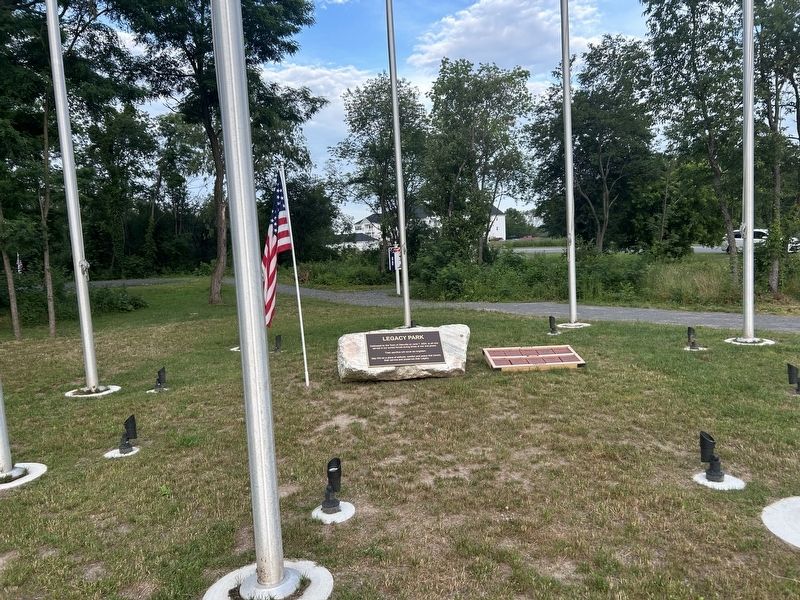
Photographed by Steve Stoessel, June 30, 2025
4. Legacy Park Marker
Also see . . . Vietnam War (Wikipedia). (Submitted on June 30, 2025, by Steve Stoessel of Niskayuna, New York.)
Credits. This page was last revised on June 30, 2025. It was originally submitted on June 30, 2025, by Steve Stoessel of Niskayuna, New York. This page has been viewed 114 times since then and 21 times this year. Photos: 1, 2, 3, 4. submitted on June 30, 2025, by Steve Stoessel of Niskayuna, New York.
