
Tracy City in Grundy County, Tennessee — The American South (East South Central)
John Moffat
(November 9, 1828 - December 25, 1886)

Photographed by Darren Jefferson Clay, June 18, 2025
1. John Moffat Marker
At the age of 19 Moffat became a member of the Sons of Temperance. In 1851 he was appointed its lecturer for the Province of Canada. In 1858 the Sons of Temperance selected Moffat as associate editor of its national publication, Crusader. It is believed that about 1858, while on a temperance lecture tour, he crossed the Cumberland Plateau on a stagecoach, traveling from Nashville to Chattanooga, at the place he later named Moffat. He was impressed with the climate, the natural beauty of the area and what he envisioned as an excellent area for development.
Moffat wrote in the initial August 1871 edition of The Enterprise of which he was editor:
The measure of land values depends upon the population. Every addition to the population of a county increase
this page online
The Enterprise was a monthly journal of Tennessee immigration, Real Estate and Labor Association. Its president was Arthur St. Clair Colyar. Colyar, like Moffat, was a temperance advocate and they probably knew each other through their mutual temperance interests. Moffat was Secretary and Treasurer of the Association. Together Moffat and Colyar worked to develop the plateau through Tennessee Immigration, Real Estate and labor Association.
The scheme of Tennessee Immigration, Real Estate and Labor Association was the formation of county co-operative associations of not more than ten citizens within a county to collect and make available statistics relative to a county useful to immigrants and others. The statistics for the locality embraced temperature of the climate, accessibility, character of the soil, productions, the mean value of improved and unimproved lands, water power, mines and minerals, timber, manufactures, markets, means of getting
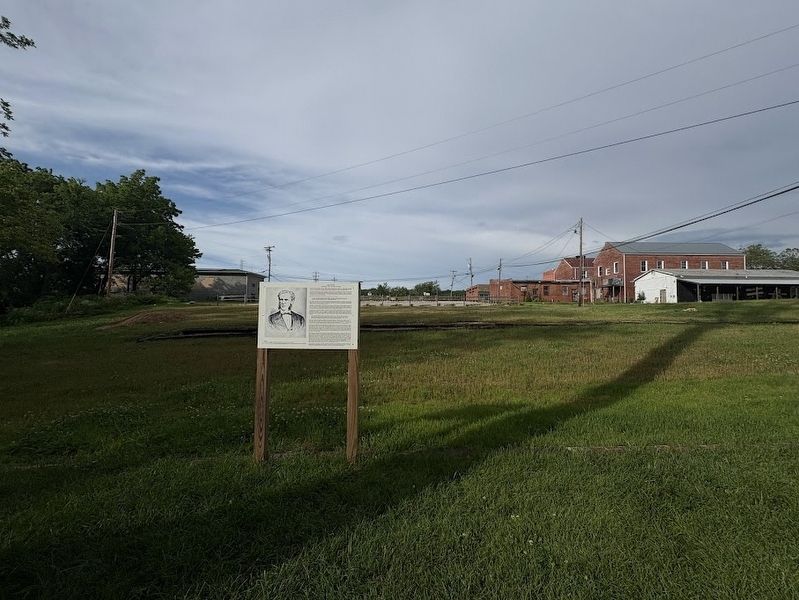
Photographed by Darren Jefferson Clay, June 18, 2025
2. John Moffat Marker
Both Moffat and Colyar advocated immigration to the plateau, not only from foreign countries but also from the northern states of the United States. In the latter part of 1871 the Governor of Tennessee, perhaps through the influence of Colyar, appointed Moffat Commissioner of Immigration. In 1876, as Commissioner of Immigration, Moffat authored A Brochure of Tennessee's Attractions to the Immigrant. This was a twenty-one page pamphlet that describes the state as eight well defined natural divisions. The most attention is given to the Cumberland Plateau. It is extolled as a land of people without consumption. Under Watering Places, It proclaimed:
The Monteagle Health Resort at Moffat, Marion County, was opened last year, (1875) and bids fair to be a popular Resort, not only for parties from the low countries of the south in the summer. But also a winter resort for parties afflicted with pulmonary diseases from the North. Here may be found, during the hot months of summer, families from the different localities, in the lowlands, enjoying the cool and invigorating atmosphere. Moffat was the founder and developer of Monteagle. In 1870, after acquiring 1,761 acres of the John G. Bostick and Tandy C.K. Bostick grants in Marion and Grundy Counties and after contracting for the purchase of 1,146 2/3 acres of the Charles Christian Grant, Moffat nailed a sign, Moffat, on a tree along the Mountain Goat railroad tracts owned and operated by Tennessee Coal and Railroad Company. The railroad company designated the place Moffat Station and established it as a stop. On January 18, 1871 Moffat Station was approved as a post office by the postal authorities. On October 15, 1874 the name was shortened to Moffat.
John Moffat was an educator even though he had little formal education. While in Canada he and his brother established in 1862 the Moffat Academy at Komoka, Ontario. He taught elocution and general literature. He also edited the Ontario Review, a monthly Journal dedicated to education and temperance. In Monteagle education was a major emphasis in his plans. On October 21, 1872 he gave 50 acres that is today the site of the former DuBose Conference Center to Mrs. Maria Louise Yerger and Mrs. Harriet B. Kells, school teachers from Jackson, Mississippi, for a select academy for young women. The school was named Fairmont College (later Fairmont Female College). The academic year was organized so that the vacation term would be during the winter months. The terms were planned to enable southern girls to escape the warm climate and malaria risks in their home areas during the summer and return in the winter to a warmer climate than prevailed on the Cumberland Plateau and at a time of the year when their home areas were free from malaria fevers.
One of Moffat's most intense efforts was to establish The Moffat Collegiate and Normal institute. A charter was obtained from the State of Tennessee on August 11, 1876 that provided for establishing a college with power to confer degrees on students in the collegiate department and to Issue certificates of qualifications to students in the Normal Department. On September 12, 1876 700 acres were conveyed by Moffat to the institution, being all the lands within the Village of Moffat survey not previously sold. He allegedly secured pledges for a like amount of land from others to be conveyed upon the opening of the school. A building was purchased large enough to house 100 students. The building was likely Monteagle Health Resort on the northwest corner of College Street and Central Avenue that had been opened in 1875. Moffat's goal was to establish an institution to provide a Christian education for those not able to pay. Moffat considered the lands conveyed and pledged to be conveyed as providing an endowment to accomplish the school's mission. The mission was to educate poor white people of the South. Fund raising failed in the South because the institution was nonsectarian and in the North because blacks were not included in the educational scheme. Moffat Collegiate and Normal Institute never opened. Moffat, an established temperance lecturer and authority on the Scottish poet Robert Burns, returned to the lecture circuit to help pay for the debt that had been incurred.
In 1882, John Moffat was successful in enticing the Committee on Site Selection of the Representatives to Organize a Chautauqua for the South called by the State Sunday School Convention of Tennessee to locate its proposed Chautauqua Assembly at Mont Eagle. This became Monteagle Sunday School Assembly that thrives today (2024) as John Moffat's most enduring legacy
Sources:
Jervis, Oliver W., Moffat, Unpublished article (2003), Grundy County Historical Society
Hornaday, Aline Grandier, John Moffat and the Komoka Academy, Western Ontario Historical Notes Vol. XXV, Spring 1969
Topics. This historical marker is listed in these topic lists: Education • Religion & Religious Structures.
Location. 35° 15.621′ N, 85° 44.281′ W. Marker is in Tracy City, Tennessee, in Grundy County. It can be reached from Railroad Avenue west of Depot St, on the left when traveling east. Touch for map. Marker is at or near this postal address: 345 Railroad Ave, Tracy City TN 37387, United States of America. Touch for directions.

Regionally, this marker is in Tennessee’s Cumberland Plateau and in the Highland Rim. It is also in the American South, specifically in the Upper South, in Appalachia, and specifically in Southern Appalachia. Globally, it is in North America, the Western Hemisphere, the Western World, and the Anglosphere. Historically, it finds itself in what was once the territory of the Mississippian Culture, one of the Confederate States of America, and the Antebellum South.
Other nearby markers. At least 8 other markers are within walking distance of this marker: Southern Writers at Monteagle / Artist at Monteagle (here, next to this marker); Dr. Lilian W. Johnson (1864-1956), Advocate for Agricultural Cooperatives / "Highlander's An Idea" (here, next to this marker); Tennessee Consolidated Coal Company (a few steps from this marker); William L. Beard (a few steps from this marker); E.L. Hampton (a few steps from this marker); The Civil War on the Plateau / Troop Movements Across the Plateau Following the Tullahoma Campaign (a few steps from this marker); The Tidman Hotel (a few steps from this marker); Einar Oswald Nathurst (a few steps from this marker). Touch for a list and map of all markers in Tracy City.
Credits. This page was last revised on July 1, 2025. It was originally submitted on June 30, 2025, by Darren Jefferson Clay of Duluth, Georgia. This page has been viewed 131 times since then and 34 times this year. Photos: 1, 2. submitted on June 30, 2025, by Darren Jefferson Clay of Duluth, Georgia. • James Hulse was the editor who published this page.
