Ranville in Calvados, Normandy, France — Western Europe
Les Ponts Bailey
⎯⎯⎯
The Bailey Bridges
Photographed by James Hulse, June 2, 2025
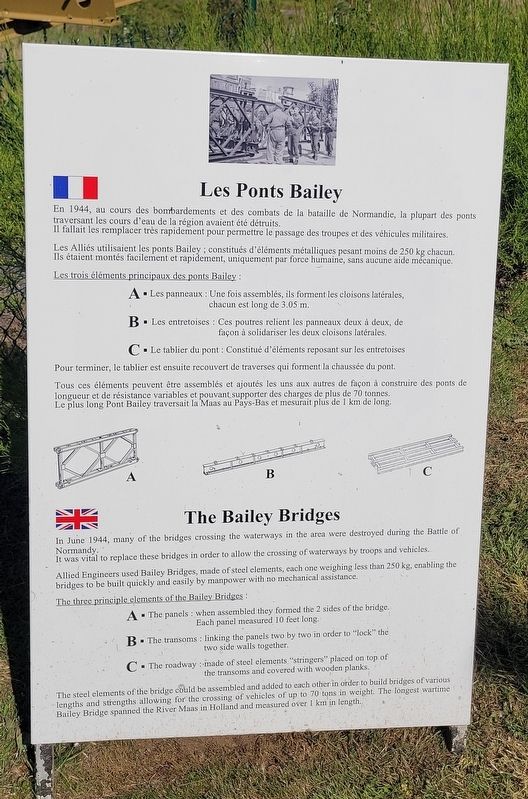
1. Les Ponts Bailey / The Bailey Bridges Marker

En 1944, au cours des bombardements et des combats de la bataille de Normandie, la plupart des ponts traversant les cours d'eau de la région avaient été détruits. Il fallait les remplacer très rapidement pour permettre le passage des troupes et des véhicules militaires. Les Alliés utilisaient les ponts Bailey; constitués d'éléments métalliques pesant moins de 250 kg chacun. Ils étaient montés facilement et rapidement, uniquement par force humaine, sans aucune aide mécanique.
Les trois éléments principaux des ponts Bailey:
A - Les panneaux: Une fois assemblés, ils forment les cloisons latérales, chacun est long de 3.05 m.
B - Les entretoises: Ces poutres relient les panneaux deux à deux, de façon à solidariser les deux cloisons latérales.
C - Le tablier du pont: Constitué d'éléments reposant sur les entretoises.
Pour terminer, le tablier est ensuite recouvert de traverses qui forment la chaussée du pont. Tous ces éléments peuvent être assemblés et ajoutés les uns aux autres de façon à construire des ponts de longueur et de résistance variables et pouvant supporter des charges de plus de 70 tonnes. Le plus long Pont Bailey traversait la Maas au Pays-Bas et mesurait plus de 1 km de long.
In June 1944, many of the bridges crossing the waterways in the area were destroyed during the Battle of Normandy. It was vital to replace these bridges in order to allow the crossing of waterways by troops and vehicles. Allied Engineers used Bailey Bridges, made of steel elements, each one weighing less than 250 kg, enabling the bridges to be built quickly and easily by manpower with no mechanical assistance.
The three principle elements of the Bailey Bridges:
A - The panels: when assembled they formed the 2 sides of the bridge. Each panel measured 10 feet long.
B- The transoms: linking the panels two by two in order to "lock" the two side walls together.
Click or scan to see
this page online
C - The roadway: made of steel elements "stringers" placed on top of the transoms and covered with wooden planks.
The steel elements of the bridge could be assembled and added to each other in order to build bridges of various lengths and strengths allowing for the crossing of vehicles of up to 70 tons in weight. The longest wartime Bailey Bridge spanned the River Maas in Holland and measured over 1 km in length.
Erected by Memorial Pegasus and Museum.
Topics. This historical marker is listed in this topic list: War, World II. A significant historical month for this entry is June 1944.
Location. 49° 14.576′ N, 0° 16.254′ W. Marker is in Ranville, Normandie (Normandy), in Calvados. It is at the intersection of Av. Major John Howard and Normandie Route D514 on Av. Major John Howard. The marker is located on the grounds of the Memorial Pegasus and Museum. Touch for map. Marker is at or near this postal address: 1 Av Major John Howard, Ranville, Normandie 14860, France. Touch for directions.

Regionally, it is in the North Atlantic Region,
Photographed by James Hulse, June 2, 2025
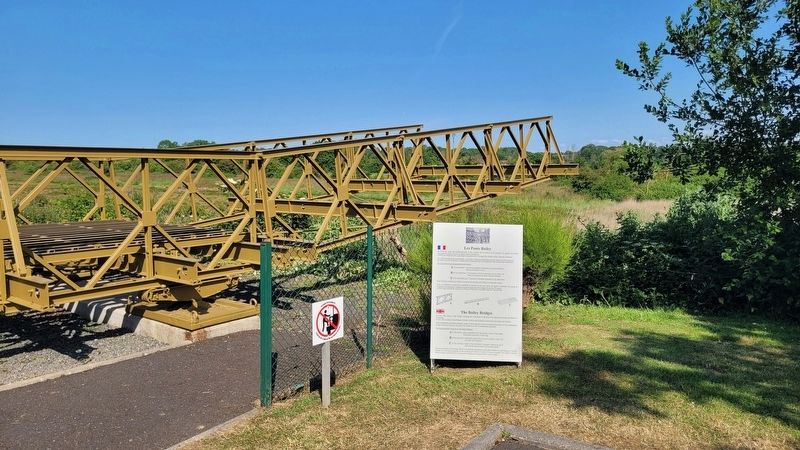
2. The Bailey Bridges and Marker
Other nearby markers. At least 8 other markers are within walking distance of this marker: Ponts Bailey / The Bailey Bridge (here, next to this marker); Ce pont Bailey / This Bailey bridge (a few steps from this marker); 'Coup de Main' Glider Operation Memorial (a few steps from this marker); The Veterans Charity (within shouting distance of this marker); Horsa Glider (within shouting distance of this marker); Le Canon Anti Char de 17 Livres (76.2mm) / The 17 Pounder Anti-tank Gun (within shouting distance of this marker); La défense des ponts sur le Canal de Caen et de l'Orne (within shouting distance of this marker); Canon de 40 mm Bofors / Bofors 40 mm Gun (within shouting distance of this marker). Touch for a list and map of all markers in Ranville.
More about this marker. The static displays and markers are located on the grounds of the Memorial Pegasus and Museum. There is an entrance fee
Photographed by James Hulse, June 2, 2025
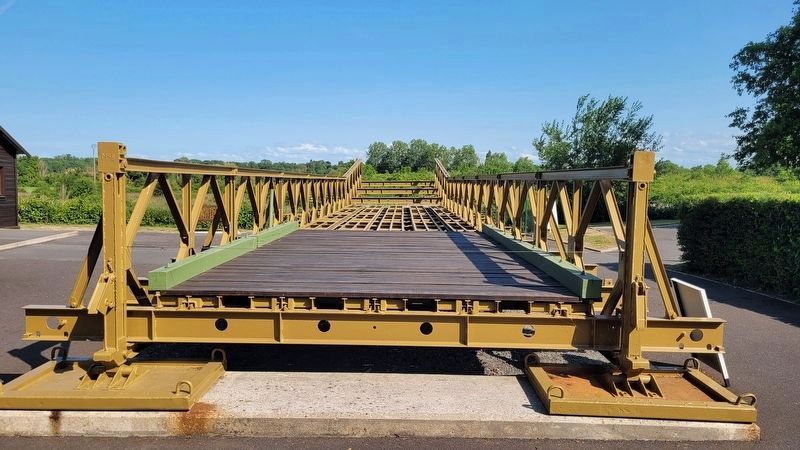
3. The deck of the Bailey Bridge
Credits. This page was last revised on July 2, 2025. It was originally submitted on July 1, 2025, by James Hulse of Medina, Texas. This page has been viewed 105 times since then and 19 times this year. Photos: 1, 2, 3. submitted on July 2, 2025, by James Hulse of Medina, Texas.
