Bloomington Township in Monroe County, Indiana — The American Midwest (Great Lakes)
Rabbi Abraham Cronback
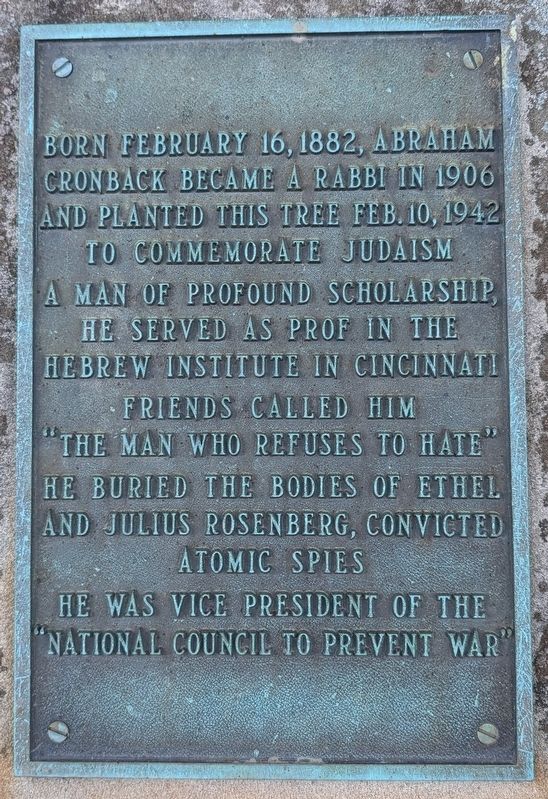
Photographed by Daniel Barriball, June 19, 2025
1. Rabbi Abraham Cronback Marker
A man of profound scholarship, he served as prof in the Hebrew Institute in Cincinnati
Friends called him "the man who refuses to hate"
He buried the bodies of Ethel and Julius Rosenberg, convicted atomic spies
He was vice president of the "National Council to Prevent War"
Topics. This historical marker is listed in these topic lists: Education • Religion & Religious Structures. A significant historical date for this entry is February 10, 1942.
Location. 39° 10.019′ N, 86° 31.326′ W. Marker is in Bloomington, Indiana, in Monroe County. It is in Bloomington Township. It can be reached from East 7th Street. This marker is in the Grove of All Faiths in the churchyard west of Beck Chapel on the campus of Indiana University. Touch for map. Marker is at or near this postal address: 900 E 7th St, Bloomington IN 47405, United States of America. Touch for directions.

Regionally, this marker is in Southern Indiana. It is also in the American Midwest and in the Corn Belt. Globally, it is in North America, the Western Hemisphere, the Western World, and the Anglosphere. Historically, it finds itself in what was once the territory of the Mississippian Culture and also the Northwest Territory.
Other nearby markers. At least 8 other markers are within walking distance of this marker: Charles Clayton Morrison (here, next to this marker); Father James Martin Gilles (a few steps from this marker); Ernie Pyle (about 500 feet away, measured in a direct line); Integrating Basketball (about 600 feet away); Elinor Ostrom (about 700 feet away); Alfred C. Kinsey (approx. 0.2 miles away); Class of 1942 (approx. 0.2 miles away); The River Jordan (approx. 0.2 miles away). Touch for a list and map of all markers
this page online
Also see . . .
1. Abraham Cronbach. Wikipedia (Submitted on July 1, 2025, by Daniel Barriball of Chesterton, Indiana.)
2. Beck Chapel: Steeped in more than 60 years of history. News at IU (Submitted on July 1, 2025, by Daniel Barriball of Chesterton, Indiana.)
Additional commentary.
1.
In 1942, before the chapel was constructed, three trees were planted on the proposed building site to represent the faiths of three religious leaders – Rabbi Abraham Cronbach, professor at the Hebrew Institute of Cincinnati; the Rev. James Gillis, editor of The Catholic World; the Rev. Charles C. Morrison, editor of the Christian Century. The trees were planted in a triangle to symbolize harmony and unity. In the years following, other trees were planted to symbolize other world faiths. While the trees are no longer standing, the plaques can still be found in the grove today, which is situated to the west of the chape
— Submitted July 12, 2025, by Bill Pfingsten of Bel Air, Maryland.
2.
In 1942, before the chapel was constructed, three trees were planted on the proposed building
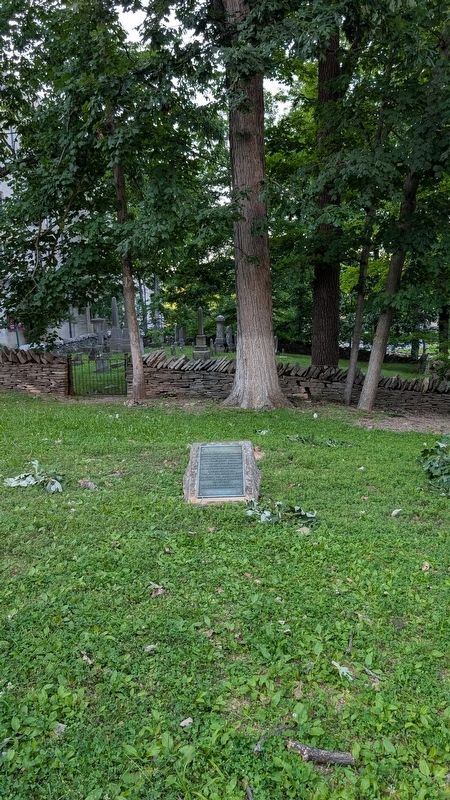
Photographed by Daniel Barriball, June 19, 2025
2. Rabbi Abraham Cronback Marker in context
— Submitted July 12, 2025, by Cheryll Woods-Flowers of Mount Pleasant, South Carolina.
Credits. This page was last revised on July 12, 2025. It was originally submitted on July 1, 2025, by Daniel Barriball of Chesterton, Indiana. This page has been viewed 84 times since then and 21 times this year. Photos: 1, 2. submitted on July 1, 2025, by Daniel Barriball of Chesterton, Indiana. • Bill Pfingsten was the editor who published this page.
