
Tracy City in Grundy County, Tennessee — The American South (East South Central)
Leonard L. Tate
From the Heritage Center
| — | By Oliver W. Jervis, Grundy County Historical Society | — |
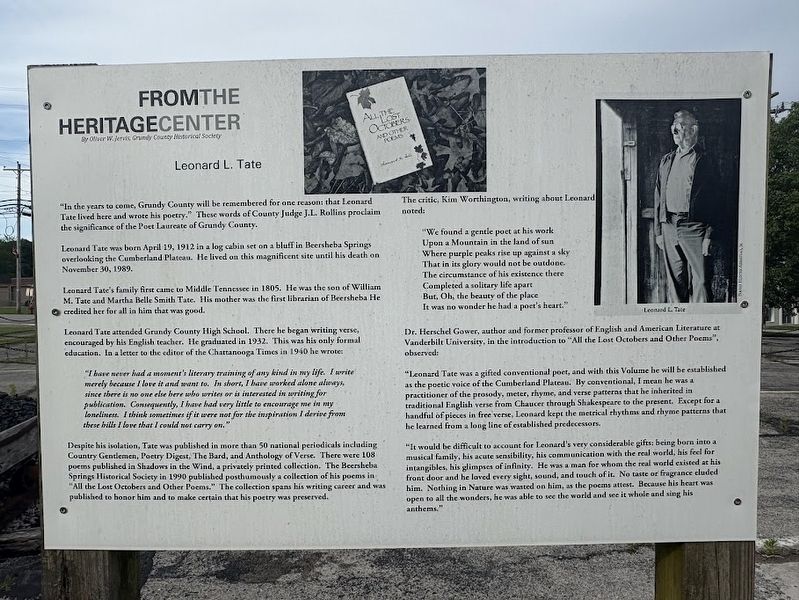
Photographed by Darren Jefferson Clay, June 18, 2025
1. Leonard L. Tate Marker
Leonard Tate was born April 19, 1912 in a log cabin set on a bluff in Beersheba Springs overlooking the Cumberland Plateau. He lived on this magnificent site until his death on November 30, 1989.
Leonard Tate's family first came to Middle Tennessee in 1805. He was the son of William M. Tate and Martha Belle Smith Tate. His mother was the first librarian of Beersheba. He credited her for all in him that was good.
Leonard Tate attended Grundy County High School. There he began writing verse, encouraged by his English teacher. He graduated in 1932. This was his only formal education. In a letter to the editor of the Chattanooga Times in 1940 he wrote:
"I have never had a moment's literary training of any kind in my life. I write merely because I love it and want to. In short, I have worked alone always, since there is no one else here who writes or is interested in writing for publication.Consequently, I have had very little to encourage me in my loneliness. I think sometimes if it were not for the inspiration I derive from these hills I love that I could not carry on."
Click or scan to see
this page online
Despite his isolation, Tate was published in more than 50 national periodicals including Country Gentlemen, Poetry Digest, The Bard, and Anthology of Verse. There were 108 poems published in Shadows in the Wind, a privately printed collection. The Beersheba Springs Historical Society in 1990 published posthumously a collection of his poems in "All the Lost Octobers and Other Poems." The collection spans his writing career and was published to honor him and to make certain that his poetry was preserved.
The critic, Kim Worthington, writing about Leonard noted:
"We found a gentle poet at his work
Upon a Mountain in the land of sun
Where purple peaks rise up against a sky
That in its glory would not be outdone.
The circumstance of his existence there
Completed a solitary life apart
But, Oh, the beauty of the place
It was no wonder he had a poet's heart."
Dr. Herschel Gower, author and former professor of English and American Literature at Vanderbilt

Photographed by Darren Jefferson Clay, June 18, 2025
2. Leonard L. Tate Marker
"Leonard Tate was a gifted conventional poet, and with this Volume he will be established as the poetic voice of the Cumberland Plateau. By conventional, I mean he was a practitioner of the prosody, meter, rhyme, and verse patterns that he inherited in traditional English verse from Chaucer through Shakespeare to the present. Except for a handful of pieces in free verse, Leonard kept the metrical rhythms and rhyme patterns that he learned from a long line of established predecessors.
"It would be difficult to account for Leonard's very considerable gifts: being born into a musical family, his acute sensibility, his communication with the real world, his feel for intangibles, his glimpses of infinity. He was a man for whom the real world existed at his front door and he loved every sight, sound, and touch of it. No taste or fragrance eluded him. Nothing in Nature was wasted on him, as the poems attest. Because his heart was open to all the wonders, he was able to see the world and see it whole and sing his anthems."
Topics. This historical marker is listed in this topic list: Arts, Letters, Music.
Location. 35° 15.665′ N, 85° 44.229′ W. Marker is in Tracy City, Tennessee, in Grundy County. It is at the intersection of Laurel Street and Main Street (Scenic U.S. 41), on the right when traveling north on Laurel Street. Touch for map. Marker is at or near this postal address: 14 Laurel St, Tracy City TN 37387, United States of America. Touch for directions.

Regionally, this marker is in Tennessee’s Cumberland Plateau and in the Highland Rim. It is also in the American South, specifically in the Upper South, in Appalachia, and specifically in Southern Appalachia. Globally, it is in North America, the Western Hemisphere, the Western World, and the Anglosphere. Historically, it finds itself in what was once the territory of the Mississippian Culture, one of the Confederate States of America, and the Antebellum South.
Other nearby markers. At least 8 other markers are within walking distance of this marker: The Formation of Coal on the Plateau (here, next to this marker); Mountain People (here, next to this marker); Tracy City (a few steps from this marker); Farquhar Steam Engine and Boiler (a few steps from this marker); Mary Noailles Murfree (a few steps from this marker); Golden's No. 1 New Model Sorghum Mill (a few steps from this marker); WPA in Grundy County and Highlander Folk School - Part 2 (a few steps from this marker); Wooten Mine (a few steps from this marker). Touch for a list and map of all markers in Tracy City.
Credits. This page was last revised on July 9, 2025. It was originally submitted on July 3, 2025, by Darren Jefferson Clay of Duluth, Georgia. This page has been viewed 94 times since then and 16 times this year. Photos: 1, 2. submitted on July 6, 2025, by Darren Jefferson Clay of Duluth, Georgia. • James Hulse was the editor who published this page.
