Tracy City in Grundy County, Tennessee — The American South (East South Central)
Why President Taft Came to Sewanee
From the Heritage Center
| — | By David Bowman | — |
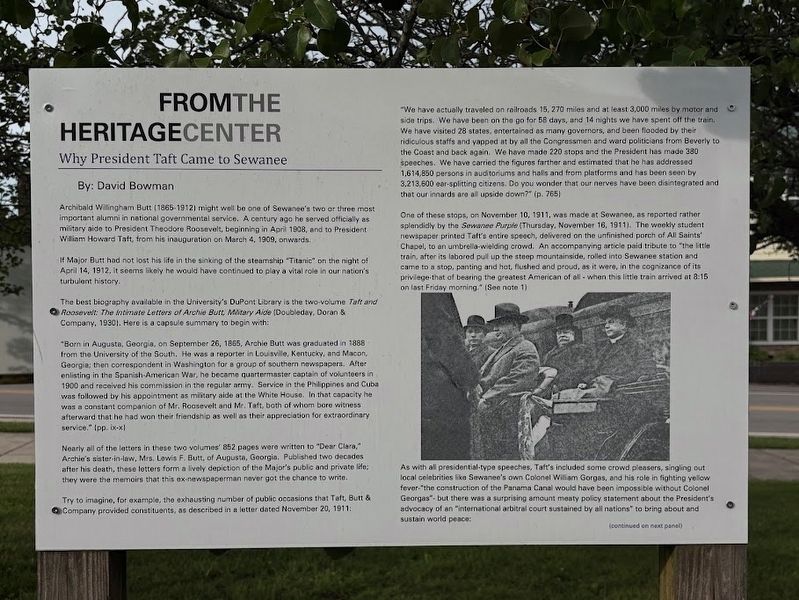
Photographed by Darren Jefferson Clay, June 18, 2025
1. Why President Taft Came to Sewanee Marker
If Major Butt had not lost his life in the sinking of the steamship "Titanic" on the night of April 14, 1912, it seems likely he would have continued to play a vital role in our nation's turbulent history.
The best biography available in the University's DuPont Library is the two-volume Taft and Roosevelt: The Intimate Letters of Archie Butt, Military Aide (Doubleday, Doran & Company, 1930). Here is a capsule summary to begin with:
"Born in Augusta, Georgia, on September 26, 1865, Archie Butt was graduated in 1888 from the University of the South. He was a reporter in Louisville, Kentucky, and Macon, Georgia; then correspondent in Washington for a group of southern newspapers. After enlisting in the Spanish-American War, he became quartermaster captain of volunteers in 1900 and received his
this page online
Nearly all of the letters in these two volumes 852 pages were written to "Dear Clara," Archie's sister-in-law, Mrs. Lewis F. Butt, of Augusta, Georgia. Published two decades after his death, these letters form a lively depiction of the Major's public and private life; they were the memoirs that this ex-newspaperman never got the chance to write.
Try to imagine, for example, the exhausting number of public occasions that Taft, Butt & Company provided constituents, as described in a letter dated November 20, 1911: "We have actually traveled on railroads 15,270 miles and at least 3,000 miles by motor and side trips. We have been on the go for 58 days, and 14 nights we have spent off the train. We have visited 28 states, entertained as many governors, and been flooded by their ridiculous staffs
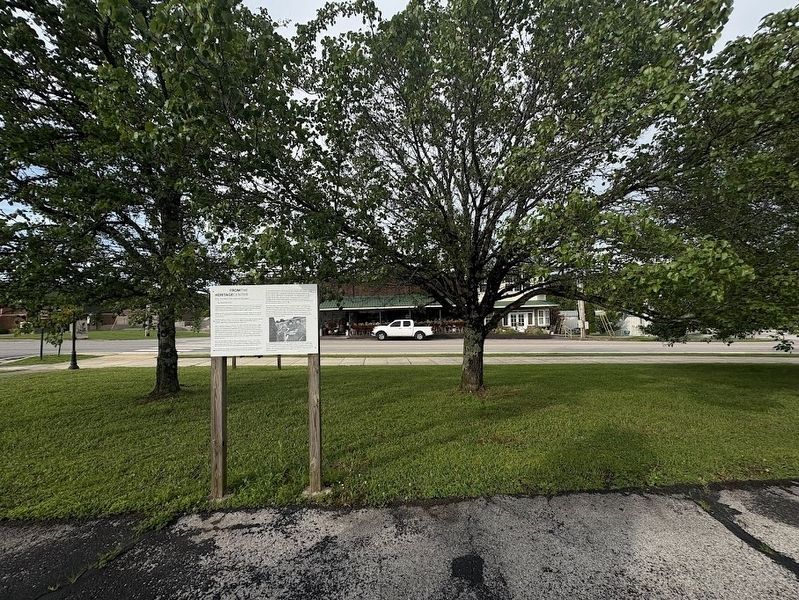
Photographed by Darren Jefferson Clay, June 18, 2025
2. Why President Taft Came to Sewanee Marker
One of these stops, on November 10, 1911, was made at Sewanee, as reported rather splendidly by the Sewanee Purple (Thursday, November 16, 1911). The weekly student newspaper printed Taft's entire speech, delivered on the unfinished porch of All Saints Chapel, to an umbrella-wielding crowd. An accompanying article paid tribute to "the little train, after its labored pull up the steep mountainside, rolled into Sewanee station and came to a stop, panting and hot, flushed and proud, as it were, in the cognizance of its privilege-that of bearing the greatest American of all - when this little train arrived at 8:15 on last Friday morning" (See note 1)
As with all presidential-type speeches, Taft's included some crowd pleasers, singling out local celebrities like Sewanee's own Colonel Willian Gorgas, and his role in fighting yellow fever-the construction of the Panama Canal would have been impossible without Colonel Georgas" but there was a surprising amount meaty policy statement about the President's advocacy of an "international arbitral court sustained by all nations" to bring about and sustain world peace:
(continued on next panel)
Topics. This historical marker is listed in this topic list: Government & Politics.
Location. 35° 15.672′ N, 85° 44.22′ W. Marker is in Tracy City, Tennessee, in Grundy County. It is at the intersection of Laurel Street and Main Street, on the right when traveling north on Laurel Street. Touch for map. Marker is at or near this postal address: 14 Laurel St, Tracy City TN 37387, United States of America. Touch for directions.

Regionally, this marker is in Tennessee’s Cumberland Plateau and in the Highland Rim. It is also in the American South, specifically in the Upper South, in Appalachia, and specifically in Southern Appalachia. Globally, it is in North America, the Western Hemisphere, the Western World, and the Anglosphere. Historically, it finds itself in what was once the territory of the Mississippian Culture, one of the Confederate States of America, and the Antebellum South.
Other nearby markers. At least 8 other markers are within walking distance of this marker: Farquhar Steam Engine and Boiler (here, next to this marker); Golden's No. 1 New Model Sorghum Mill (a few steps from this marker); Why President Taft Came to Sewanee (Part II) (a few steps from this marker); Tracy City (a few steps from this marker); Shook School Traffic Control (a few steps from this marker); Leonard L. Tate (a few steps from this marker); The Formation of Coal on the Plateau (a few steps from this marker); Mountain People (a few steps from this marker). Touch for a list and map of all markers in Tracy City.
Credits. This page was last revised on July 18, 2025. It was originally submitted on July 3, 2025, by Darren Jefferson Clay of Duluth, Georgia. This page has been viewed 173 times since then and 43 times this year. Photos: 1, 2. submitted on July 6, 2025, by Darren Jefferson Clay of Duluth, Georgia. • James Hulse was the editor who published this page.
