
Tracy City in Grundy County, Tennessee — The American South (East South Central)
Why President Taft Came to Sewanee (Part II)
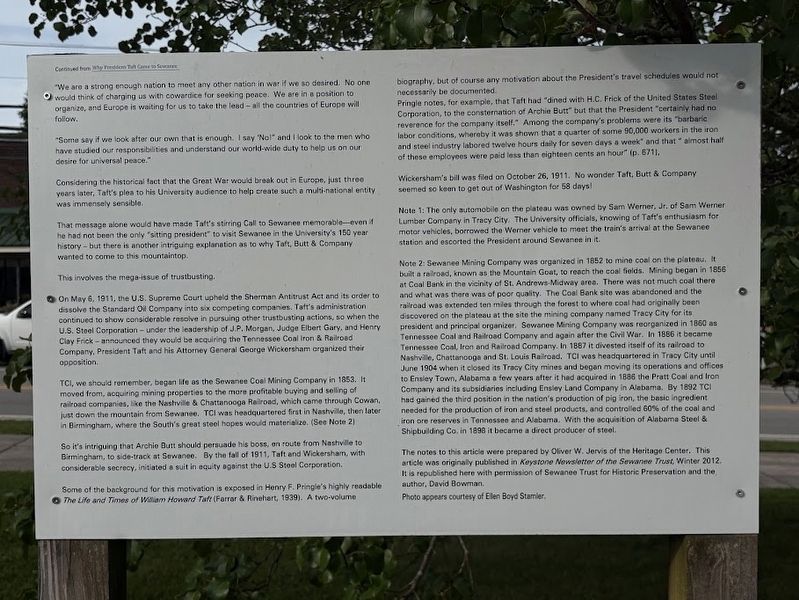
Photographed by Darren Jefferson Clay, June 18, 2025
1. Why President Taft Came to Sewanee (Part II) Marker
"Some say if we look after our own that is enough. I say "No!" and I look to the men who have studied our responsibilities and understand our world-wide duty to help us on our desire for universal peace."
Considering the historical fact that the Great War would break out in Europe, just three years later, Taft's plea to his University audience to help create such a multi-national entity was immensely sensible.
That message alone would have made Taft's stirring Call to Sewanee memorable-even if he had not been the only "sitting president" to visit Sewanee in the University's 150 year history-but there is another intriguing explanation as to why Taft, Butt & Company wanted to come to this mountaintop.
This involves the mega-issue of trustbusting.
On May 6, 1911, the U.S. Supreme Court upheld the Sherman Antitrust Act and its order to dissolve the Standard
this page online
TCI, we should remember, began life as the Sewanee Coal Mining Company in 1853. It moved from, acquiring mining properties to the more profitable buying and selling of railroad companies, like the Nashville & Chattanooga Railroad, which came through Cowan, just down the mountain from Sewanee. TCI was headquartered first in Nashville, then later in Birmingham, where the South's great steel hopes would materialize. (See Note 2)
So it's intriguing that Archie Butt should persuade his boss, en route from Nashville to Birmingham, to side-track at Sewanee. By the fall of 1911, Taft and Wickersham, with considerable secrecy, initiated a suit in equity against the US Steel Corporation.
Some of the background for this motivation
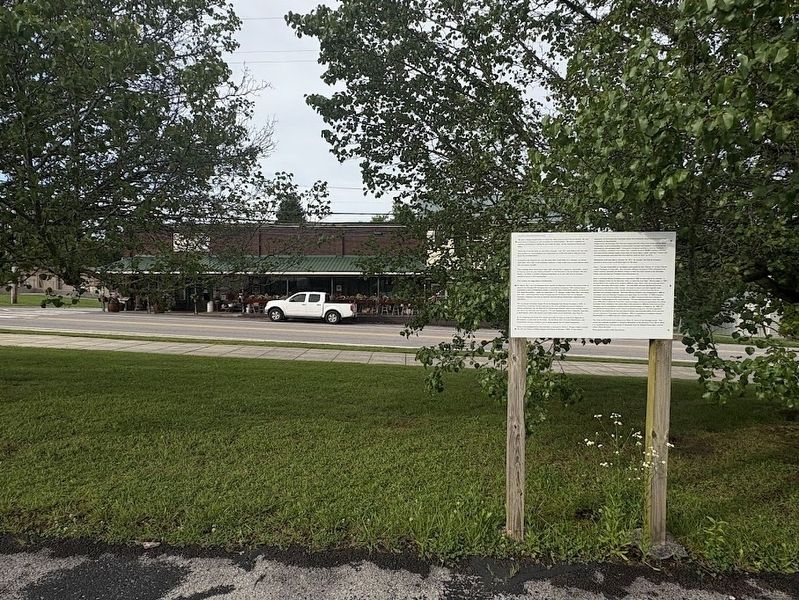
Photographed by Darren Jefferson Clay, June 18, 2025
2. Why President Taft Came to Sewanee (Part II) Marker
Pringle notes, for example, that Taft had "dined with H.C. Frick of the United States Steel Corporation, to the consternation of Archie Butt" but that the President "certainly had no reverence for the company itself. Among the company's problems were its "barbaric labor conditions, whereby it was shown that a quarter of some 90,000 workers in the iron and steel industry labored twelve hours daily for seven days a week" and that" almost half of these employees were paid less than eighteen cents an hour" (p. 671).
Wickersham's bill was filed on October 26, 1911. No wonder Taft, Butt & Company seemed so keen to get out of Washington for 58 days!
Note 1: The only automobile on the plateau was owned by Sam Werner, Jr. of Sam Werner Lumber Company in Tracy City. The University officials, knowing of Taft's enthusiasm for motor vehicles, borrowed the Werner vehicle to meet the train's arrival at the Sewanee station and escorted the President around Sewanee in it.
Note 2: Sewanee Mining Company was organized in 1852 to mine coal on the plateau. It built a railroad, known as the Mountain Goat, to reach the coal fields. Mining began in 1856 at Coal Bank in the vicinity of St. Andrews-Midway area. There was not much coal there and what was there was of poor quality. The Coal Bank site was abandoned and the railroad was extended ten miles through the forest to where coal had originally been discovered on the plateau at the site the mining company named Tracy City for its president and principal organizer. Sewanee Mining Company was reorganized in 1860 as Tennessee Coal and Railroad Company and again after the Civil War. In 1886 it became Tennessee Coal, Iron and Railroad Company. In 1887 it divested itself of its railroad to Nashville, Chattanooga and St. Louis Railroad. TCI was headquartered in Tracy City until June 1904 when it closed its Tracy City mines and began moving its operations and offices to Ensley Town, Alabama a few years after it had acquired in 1886 the Pratt Coal and Iron Company and its subsidiaries including Ensley Land Company in Alabama. By 1892 TCI had gained the third position in the nation's production of pig iron, the basic ingredient needed for the production of iron and steel products, and controlled 60% of the coal and iron ore reserves in Tennessee and Alabama. With the acquisition of Alabama Steel & Shipbuilding Co. in 1898 it became a direct producer of steel.
The notes to this article were prepared by Oliver W. Jervis of the Heritage Center. This article was originally published in Keystone Newsletter of the Sewanee Trust, Winter 2012. It is republished here with permission of Sewanee Trust for Historic Preservation and the author, David Bowman.
Photo appears courtesy of Ellen Boyd Stamler
Topics. This historical marker is listed in this topic list: Government & Politics.
Location. 35° 15.668′ N, 85° 44.215′ W. Marker is in Tracy City, Tennessee, in Grundy County. It is at the intersection of Laurel Street and Main Street, on the right when traveling north on Laurel Street. Touch for map. Marker is at or near this postal address: 14 Laurel St, Tracy City TN 37387, United States of America. Touch for directions.

Regionally, this marker is in Tennessee’s Cumberland Plateau and in the Highland Rim. It is also in the American South, specifically in the Upper South, in Appalachia, and specifically in Southern Appalachia. Globally, it is in North America, the Western Hemisphere, the Western World, and the Anglosphere. Historically, it finds itself in what was once the territory of the Mississippian Culture, one of the Confederate States of America, and the Antebellum South.
Other nearby markers. At least 8 other markers are within walking distance of this marker: Golden's No. 1 New Model Sorghum Mill (here, next to this marker); Why President Taft Came to Sewanee (a few steps from this marker); Shook School Traffic Control (a few steps from this marker); Farquhar Steam Engine and Boiler (a few steps from this marker); Artifacts in the Exhibit Area (a few steps from this marker); Mountain People (a few steps from this marker); Wooten Mine (a few steps from this marker); Leonard L. Tate (a few steps from this marker). Touch for a list and map of all markers in Tracy City.
Credits. This page was last revised on July 18, 2025. It was originally submitted on July 3, 2025, by Darren Jefferson Clay of Duluth, Georgia. This page has been viewed 306 times since then and 21 times this year. Photos: 1, 2. submitted on July 6, 2025, by Darren Jefferson Clay of Duluth, Georgia. • James Hulse was the editor who published this page.
