Lockport in Niagara County, New York — The American Northeast (Mid-Atlantic)
History of the Purple Heart Award
Photographed by Bradley Owen, July 2, 2025
1. History of the Purple Heart Award Marker
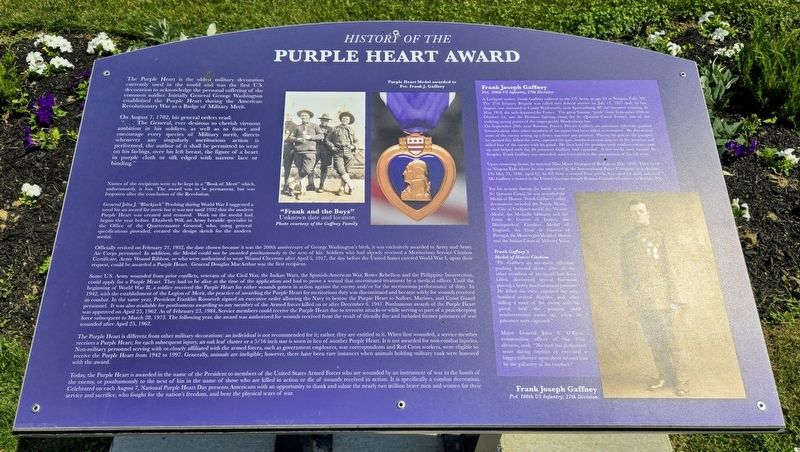
The Purple Heart is the oldest military decoration currently used in the world and was the first U.S. decoration to acknowledge the personal suffering of the common soldier. Initially General George Washington established the Purple Heart during the American Revolutionary War as a Badge of Military Merit.
On August 7, 1782, his general orders read:
"... The General, ever desirous to cherish virtuous ambition in his soldiers, as well as to foster and encourage every species of Military merit, directs whenever any singularly meritorious action is performed, the author of it shall be permitted to wear on his facings, over his left breast, the figure of a heart in purple cloth or silk edged with narrow lace or binding."
Names of the recipients were to be kept in a "Book of Merit" which, unfortunately, is lost. The award was to be permanent, but was forgotten after the conclusion of the Revolution.
General John J. "Blackjack" Pershing during World War I suggested a need for an award for merit but it was not until 1932 that the modern Purple Heart was created and restored. Work on the medal had begun the year before.
this page online
Officially revived on February 21, 1932, the date chosen because it was the 200th anniversary of George Washington's birth, it was exclusively awarded to Army and Army Air Corps personnel. In addition, the Medal could not be awarded posthumously to the next of kin. Soldiers who had already received a Meritorious Service Citation Certificate, Army Wound Ribbon, or who were authorized to wear Wound Chevrons after April 3, 1917, the day before the United States entered World War I, upon their request, could be awarded a Purple Heart. General Douglas MacArthur was the first recipient.
Some U.S. Army wounded from prior conflicts, veterans of the Civil War, the Indian Wars, the Spanish-American War, Boxer Rebellion and the Philippine Insurrection, could apply for a Purple Heart. They had to be alive at the time of the application and had to prove a wound that necessitated treatment by a medical officer. Until the beginning of World War II, a soldier received
Photographed by Bradley Owen, July 2, 2025
2. History of the Purple Heart Award Marker
The Purple Heart is different from other military decorations: an individual is not recommended for it, rather, they are entitled to it. When first wounded,
Photographed by Bradley Owen, July 2, 2025
3. History of the Purple Heart Award Marker
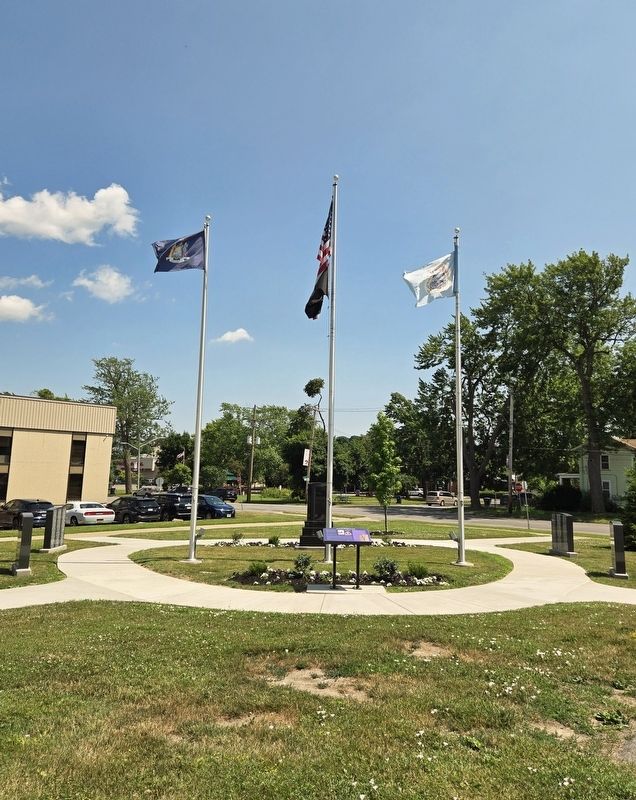
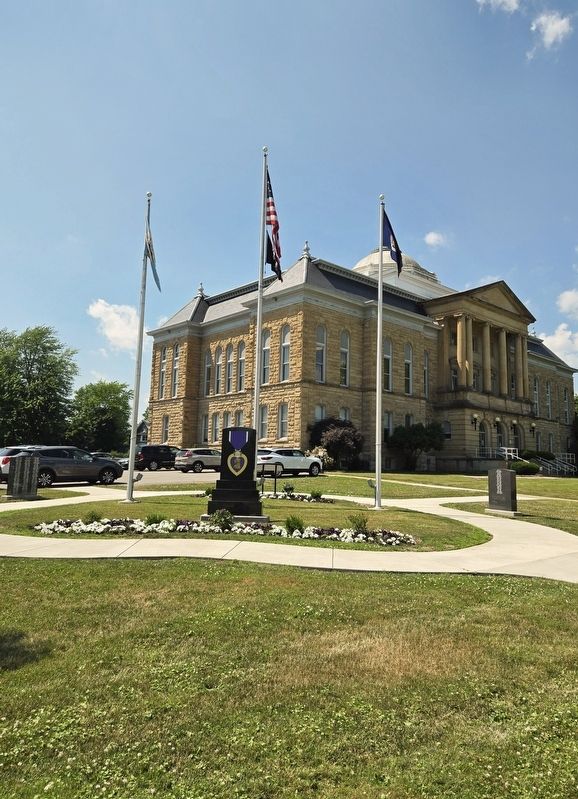
Marker is located at the base of the U.S. flagpole. The Niagara County Courthouse is in the background.
Today, the Purple Heart is awarded in the name of the President to members of the United States Armed Forces who are wounded by an instrument of war in the hands of the enemy, or posthumously to the next of kin in the name of those who are killed in action or die of wounds received in action. It is specifically a combat decoration. Celebrated on each August 7, National Purple Heart Day presents Americans with an opportunity to thank and salute the nearly two million brave men and women for their service and sacrifice, who fought for the nation's freedom, and bear the physical scars of war.
Frank Joseph Gaffney
Pvt. 108th US Infantry, 27th Division
A Lockport native, Frank Gaffney enlisted in the US Army at age 33 at Niagara Falls, NY. The 27th Infantry Brigade was called into federal service on July 15, 1917 and, by late August, was stationed at Camp Wadsworth, near Spartanburg, SC for intensive training. In May, 1918, the unit departed for France. The great Somme "push" from September 24th to October 1st, saw the Division fighting along the St. Quentin Canal Tunnel, one of the outlying strong points of the impregnable Hindenburg line.
On September 29th, near Ronssoy, France, Private Gaffney, an automatic rifleman, pushed forward alone after other members of his squad had been killed or wounded. He discovered some of the enemy setting up a heavy machine gun position. Placing his gun on the parapet, he opened fire, killed the crew, captured the gun, bombed several dugouts in the trenches and killed four of the enemy with his pistol. He then held the position until reinforcements came up and helped with the 80 prisoners Gaffney had captured. A few weeks later, outside St. Souplet, Frank Gaffney was wounded, which resulted in the amputation of his left arm.
Upon returning home, he married Miss Marie Georgen of Buffalo in May 1920. They lived in Niagara Falls where he was employed by the International Paper Company as a chemist. On May 25, 1948, aged 62, he fell from a second floor porch, fractured his skull and died. Mr. Gaffney is buried in the United German-French Roman Catholic Cemetery in Buffalo, NY.
For his actions during the battle at the St. Quentin Canal, he was awarded the Medal of Honor. Frank Gaffney's other decorations included the Purple Heart, the City of Lockport medal, the Victory Medal, the Medaille Militaire and the Croix de Guerre of France, the Distinguished Conduct Medal of England, the Cruz de Guerra of Portugal, the Montenegro Medal of Honor and the Italian Cross of Military Valor.
Frank Gaffney's Medal of Honor Citation
"Pfc. Gaffney, an automatic rifleman, pushing forward alone, after all the other members of his squad had been killed, discovered several Germans placing a heavy machinegun in position. He killed the crew, captured the gun, bombed several dugouts, and, after killing 4 more of the enemy with his pistol, held the position until reinforcements came up, when 80 prisoners were captured."
Major General John F. O'Ryan, commanding officer of the 27th division, said: "No man has performed more daring exploits or exercised a bigger influence upon those around him by the gallantry of his conduct."
(Captions):
Purple Heart Medal awarded to Pvt. Frank J. Gaffney
"Frank and the Boys"
Unknown date and location
Photo courtesy of the Gaffney Family
Frank Joseph Gaffney
Pvt. 108th US Infantry, 27th Division
Erected 2023 by Niagara County, N.Y.
Topics and series. This historical marker is listed in these topic lists: Military • War, US Revolutionary • War, World I. In addition, it is included in the Former U.S. Presidents: #01 George Washington, the Medal of Honor Recipients, and the Military Order of the Purple Heart series lists. A significant historical date for this entry is February 21, 1932.
Location. 43° 10.15′ N, 78° 41.985′ W. Marker is in Lockport, New York, in Niagara County. It is at the intersection of Park Avenue and Hawley Street, on the right when traveling west on Park Avenue. Touch for map. Marker is at or near this postal address: 77 Park Avenue, Lockport NY 14094, United States of America. Touch for directions.

Regionally, this marker is in Upstate New York, specifically in Western New York, and in the Buffalo Metropolitan Area. It is also in the American Northeast and in the Mid-Atlantic. Globally, it is in North America, on the Great Lakes, in the Western Hemisphere, in the Western World, and in the Anglosphere. Historically, it finds itself in what was once the Viceroyalty of New France, the Haudenosaunee (Iroquois) Confederacy, New Netherland, and one of the original Thirteen Colonies.
Other nearby markers. At least 8 other markers are within walking distance of this marker: Niagara County Courthouse (within shouting distance of this marker); Edwin "Bus" Metzger (about 400 feet away, measured in a direct line); Welcome to Ida Fritz Park (about 500 feet away); Lockport Locks (about 500 feet away); Lafayette's Tour (about 700 feet away); Dole House (about 700 feet away); Col. W. M. Bond House (approx. 0.2 miles away); Washington Hunt Law Office (approx. 0.2 miles away). Touch for a list and map of all markers in Lockport.
Credits. This page was last revised on July 4, 2025. It was originally submitted on July 4, 2025, by Bradley Owen of Morgantown, West Virginia. This page has been viewed 177 times since then and 35 times this year. Photos: 1, 2, 3. submitted on July 4, 2025, by Bradley Owen of Morgantown, West Virginia.
