Guisborough in Redcar and Cleveland, England, United Kingdom — Northwestern Europe (the British Isles)
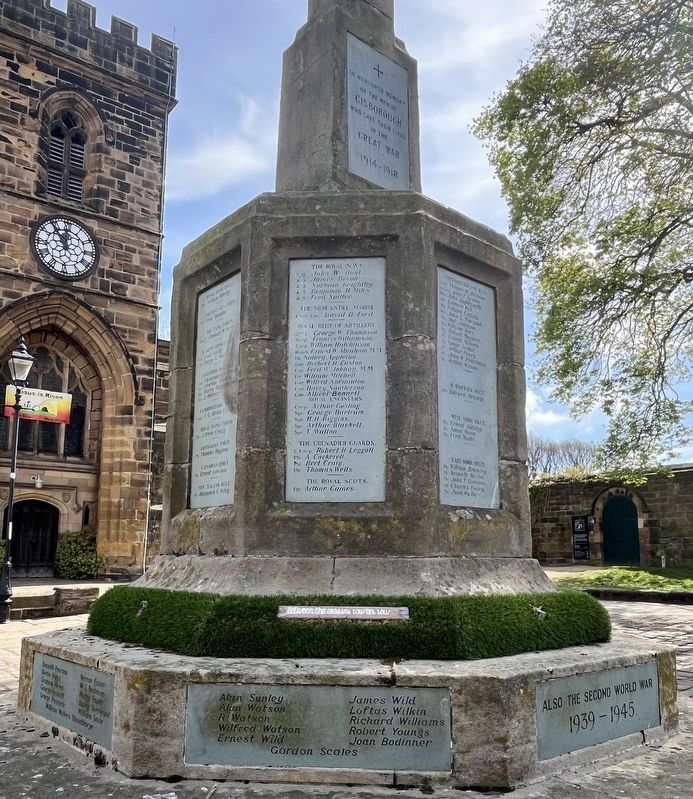
The War Memorial - Guisborough
Photographed by Ray Gurganus, April 22, 2025
1. The War Memorial - Guisborough Marker
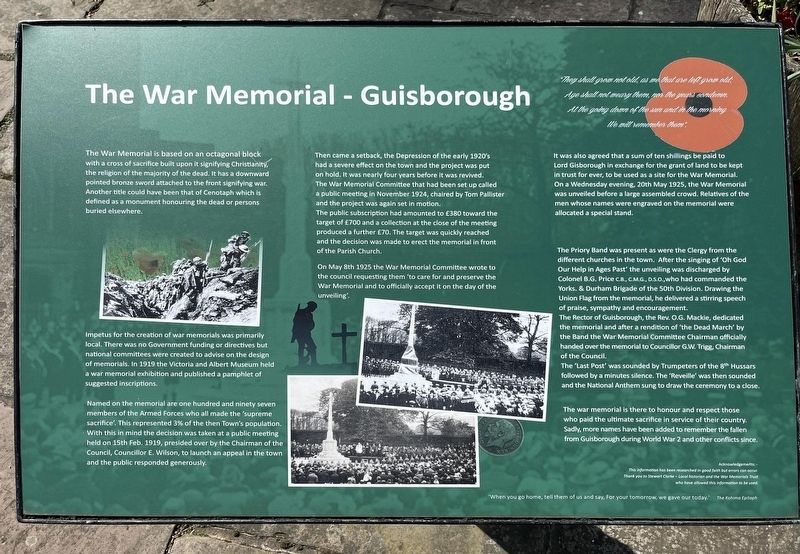
Impetus for the creation of war memorials was primarily local. There was no Government funding or directives but national committees were created to advise on the design of memorials. In 1919 the Victoria and Albert Museum held a war memorial exhibition and published a pamphlet of suggested inscriptions.
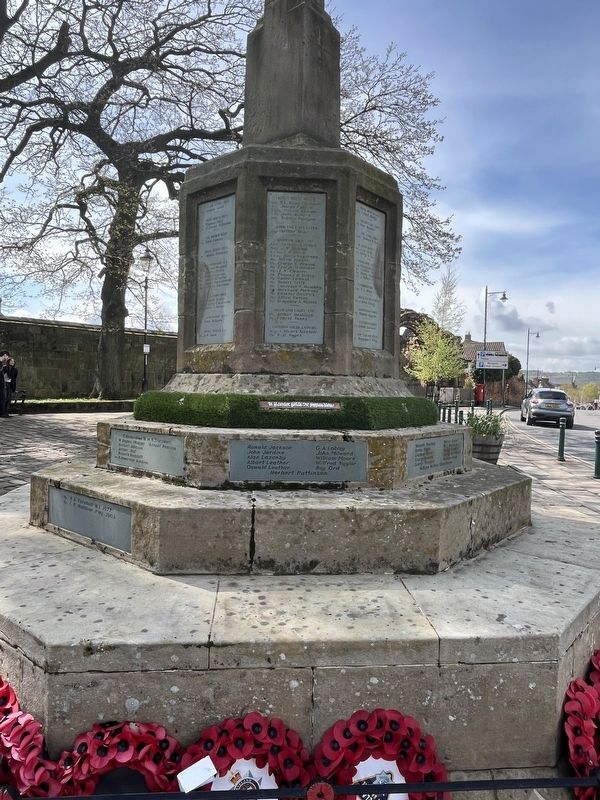
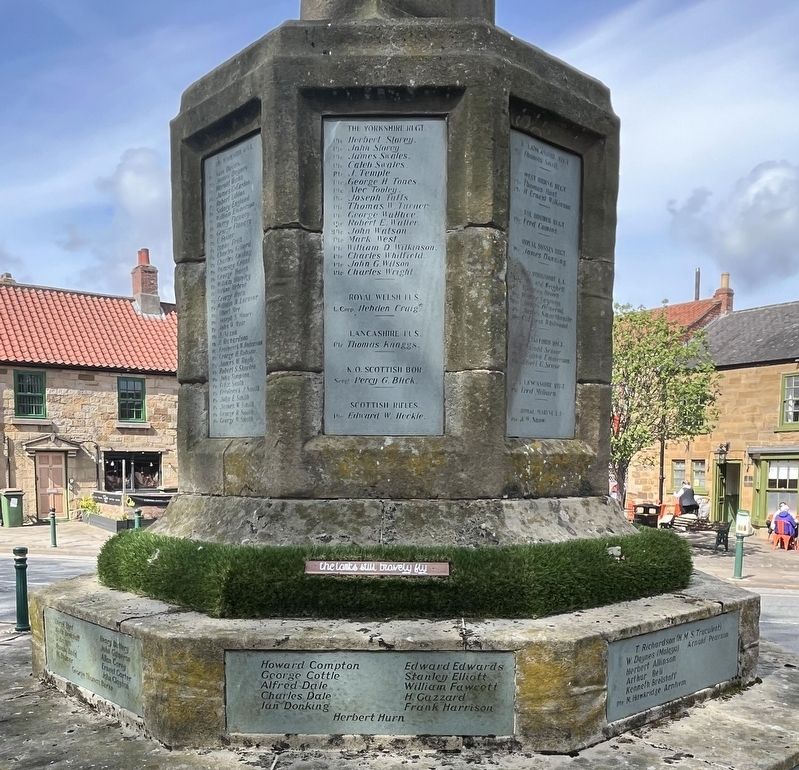
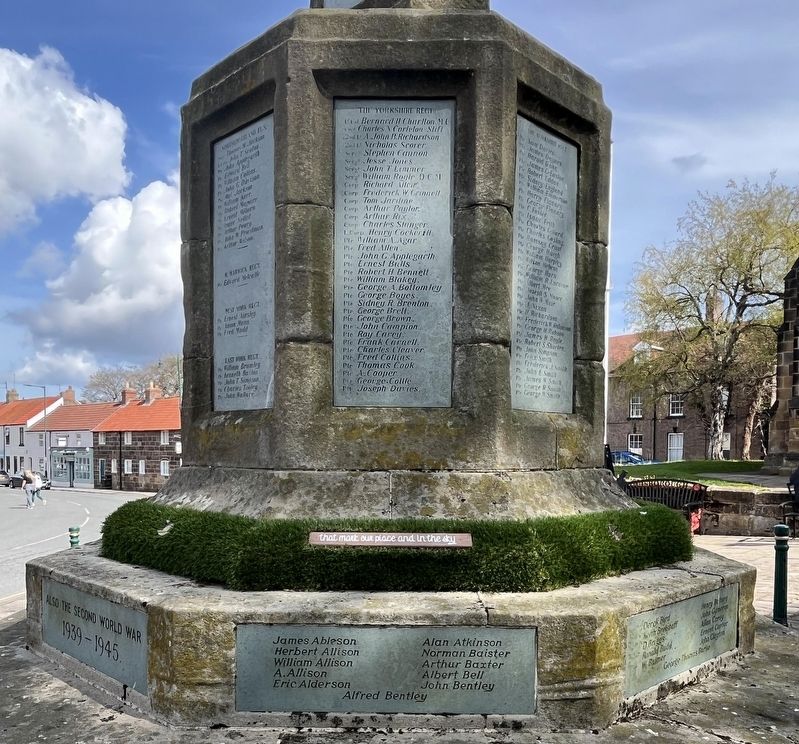
Named on the memorial are one hundred and ninety seven members of the Armed Forces who all made the 'supreme sacrifice'. This represented 3% of the then Town's population. With this in mind the decision was taken at a public meeting held on 15th Feb. 1919, presided over by the Chairman of the Council, Councillor E. Wilson, to launch an appeal in the town and the public responded generously.
Then came a setback, the Depression of the early 1920's had a severe effect
this page online
The public subscription had amounted to £380 toward the target of £700 and a collection at the close of the meeting produced a further £70. The target was quickly reached and the decision was made to erect the memorial in front of the Parish Church.
On May 8th 1925 the War Memorial Committee wrote to the council requesting them 'to care for and preserve the War Memorial and to officially accept it on the day of the unveiling'.
It was also agreed that a sum of ten shillings be paid to Lord Gisborough in exchange for the grant of land to be kept in trust for ever, to be used as a site for the War Memorial. On a Wednesday evening, 20th May 1925, the War Memorial was unveiled before a large assembled crowd. Relatives of the men whose names were engraved on the memorial were allocated a special stand.
The Priory Band was present as were the Clergy from the different churches in the
Photographed by Ray Gurganus, April 22, 2025
2. The War Memorial
The Rector of Guisborough, the Rev. O.G. Mackie, dedicated the memorial and after a rendition of 'the Dead March' by the Band the War Memorial Committee Chairman officially handed over the memorial to Councillor G.W Trigg Chairman of the Council.
The 'Last Post' was sounded by Trumpeters of the 8 Hussars followed by a minutes silence. The Reveille' was then sounded and the National Anthem sung to draw the ceremony to a close.
The war memorial is there to honour and respect those who paid the ultimate sacrifice in service of their country. Sadly, more names have been added to remember the fallen from Guisborough during World War 2 and other conflicts since.
'When you go home, tell them of us and say, For your tomorrow we gave our today.' -- The Kohima Epitaph
Topics and series. This memorial is listed in this topic
Photographed by Ray Gurganus, April 22, 2025
3. The War Memorial
Location. 54° 32.195′ N, 1° 2.96′ W. Memorial is in Guisborough, England, in Redcar and Cleveland. It is on Church Street, on the right when traveling north. Touch for map. Memorial is at or near this postal address: 50 Church Street, Guisborough, England TS14 6HG, United Kingdom. Touch for directions.

Regionally, this memorial is in North East England. Globally, it is on the Atlantic Ocean, in the North Atlantic Region, in Europe, in Atlantic Europe, on one of the British Isles, in the Western World, and in the Anglosphere. Historically, it finds itself in what was once the Roman Empire.
Other nearby markers. At least 8 other markers are within 21 kilometers of this marker, measured as the crow flies: The de Brus Cenotaph (a few steps from this marker); Redcar Pier (approx. 9.1 kilometers away); The Birger (approx. 9.1 kilometers away); A Trophy from Sebastopol (approx. 19.6 kilometers away); The Bombardment of the Hartlepools (approx. 19.6 kilometers away); a different marker also
Photographed by Ray Gurganus, April 22, 2025
4. The War Memorial
Photographed by Ray Gurganus, April 22, 2025
5. The War Memorial
Credits. This page was last revised on July 9, 2025. It was originally submitted on July 4, 2025, by Ray Gurganus of Washington, District of Columbia. This page has been viewed 78 times since then and 9 times this year. Photos: 1, 2, 3, 4, 5. submitted on July 4, 2025, by Ray Gurganus of Washington, District of Columbia. • Andrew Ruppenstein was the editor who published this page.
